Andi Crist: The Art of The Pun
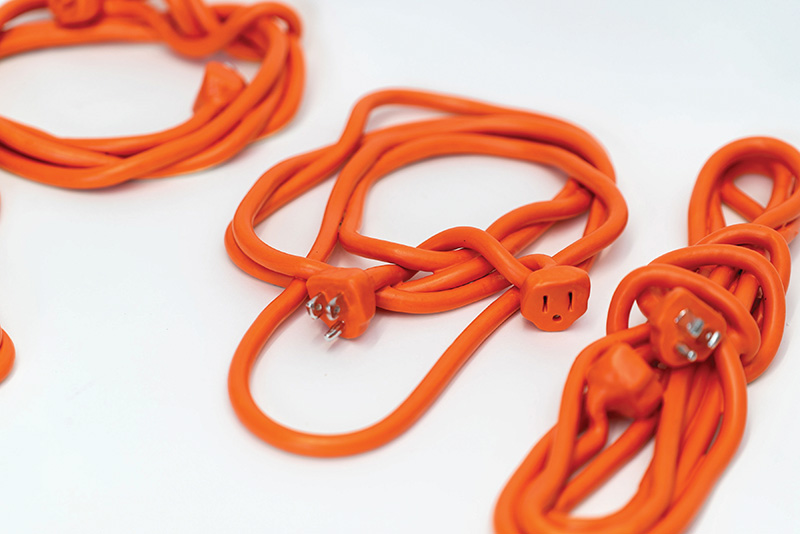
Andi Crist, Extension Cords, Glazed stoneware, chrome, Sizes vary 2021-present. Photo: Mikey Mosher
This interview is part of CGN's Fall 2026 issue. Purchase a copy or subscribe.
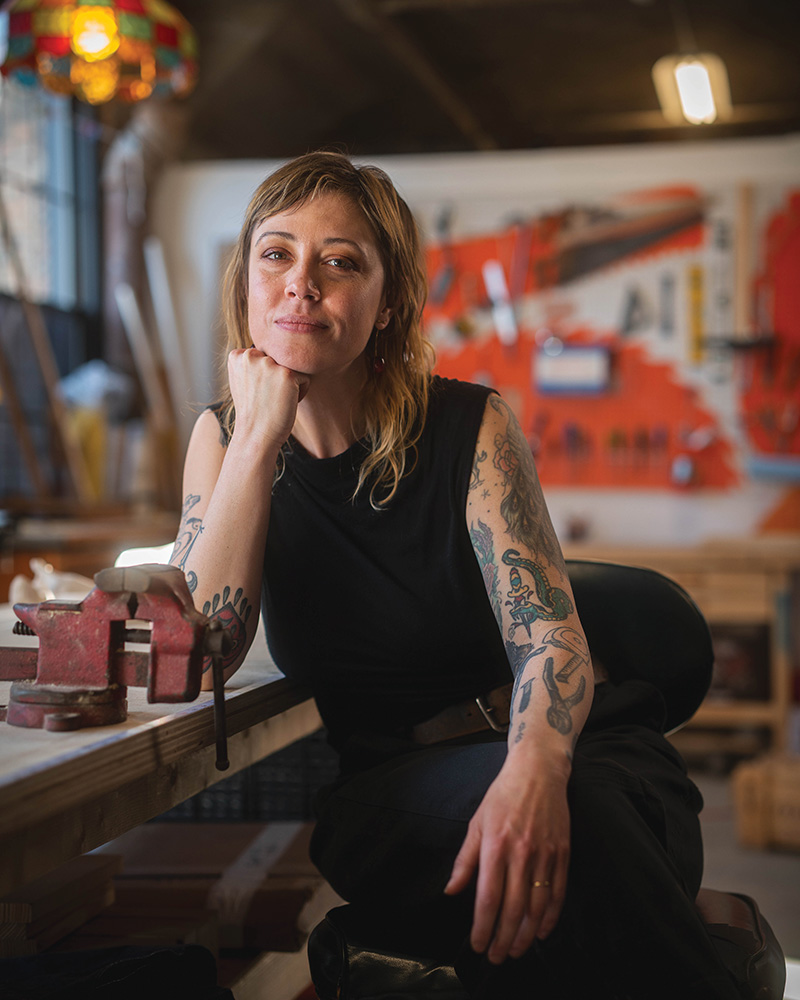
Andi Crist
BY ALISON REILLY
Andi Crist’s warm, engaging demeanor is evident in the first few minutes of our conversation. Generous with her time and forthcoming in her observations, she cares deeply about building relationships through her art making. Crist grew up in Birmingham, Alabama, devoured art classes, wrote songs and played music in high school, and moved to Chicago to study visual art at Columbia College. In 2024, she received her MFA from the University of Illinois at Chicago. She is a woodworker, sculptor, ceramicist, and conceptual artist, and she teaches at Illinois Institute of Technology. We discussed her multidisciplinary practice, her experience working as an art handler, preparator, and fabricator, and how she thinks about labor, creativity, and value in the art world.
CGN: You grew up in Birmingham, Alabama. How did that environment shape your point of view as an artist?
Andi Crist: That’s such a funny question. Nobody’s ever really asked.
CGN: Oh, really?
AC: Yeah, maybe because I never was super connected with the arts community down in Birmingham. I moved to Chicago in 2007, so it’s been 20 years since I lived in the South. I was definitely one of those art kids—one art credit was required in high school, and I graduated with like seven. I was surrounded by artists who had a big impact on me, because they were working artists. All my art teachers were trained in Alabama and then continued to teach and work in Alabama, which gave me this desire to try to expand my community outside of what I was familiar with.
CGN: Do you identify as a Chicagoan?
AC: My family still lives in Alabama, and I go back every year. I love being in Alabama. Maybe now being in Chicago for almost 20 years, I identify as a southerner living in the city. I carry on the social qualities of a friendly southern person [laughs].
CGN: You have a varied art practice—woodwork, ceramics, mold making. What drew you to those types of fabrication methods and that type of art making?
AC: My dad is a carpenter and a hobbyist woodworker, but his career was psychology, and my mom was a professor and an incredible craftswoman. I absorbed my mom’s model of creativity, which is to try a bunch of different things and not necessarily finish them but to try to learn as much as I can by just going for it. My practice over the years has become an exploration of conceptual elements of what makes art art and not just craft. Do you have to be a master craftsperson or a professional artist in order to make something that resonates with people?
I make a lot of work that references the mode of making and requires a variety of different media. I just finished teaching a ceramics production class where students learned how to produce molds, think about positives and negatives, and get into a level of production rather than just handicraft as a way to multiply their output.
I got into fabrication because I’ve always liked working with other artists. I have a background in theater and gallery work. I’m a voracious learner, and I like being able to share those skills with my community. Then I end up making work about that. It’s a self-feeding cycle.
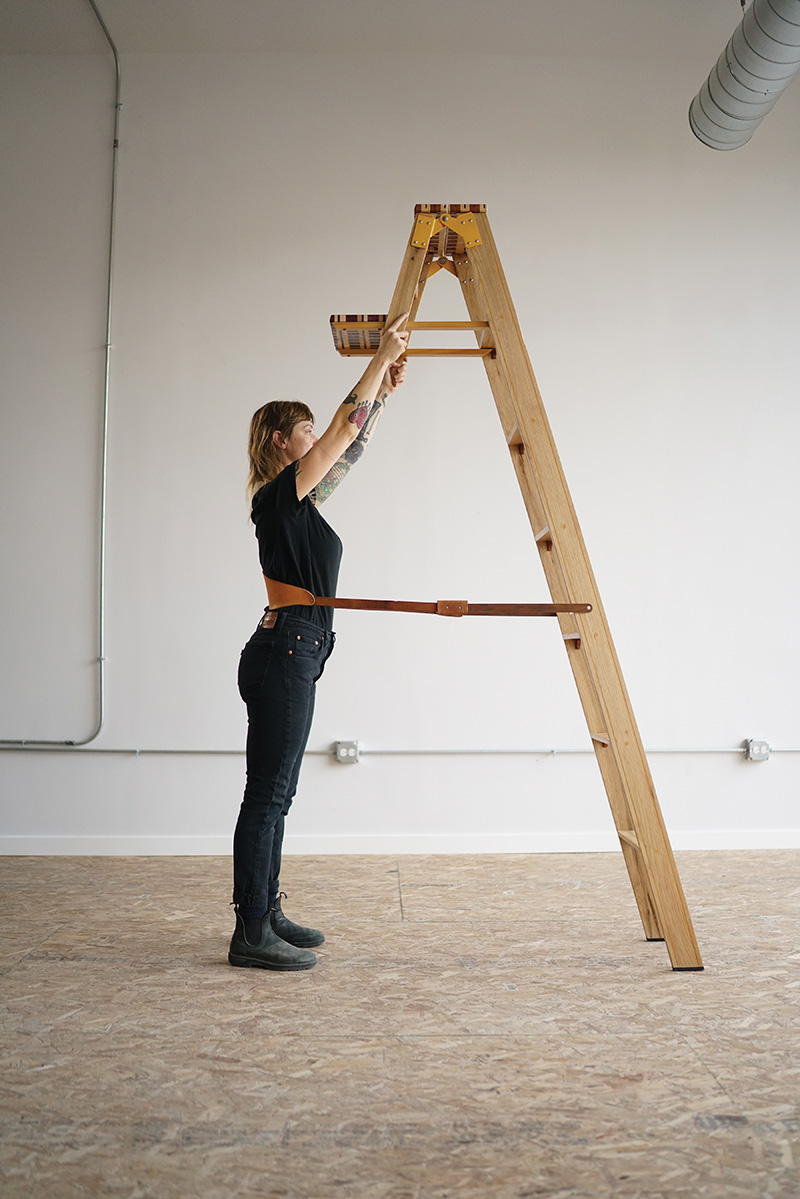
Andi Crist, Artist’s Ladder, 2023. Photo: Jeff Perlman
CGN: Thinking about your background as an art handler and preparator—how did you get to the point where you were making work about that experience?
AC: In 2010, right before I graduated from Columbia, I was living in a storefront in West Logan Square with my partner at the time. We started a gallery called Autotelic in the space and had to build it out using the worst tools with very minimal resources. Then we started curating shows there and that meant helping other artists figure out how to install their work in our unusual space. Eventually, I gained the reputation for knowing how to do that type of work. I started getting invited to work in museums and galleries.
The Holocaust Museum was the first museum I worked at, and as difficult as that subject matter is, that experience was really important to me because I was learning more about the larger world of gallery work. As an artist working as a preparator, you’re straddling both sides of that space. You’re really seeing how the sausage is made. You’re hearing all the conversations about artists, curators, the process of exhibition making. There is a lot of information you can gather about the economics of the art world by just being the person that has the know-how to touch and handle artwork. Eventually that started feeding into my art practice because I wanted to make work that was contributing to a conversation around art as a type of job. It fueled a methodology of seeing everything in the world as the result of a long line of processes that required effort and thoughtfulness by many hands.
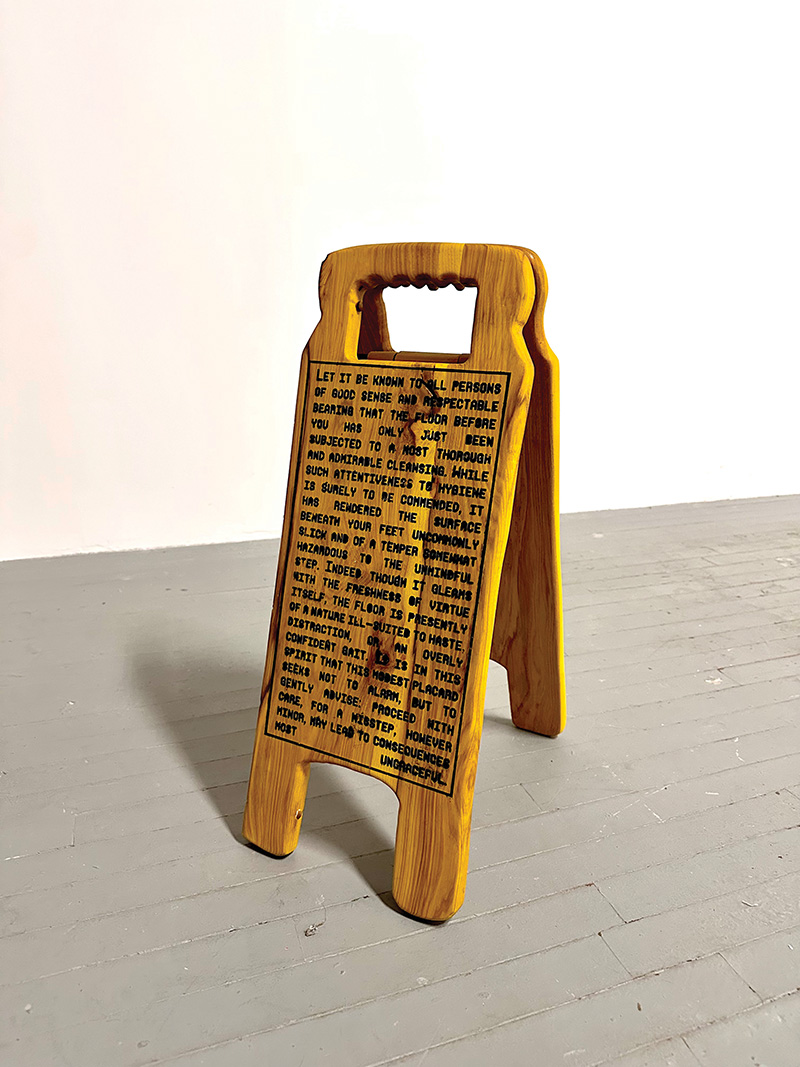
Andi Crist, Fair Warning, 2025.
CGN: The title of your recent exhibition at the Cleve Carney Museum—Live, Laugh, Lo—sorry, not Live, Laugh, Love—Live, Laugh, Labor.
AC: [Laughs] That’s what everybody does.
CGN: I love the title—it’s perfect. You incorporate humor along with thoughtful critiques about labor and value in your work. What role does humor play? How does it help you connect with your audience?
AC: One of my biggest criticisms of art with a capital A is how easily it can be overly intellectualized. I think that’s why I end up making a lot of work that references things that already exist or have some kind of real purpose. It’s important to give people a foothold so there’s an obvious place to board that train of thought. As an artist—maybe this is me getting into a sweeping argument about what artists should be—but I personally believe in intellectual accessibility. Humor is a swift way to drop defenses and allow people to come in without feeling like they are not getting the joke or not understanding. I like to make work that can hold both of those things at the same time—it’s funny on the surface level, it’s kind of cheeky, but there’s also another way to look at it that is intellectually clever. There is a joy in the attempt to “get it”. Like the satisfaction of grasping how a crossword puzzle actually works.
It’s also so much a part of my personality. I take myself seriously as an artist, but my ego isn’t at the heart of it. It’s really something that I do because I love to make things, and I love to connect with other people. My parents raised me on puns, creating those language relationships between things and people and space. Understanding a joke is the same way that we understand art, and while neither of my parents would consider themselves artists, they taught me how to think about art.
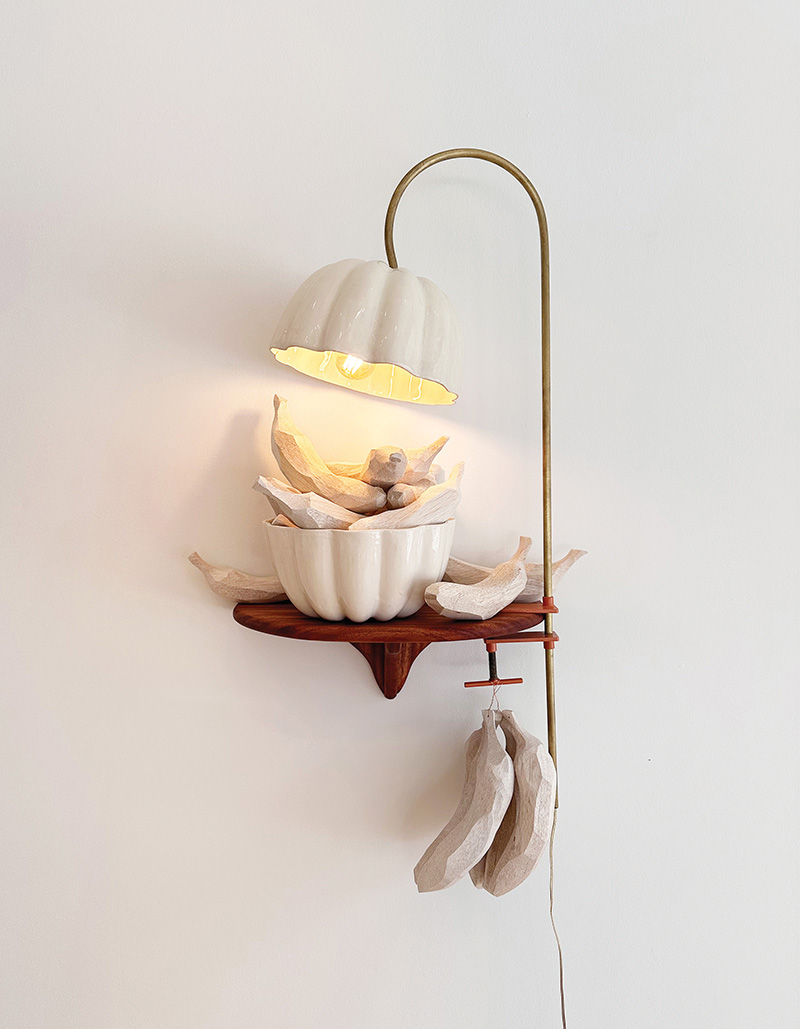
Andi Crist, 69 Bananas
CGN: Your work, Artist’s Ladder, explores hierarchies, workplace cultures, and institutional values. What experiences shaped your reflections on these themes?
AC: The ladder piece distinctly represents the complicated relationship between front of house, back of house, and the hierarchy of labor. Who is the artist in those relationships? How much does another person’s knowledge and expertise contribute to the success of another artist?
There are enormous, industrialized art practices out there, warehouses full of people making things, and those people are also artists. When you make work that involves other people, it’s important to acknowledge their contributions. I’ve had complicated interactions with other artists who are like, ‘Hey, do you want to collaborate with me on this thing?’ but really they just want me to make their idea. I made Artist’s Ladder while I was in grad school at UIC, and it really represented my relationship with a lot of other artists, because I could be an actual support structure for them. Then it turned into this absurd physical thing. It’s extremely overbuilt with inlaid racing stripes made of exotic hardwood, and a butcher’s block-style plaid top. It’s not really like an FU as much as it is asking for acknowledgement of my skills and the essential support structures that exist.
CGN: I want to ask you about another piece, Five O’Clock Somewhere, a wool rug that resembles a children’s play mat. I work at a library, and it reminded me of rugs I see all the time. It’s a peaceful image of an office park with a large fountain surrounded by a parking lot. I’m curious why you chose a rug as the medium to depict that image.
AC: To me the heart of that joke was that it was a landscape. I wanted it to be physically traversable. And that was, I don’t want to say controversial, but it was something that I had to talk about a lot. The critique of that work was the fact that I didn’t want to hang it on the wall and turn it into a tapestry. I really wanted it to be a rug that people could walk on. When I showed that work at Chicago Artists Coalition for the New City Breakout Artists show. There was a lot of pushback about having it on the floor and allowing people to walk on it.
That, to me, was such an important conversation, because, in my mind, the fact that you could walk across it and traverse it was part of how I was thinking about the object. Rugs are utilitarian–they are floor coverings. When you make art that doesn’t do anything, you don’t get to participate in that part of the conversation.
I enjoy sparring around art like that. I am totally tickled by the pushback. The critique of display is exciting, and sorting through the politics of utilitarianism in art spaces is fun to me. And then—it was so crazy—we ended up showing it halfway on the wall and halfway on the ground.
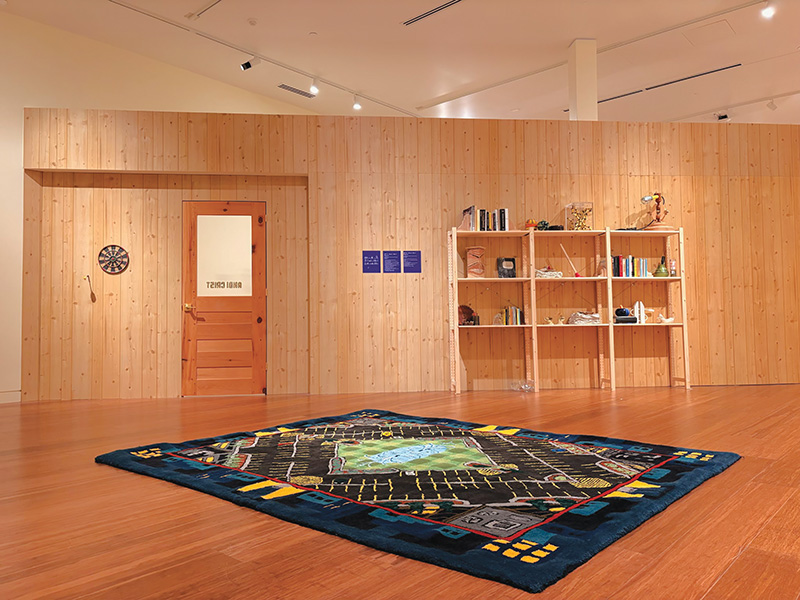
Andi Crist, Five O’Clock Somewhere, on display at Live, Laugh, Labor: Thoughts on Usefulness and Other Myths at The Cleve Carney Museum of Art, 2025.
CGN: Oh, wow.
AC: I was like, this is the epitome of compromise! I had to build a structure so that it could hang that way safely.
CGN: I would say just put it on the ground if that’s what you want to do. It’s interesting that there are still very fixed ideas about the way that art should be displayed.
AC: That preparator part of it, that’s what I’m all about. I was having that conversation about what physically supports the work or what conceptually supports it in the way that it’s shown.
CGN: Have you always been a writer? How do your art and writing practices work together?
AC: I can’t say that I’m a writer, it’s probably the same way that it can feel weird to call yourself an artist. But I feel like I’ve always been relatively good at writing. The first time I ever did any kind of professional writing was contributing, a long time ago, to a website called eHow. The editors would send me a title, and then I would have to research how to do that thing. Then I would write out step-by-step instructions for how to do that.
I think that’s how I had to make myself think through my conceptual practice—I had to do the research, coagulate that into some kind of document, and then I would have stream-of-consciousness conversations with myself. “Why are we interested in this? Why would we make it this way? What would I want to talk about if someone were to ask me about this?” It’s almost like I was pre-interviewing myself.
I think the writing is just another way for me to process that idea before I put in all of the time and energy to actually accomplish it.
CGN: What are you working on right now? What projects do you have coming up?
AC: The biggest project that I have right now is my house. My family and I suffered a major house fire on New Year’s Day. We’ve been displaced since then and are navigating rebuilding our house. It was a total loss.
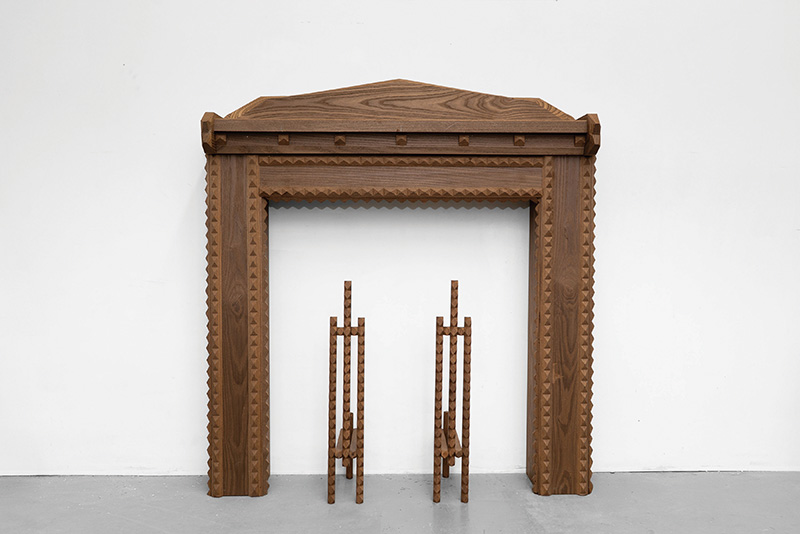
Andi Crist, Single-Use Fireplace, 2025. Photo: Mikey Mosher.
CGN: I’m so sorry to hear that.
AC: Thank you. We’re all okay, but it’s been a really tumultuous year. I moved my studio into a storefront last summer, and so most of my, at least relatively recent, work is safe, and I still have all of my materials, but my home life is starting over. I just had my first full year at this space, and it’s got a little gallery built out in the front called Coming Soon. It’s beautiful with floor-to-ceiling windows on Division and Central Park. I’ve been inviting people into the space to try things out.
After teaching the ceramics class, I came into a bunch of nice slip casting molds, and I’m making some really playful, weird, ceramic stuff. I want to be open and not put too much pressure on myself. Having a big studio by myself is very expensive, so it’s easy to want to make it feel like it’s worth it. But if for now all I can do is make it a resource for other people, then that will be the thing I do. Be less selfish, but more selfish with my time. Saying I can’t do that, or I don’t want to do that. It’s not my nature to say no—I’m such a yes man. I’m learning how to be a yes man for myself.
CGN: That makes sense after going through something so traumatic.
AC: I have an amazing support system. Our friends started a GoFundMe. It was incredible. I’m so humbled and floored by how held I felt by Chicago. I can’t help but throw a little shout out to my Chicago people. I can see how people’s lives get totally ruined by this kind of tragedy. I feel so lucky. Chicago definitely showed its love back.
CGN: For your project Coming Soon, are you bringing in other artists?
AC: My philosophy is that I want to be involved as little as possible. I am thinking about it more as a hosted than curated space. I’m actively soliciting proposals or ideas for workshops, meetings, book clubs—I’m down for making it a resource, whatever that means. I don’t want to over-think it, I want it to be an intuitive and organic thing, which is why I call it Coming Soon—it can be a placeholder for anything. It’s exciting. Taking my hands off the reins is a good exercise for me.
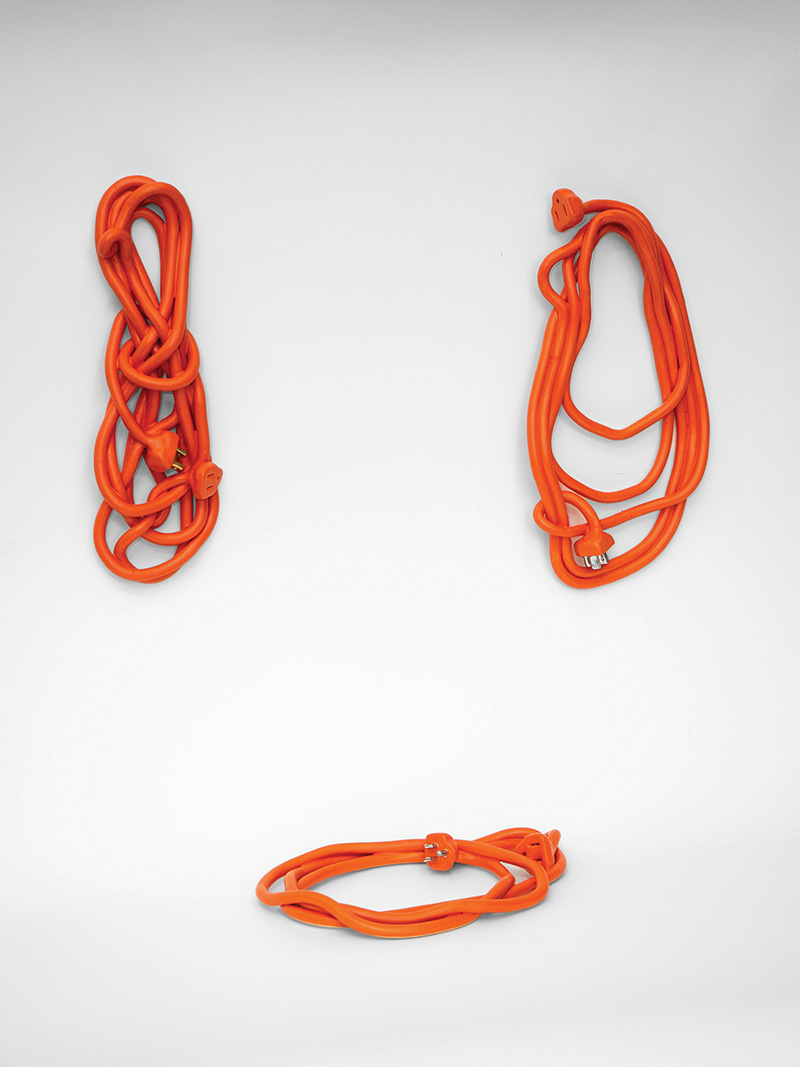
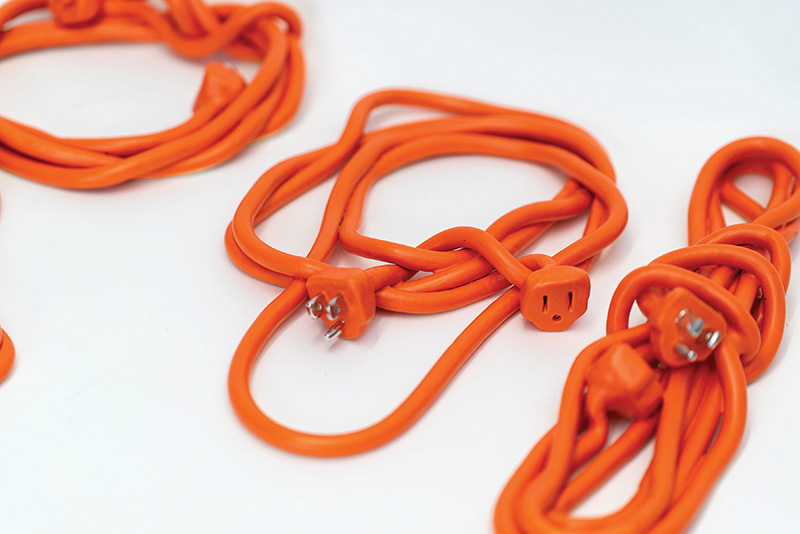
Andi Crist, Extension Cords, Glazed stoneware, chrome, Sizes vary 2021-present. Photo: Mikey Mosher