Andrea Carlson: Mapping New Futures

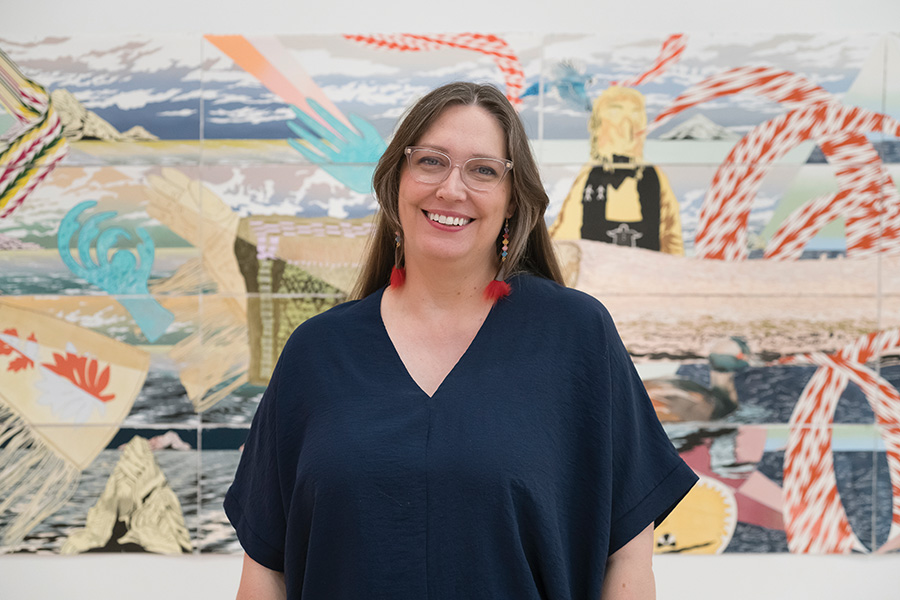
Andrea Carlson, 2025. Courtesy of the artist and Jessica Silverman. Photo: Philip Maisel.
Note: this interview is the cover feature for CGN's spring/summer 2026 magazine. To purchase a print copy or subscription click here.
By ALISON REILLY
Andrea Carlson’s layered, large-scale paintings explore the liminality of the shoreline–specifically the Great Lakes. Born and raised in northern Minnesota, Carlson’s complex landscapes pulse with repeated geometric patterns, portraits of animals, and the products of art making such as pottery, baskets, and statues set against a persistent horizon line. Through her work, she challenges the colonial cannibalism of Indigenous peoples and cultures and presents new, counter narratives. Carlson, who exhibited at the Museum of Contemporary Art Chicago in 2024-2025, has been busy preparing her upcoming exhibition at the Contemporary Art Museum St. Louis, which will feature a new series of paintings on birchbark along with screenprints and sculpture.
CGN: What are some of your earliest memories making art?
Andrea Carlson: I doubt there was a single day growing up when I didn’t draw, so it is really hard for me to isolate specific memories. Typically I’d draw horses as a kid, because they were the most beautiful animal I could imagine. When I was about six years old, my dad was going to throw away some roller window blinds that were made of thick paper. I remember that he cut off the metal rods on the ends of the blinds and gave me the paper part. I was able to draw large horses on those, and that was his idea. He told me that I had to fill the whole sheet. It seemed like every birthday or Christmas, someone would give me a RoseArt box set of artists’ pens, pencils, and watercolors, and I would burn through those supplies pretty quickly.
CGN: When did you know that you wanted to be an artist?
AC: I come from a family of artists going all the way back. I was always an artist, there was no realization, no story. In college I had a moment of doubt when thinking about my employment prospects as an artist. I thought maybe I should pursue linguistics for grad school, because I learned Ojibwe in undergrad, and I really loved teaching the language. In the end, art school won out, and I went to the Minneapolis College of Art and Design for my MFA and have been working as an artist ever since.
CGN: What is a typical day in your studio like?
AC: The image of me in my studio is so bleak: it is just my broken body sitting, hunched over a table for 12 hours a day including weekends. That has been going on for years now. Sometimes I have online meetings and take calls, but generally I’m in a trance while making work. I’m able to listen to audiobooks while I work, and I solicit everyone for book recommendations. I’m on a horror kick right now, but I’ll go through entire genres of books. I’ll listen to anything. Recently, I was able to hire a studio manager, and it is so odd to have another person in my space. It might be better to work with people, because when I spend so much time by myself I get a little socially odd and then, in total contrast, I’ll be hoisted out on stage for artist talks and openings.
My studio is on Lake Superior now and that is helpful as far as feeling a sense of belonging and security. Looking over the lake before I start my day and in the evening is very grounding for me. It is a privilege and honor to be so close to that lake.
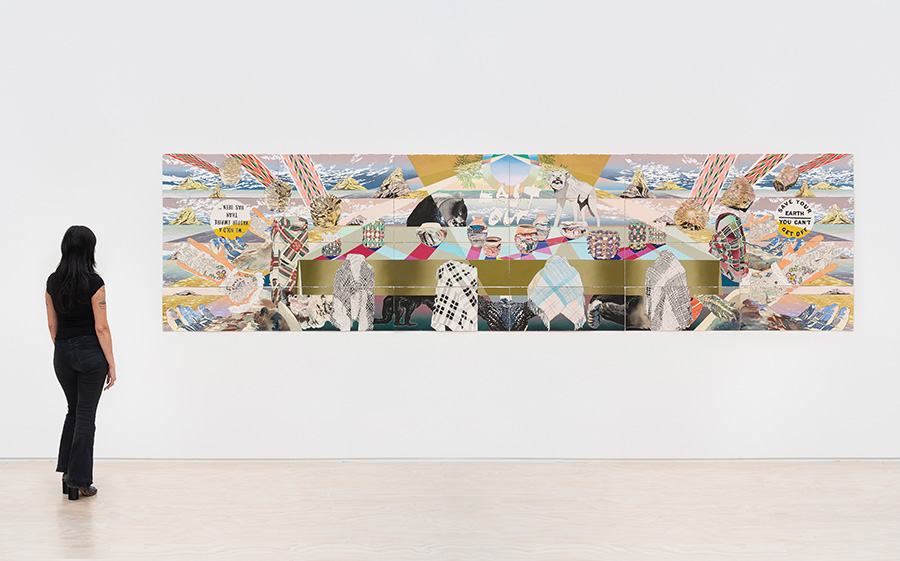
Andrea Carlson, The Buffet, 2025. Courtesy of the artist and Jessica Silverman. Photo: Philip Maisel.
CGN: How does your location–Chicago, Minneapolis, or northern Minnesota–affect the work you create?
AC: Many of my paintings are organized against the backdrop of the endless horizon of the Great Lakes. Although place is very important, many people can relate to a body of water, a mountain range, or other natural landmarks as having personhood or a sense of being. The land I reference in the work is not as specific as these post-settler place names, but more general, as if land could be seen as an access point to infinity. We all live on a sphere, a seemingly infinite surface, or infinite horizon. But there is also deep time under our feet. I live on the Laurentian Shield, on the north shore of what is now called Minnesota. The land is older than dinosaurs, and there are very few fossils here because the land mass at the surface came into existence before most life forms came into being.
One view of my work is how the earth buries narratives and takes things back. People, objects, the lives of animals, films, stories, books, teachings can all move across the surface, everything can have a diaspora, but it usually ends with things being put into the ground. In my work, the objects, film, and animal references are pre-internment, temporary, and out-of-context to the land. They are passengers heightened by the seeming oddness of their presence and arrangement against the land, or the shore of the seascape I put them on.
I often refer to the shore as a liminal space, not fully water or land. It is a space of transition where I hold things in relation to each other, but it is also a space of the Great Lakes. There is so much shoreline in the middle of this continent, so much liminality.
CGN: What is your process for making these intricate, complex paintings and drawings?
AC: My process starts with observation and conversations, reading, collecting imagery that is important to the subject of the work, or looking into a museum’s collection. Writing is a big part of my process. After I have collected the ideas I draw in light sketches and organize each figure on the paper. To complete the process for the work to have meaning it has to be seen by people. It starts in conversation and is completed in conversation.
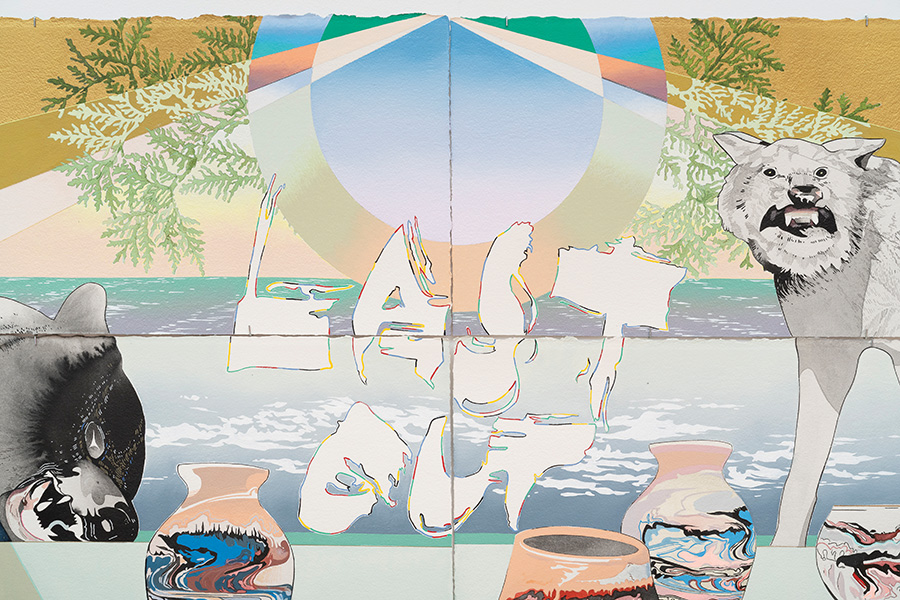
Andrea Carlson, The Buffet (detail), 2025. Courtesy of the artist and Jessica Silverman. Photo: Philip Maisel.
CGN: Can you tell me about some of the most important objects that appear in your large-scale works like The Buffet?
AC: There isn’t any one object or reference I feel is more important than another, but in the center of this painting you will see Namadjii (brand) pottery and black ash baskets that have an interesting history. Namadjii is an Ojibwe word taken from a place name in Minnesota where the clay was harvested. The pottery was meant to “look native” even though it was made by settlers. Nevertheless, those vessels are still made from Ojibwe land, and the appropriation is an act of violence. The black ash baskets reference a form of basket making that is threatened by the invasive emerald ash borer. At the center of the piece, where the baskets and pottery are placed, animals are hiding under and around the table, as a depiction of “The Last Supper” or in this case that moment before the meteors strike.
CGN: Cannibalism appears as a recurring motif in your work. How did you first become interested in exploring it? Why is it important to your work?
AC: I got interested in cannibalism, as a metaphor, because I got pissed off. I watched a horror film called Cannibal Holocaust while an undergrad, and it bothered me so terribly. I was also researching a lot of decolonial and post-colonial theory then and had noticed how the idea of cannibalism was used by scholars to describe settlers and aspects of colonization that dangerously consumed Indigenous people. Cannibalism was a metaphor for assimilation policies: consuming the other and making it part of the colonial body and identity. Jack D. Forbes wrote Columbus and Other Cannibals, bell hooks wrote an essay called “Eating the Other,” Cannibal Tours and Glass Boxes by Michael Ames, Deborah Root’s Cannibal Culture, to name a few. These books also referenced an Ojibwe monster, the Windigo, to talk about the cannibal sickness of settler colonialism. All of these pieces of information were coming to me at the same time, and I felt that my VORE series could act as a witness, almost an “I witness the continuation of these things” in my landscapes.
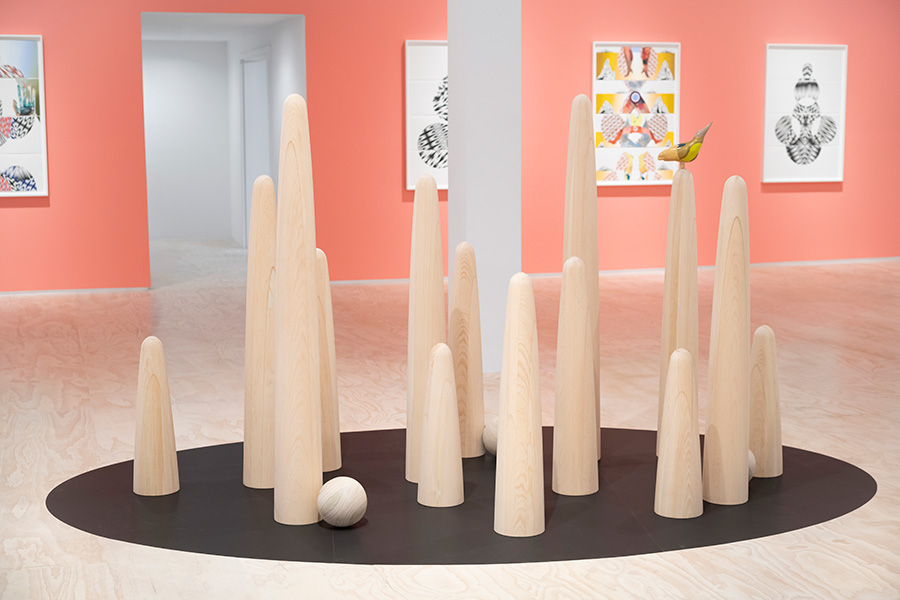
Andrea Carlson, Low Relief Mound, 2025. Courtesy of the artist and Jessica Silverman. Photo: Philip Maisel.
CGN: When did you start incorporating sculpture and video into your art practice? What motivated you to do so?
AC: In 2014 I made a few videos of masks being dissected for a solo exhibition at Plug In ICA in Winnipeg. A few years before that I had made film props and assisted in production for Shezad Dawood’s film A Mystery Play. That film was also produced at Plug In ICA. I enjoy making sculptures, and I’m a tremendous fan of film works, but painting and drawing on paper has taken precedence in my career. That will more-than-likely change in the coming years. I have plans to make more sculptures.
When it comes to film, I think the element of movement and time is interesting. Non-static art forms can’t be held all at once in the mind or can’t be observed in a fixed state because it’s always changing. I wanted my large-scale paintings and sculpture to work in a way that has to be traversed. The sculpture is relatively new in my professional work, but I have always done sculptural things, whether the mentioned film props or putting things together in a three-dimensional way. The large scale wooden column work came about through the Toronto Biennial, when I started doing sculpture as standalone work.
CGN: Can you tell me about your upcoming exhibition at the Contemporary Art Museum St. Louis? What other projects are you currently working on?
AC: The Contemporary Art Museum St. Louis will feature a few new works including Red Welcome, a ten-foot tall and eighteen-foot long work, as well as some work that I’ve been making for my Creative Capital grant. I also have a traveling exhibition organized by the Denver Art Museum that will be going to the Ringling Museum [Sarasota, FL] and Nasher Museum of Art [at Duke University]. I’m also developing some paintings on canvas and sculptural works for an upcoming museum exhibition that isn’t announced yet. I have a lot on my plate, but I am getting ready to have a few weeks off after the CAM St. Louis opening.
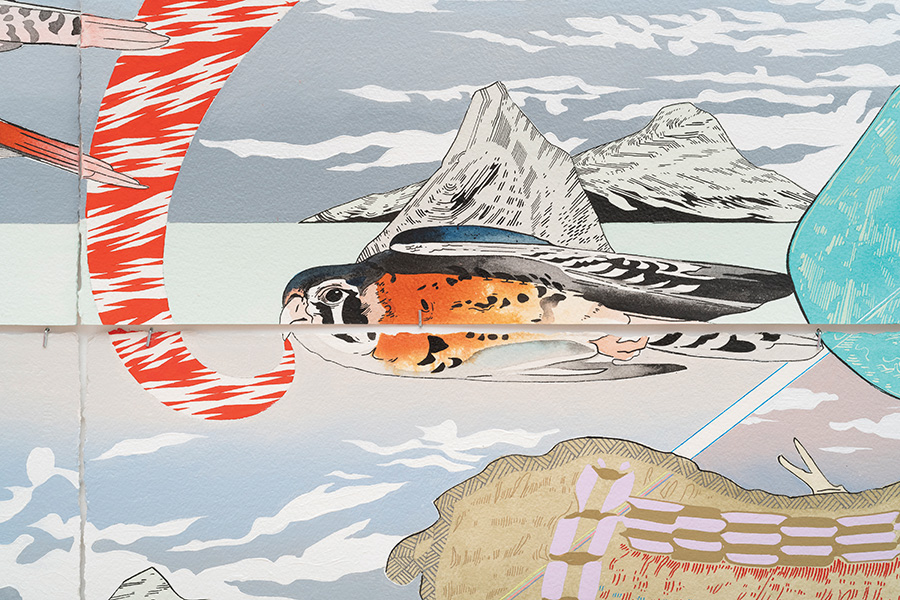
Andrea Carlson, The Host, 2025, Detail view. Courtesy of the artist and Jessica Silverman. Photo: Philip Maisel.
CGN: What motivated you to co-found the Center for Native Futures in Chicago? How has your work with the Center influenced your own art practice?
AC: The Center for Native Futures was a COVID baby. During the pandemic, Debra Yepa-Pappan organized online weekly meetings amongst a few Native artists in Chicago. At the time she was working at the Field Museum. We all missed each other, and we all wanted proximity to each other again. Through these meetings, Debra, her husband Chris Pappan, and Monica Rickert-Bolter shared their long-time dream of making a gallery where Native people had a say in what was on the walls, agency and space. The Terra Foundation and the MacArthur Foundation agreed and generously supported us. There is an irony in Native people asking for space in a land where we were forcibly removed, and a city seemingly hell bent on depicting Native people through stereotypical imagery. We wanted to contribute to healing through this space. I’m not sure that co-founding CfNF has influenced my own art practice in a direct sense, but I’ve become more sensitive to the love and care people put into the spaces I exhibit in. There is a lot of labor that goes into supporting artists’ work. Every time we exhibit as artists, there is unseen labor and people who are advocating and lifting behind the scenes.
*
Andrea Carlson: Endless Sunshine is on view at the Contemporary Art Museum St. Louis, March 6-August 9, 2026.
For more information, visit mikinaak.com and jessicasilvermangallery.com
Note: this interview is the cover feature for CGN's spring/summer 2026 magazine. To purchase a print copy or subscription click here.