Beyond the Mirrors: Four Artists at Wrightwood 659
By GINNY VAN ALYEA
Two new exhibitions at Wrightwood 659 bring works by Yayoi Kusama, Niki de Saint Phalle, Mary Bauermeister and Yuan Goang-Ming to Chicago this fall. Kusama’s two Infinity Mirror Rooms will likely be a draw for many visitors, but there is considerably more to see throughout the Lincoln Park exhibition space.
Inner Worlds: Visions from the Hirshhorn Collection features Kusama, de Saint Phalle and Bauermeister in a focused presentation drawn from the Smithsonian museum’s collection. Yuan Goang-Ming: Everyday War brings the Taiwanese artist’s video and installation work to Chicago following his presentation at the Taiwan Pavilion of the 2024 Venice Biennale.
Together, the exhibitions offer a substantial visit, with time to look closely at individual objects as well as sit and watch works that unfold over several minutes.
Curated by the Hirshhorn’s Betsy Johnson, Inner Worlds considers three artists who became part of the postwar avant-garde. Kusama, de Saint Phalle and Bauermeister were born in Japan, France and Germany, respectively, between 1929 and 1934. All three experienced World War II as children and made their way to New York by the early 1960s, developing careers that challenged expectations of women and took their work to audiences around the world.
Kusama was put to work as a young girl in factories for the war effort, sewing parachutes in the period leading into and during World War II. She has spoken at length about air-raid sirens, the terror they caused, and their impact on her psyche. The first work in the exhibition, the infinity room Phalli’s Field [Floor Show], was made by hand-stitching phallic forms, a technique the artist developed by working in a parachute factory. Here, you can leave the room only when someone outside opens the door.
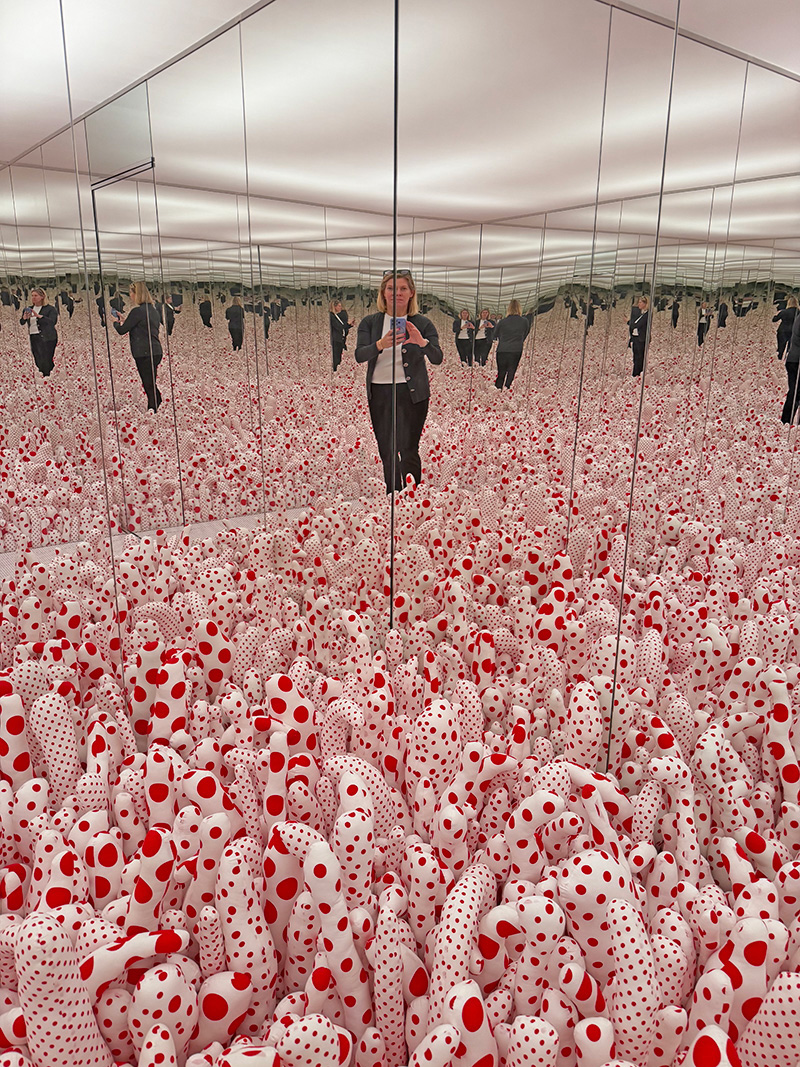
Yayoi Kusama
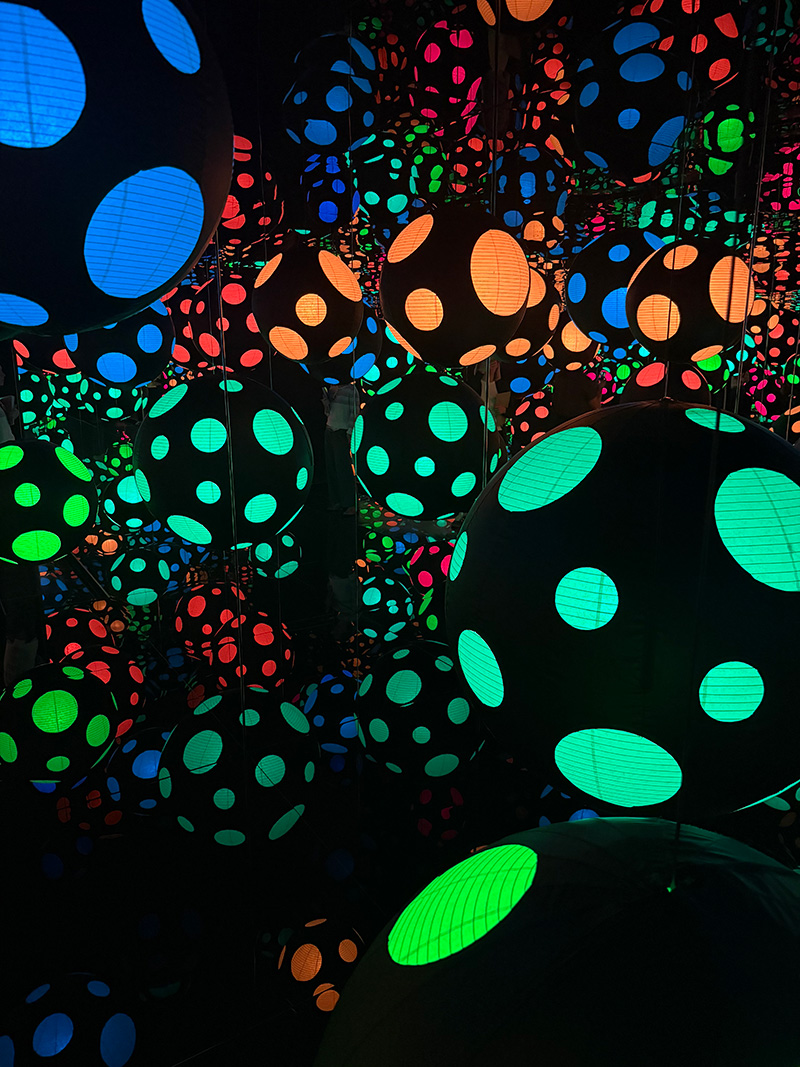
Yayoi Kusama
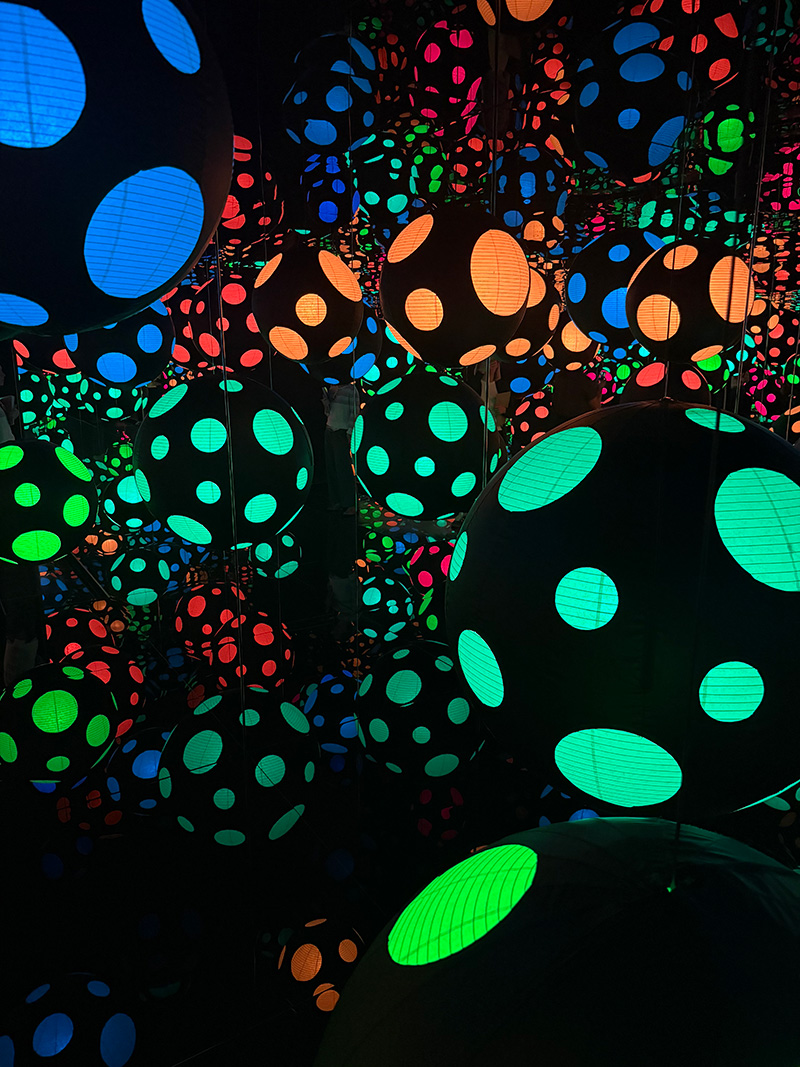
In the second room, from 2018, My Heart Is Dancing into the Universe, the visitor is disoriented by a black, mirrored space that recalls 1960s psychedelic lights. Highly reflective black tile reflect hanging, polka dot lanterns intended to realize what an afterlife might look like. This in-between space is one of Kusama’s pass-through infinity mirror rooms, where visitors can walk in one side and come out the other.
The opportunity to experience two of Kusama’s rooms in Chicago is reason enough to plan a visit. Visitors also become part of the work. Johnson explained, “She used mirrors because they implicate you in [the art] as well. You are being obliterated by the sort of environment that you’re entering.” Johnson added that Kusama’s famous polka dots became agents of this obliteration, a return to the cellular level we all come from.
At Thursday’s small press preview, our time inside the immersive spaces was limited. I had assumed the limits were for crowd control in the selfie age, so restricting just a handful of visitors made me pause. When I asked about our allotted minute and 25 seconds, a staff member explained that the interval was intentional. Johnson elaborated that Kusama’s studio had worked to establish an ideal viewing time. Infinity, I guess, does have a limit.
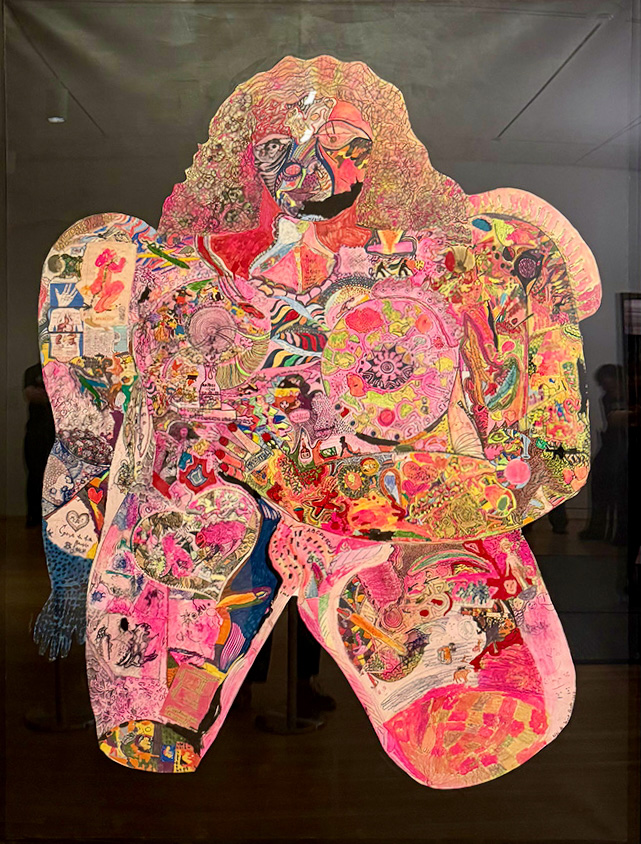
Niki de Saint Phalle
De Saint Phalle’s large mixed-media work Pink Lady introduces the expressive imagery and full-bodied female figures for which she is known. Its surface rewards close looking, with small drawings and motifs spread throughout the body of the figure. Johnson discussed the artist’s abusive childhood and early marriage. The confinement she felt resulted in a mental collapse that led to a brief period of institutionalization, where she found painting.
Seen near Kusama’s mirrored room, Pink Lady offers another example of an artist giving physical form to difficult personal experiences. The results are very different, but both women developed visual languages that could draw viewers into their worlds.
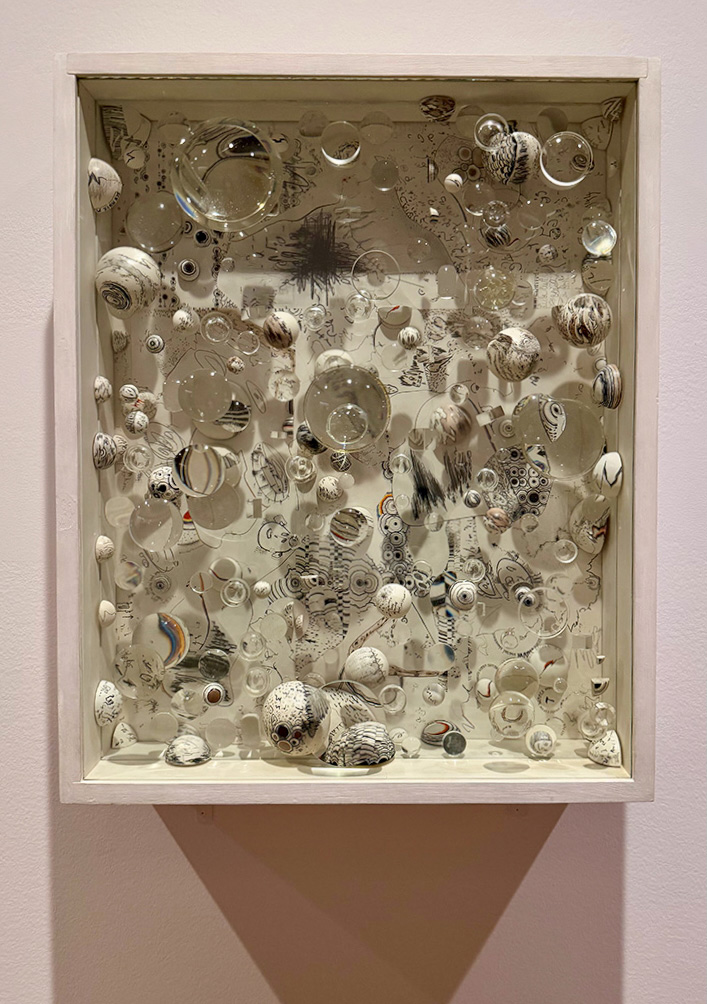
Mary Bauermeister
Bauermeister’s optical and stone assemblages occupy a narrower part of the gallery that invites close examination. Lenses alter the view of drawings and text within the works, changing what visitors see as they move around them. “It is meant to involve the viewer,” Johnson explained during the tour, comparing that experience to entering an infinity mirror room. She adds that an early reviewer of Bauermeister’s work suggested that time was the only thing preventing these works from becoming infinite: given enough time to keep making marks, they might keep expanding.
The exhibition gives visitors a chance to spend time with work that may be less familiar than Kusama’s but it no less revelatory. Considering the three artists together, as well as on their own, shows work that is clearly beautiful to behold but that also reveals what artists can express for future generations about the trauma and turmoil of living through the constant internal and external destructiveness of war.
#
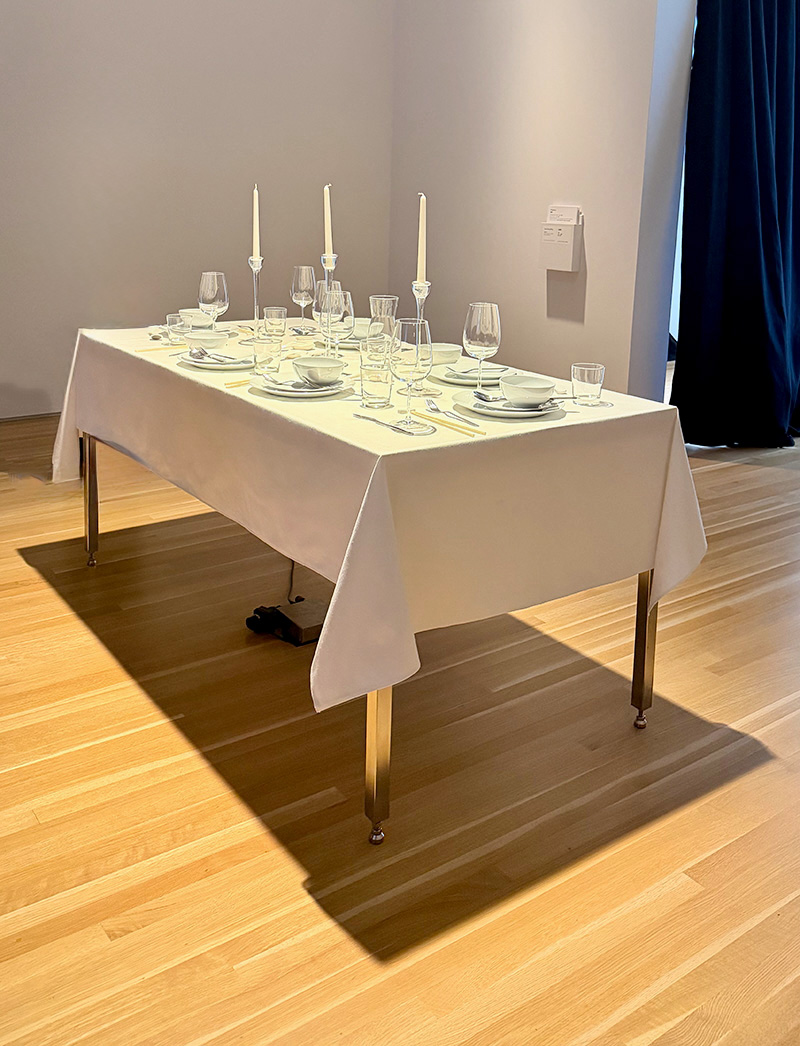
Yuan Goang-Ming, Prophecy (2014)
Yuan Goang-Ming: Everyday War occupies the upper floors, though its sounds travel through the building, signaling that even when you cannot see a battlefield, the effects of war permeate the spaces of every day life. Even before a work comes into view, a sudden crash interrupts the visit.
Adapted from the Venice exhibition curated by Abby Chen, the presentation examines how the possibility of conflict enters the day to day. As Yuan emphasized, war today is not limited to physical gunfire or military conflict: it can be experienced through pressure or conflict, including natural disasters and additional global and political threats that people are living through.
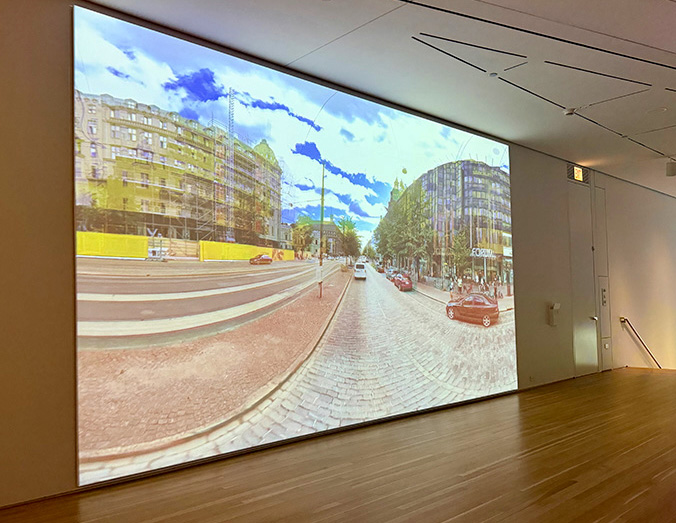
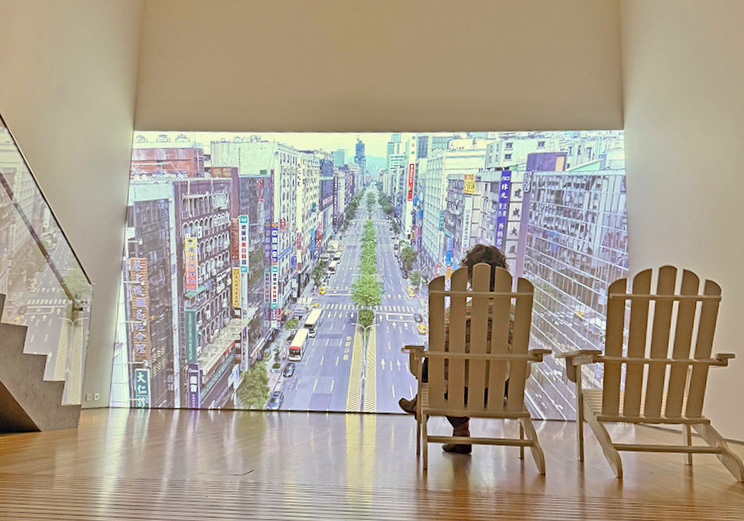
Sound is as important as the imagery in many of these works, and the videos need time to unfold. One projection takes viewers on a journey through downloaded Google Street View images, with no apparent beginning or end. In another, aerial footage shows Taipei during an annual air-raid drill. Yuan used five drones to record the city from different angles. The empty streets recall the pandemic, but this interruption takes place each year as residents rehearse what to do in an emergency.
Yuan Goang-Ming
Yuan Goang-Ming
Two Adirondack chairs on a landing between floors offer a place to watch the footage. They are an odd seating choice for viewing a city preparing for an attack, placing visitors in a comfortable position that recalls a lakeside weekend. Nearby, Yuan’s delicate drawing What Lies Beyond Us? references a 1951 photograph of American observers watching a nuclear test from Adirondack chairs. The connection gives the gallery seating a more unsettling association.
In Prophecy (2014), glasses and dinnerware shake on a kinetic table. The first disturbance is startling. As it repeated through the galleries, I found myself becoming accustomed to the crash. That adjustment was unsettling in itself, suggesting how an alarming sound might become part of the background of daily life.
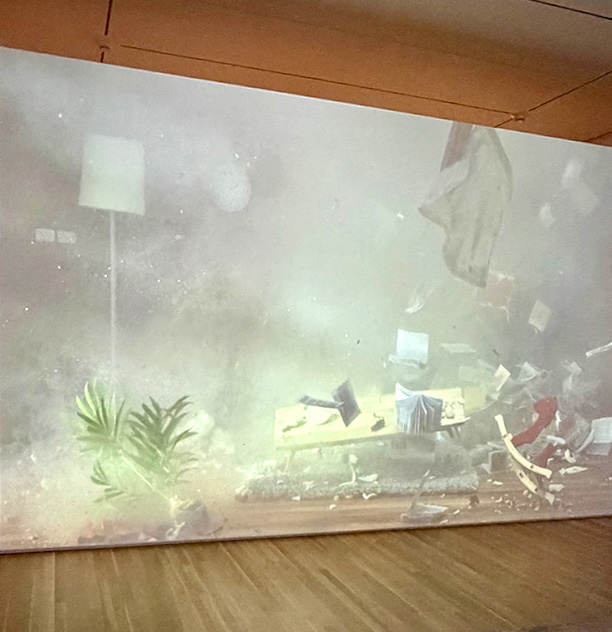
Sofas and picture lighting add to the exhibition’s domestic setting. In one video, a destroyed interior comes back together in a way that reminded me of a scene from Harry Potter. What has been blown apart is restored in reverse, while you anticipate when it will explode again.
Yuan Goang-Ming
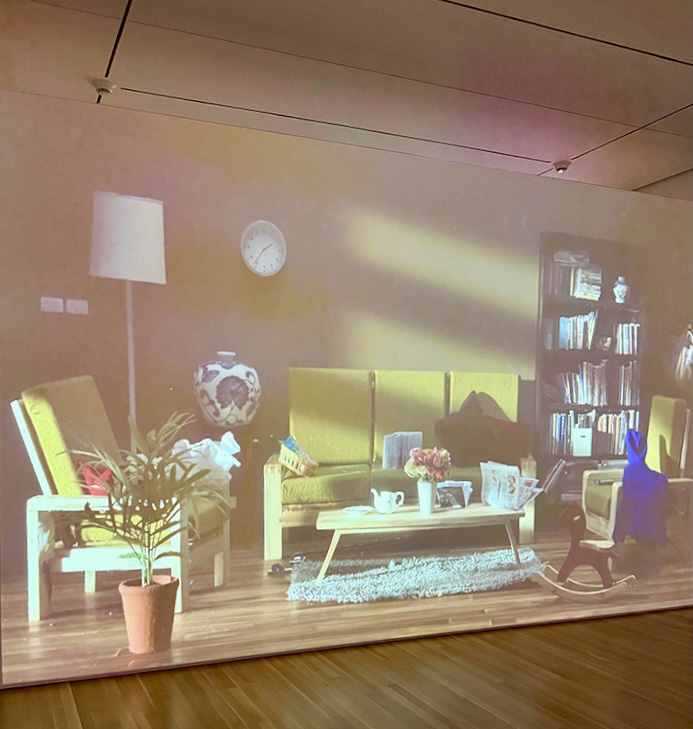
Yuan Goang-Ming
These scenes make the uncertainty surrounding Taiwan feel closer to home. They shift attention from political debates about China and Taiwan to the people living there, their kitchens and daily routines. The works stay with you because so much of what they depict is recognizable, even if, fortunately, the circumstances are not.
Visitors who come even just for Kusama's selfie opportunities will have plenty of reasons to explore art from these artists and these times more deeply. Across the two exhibitions, Wrightwood 659 offers work by four internationally significant artists, with more to absorb than many may expect when they arrive.
Inner Worlds: Visions from the Hirshhorn Collection
and Yuan Goang-Ming: Everyday War
On view through December 19, 2026
Wrightwood 659
659 W. Wrightwood Ave., Chicago.
Advance tickets are required. Visit wrightwood659.org for reservations and current hours.