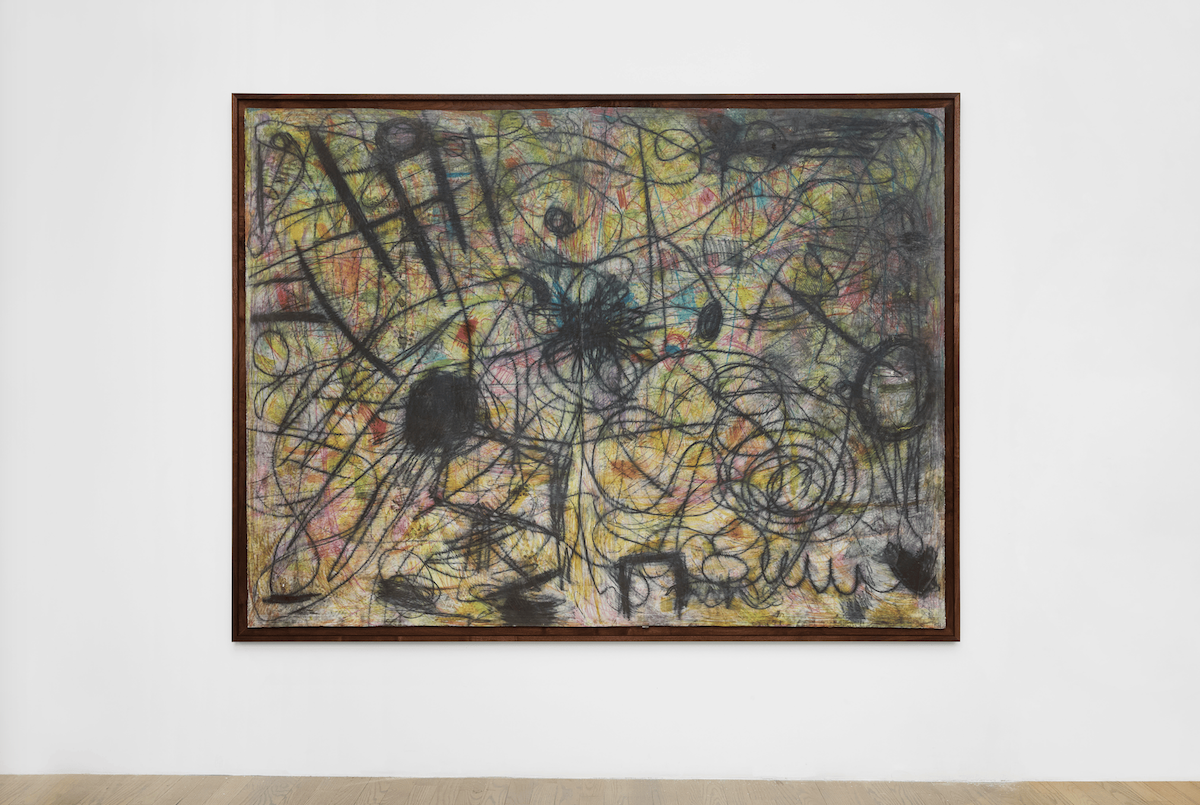
PATRON presents Let's Go Exploring!, a two-person exhibition by Chicago-based artists Gregory Bae and Tony Lewis. As studio-mates, colleagues, and peers, Bae and Lewis’s individual practices define an active, critical engagement with the world around us with a soulful awareness of being present–as individuals and in relation. Re-tracing various forms of collaboration and exchange, Let’s Go Exploring! posits friendship as one of the most underrated tools in any artist’s practice. The exhibition premieres a grouping of never - before exhibited works by both artists—tracing and expanding from Bae’s and Lewis’s 16-year friendship forged during their cohort at the School of the Art Institute of Chicago.
This exchange is introduced in the form of a salon-style installation of sketches, drawings, paintings, and ephemera from both artist’s studios. Constructed from a process of revisiting Bae’s archive, largely housed at Lewis’s studio for the past five years, the installation collapses time through references to both unrealized and realized future works, indirect to incomplete thoughts, sketches, and unfinished conversations. A partial visual representation of the artists’ diverse interests, the installation introduces shared cultural connections, including Bill Watterson’s Calvin and Hobbes comic strips, a childhood favorite of both Bae and Lewis, but also a material resonant in Lewis’s practice since 2013. Here, the dynamic impulse of the last comic strip catalyzes an active return to two practices, inspired by the artists’ shared, persistent attempts to grasp the gaps of understanding and connection created by time.
Time, as material and process appears in Bae’s 24-7, 365 (sketch) (2017), a series of paintings on used car tires. Originally part of a kinetic sculpture, 24-7, 365 (2014) in which a tire endlessly turns on a treadmill at a rate that would travel the world's circumference in a year. Installed on the wall, Bae’s tire series reveals his experimental, assemblage-based approach to painting, shaped through continual testing with nontraditional materials drawn from the American import industry. Car tires, laptop screens, and found paper transition from everyday remnants to painted surfaces, carrying the history of their use along with them.


