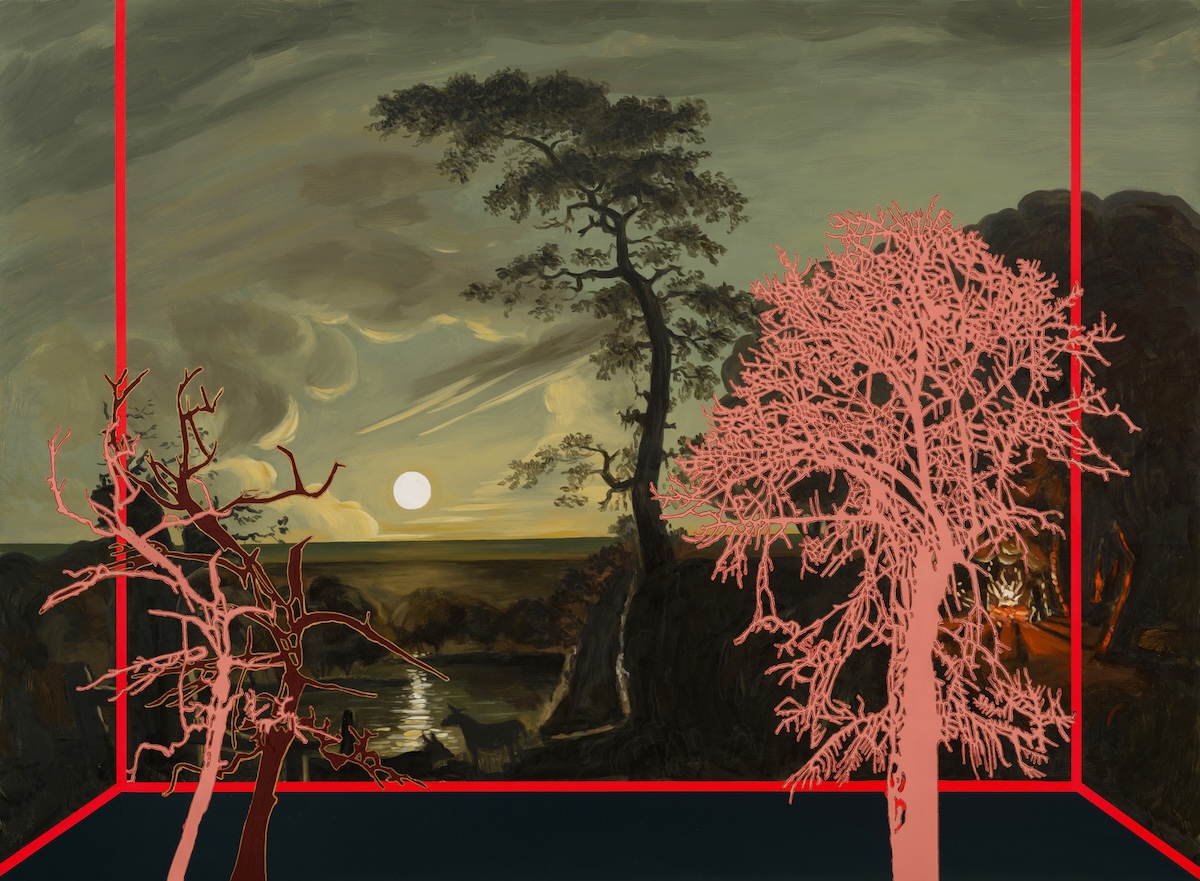
In the newest iteration of Bedford’s acclaimed Veduta series, moonscapes mark a natural progression from her previous body of work which featured sunsets, some of which were created in the aftermath of the devastating 2025 Palisades Fire in Los Angeles. In this transition from day to night, Bedford introduces a new chromatic register in Nocturnes, transforming the atmospheric qualities of the Veduta series from muted luminosity to the heightened ambiguity of moonlit landscapes. The resulting works constitute a subtle yet striking evolution of the artist’s ongoing engagement with light, atmosphere and the moods they evoke.
Veduta paintings are a genre of painting made popular throughout the 16th to 18th centuries. Originally, these highly detailed depictions of recognizable European vistas: significantly, this genre also captured imagery of healthy and pristine vistas untouched by development, pollution and other man-made blight. Seeing what the world looked like through this artistic lens in the 1600s is an eye-opening assessment of the complicated relationship between humanity and nature.
As Vedute evolved through shifting art-historical paradigms, the landscape remained recognizably the same while becoming increasingly sensorial. Artists turned to intensified color and expressive brushwork in their pursuit of the sublime. This evolution marked a shift from quaint pastoral depictions of the countryside toward more evocative, moody, and dramatic phenomenologies.
Bedford’s new series of Veduta paintings consists entirely of moonlit landscapes and seascapes that embrace the essence of the sublime while situating the series within a specific moment in time: darkness. Inspired by masterworks by artists such as Jean-Baptiste-Camille Corot, Milton Avery, Camille Pissarro, and Frederic Edwin Church as underpaintings, Bedford layers vivid neon-colored tree and cacti motifs, many native to her Southern Californian environs. A third element introduces an architectural gesture: a three-quarter view of an interior room defined by a floor, back wall, and hints of two adjoining walls. Together, the underpainting, neon flora, and architectural framework draw the viewer into an intimate, immersive space, enhancing the experience of the sublime.
With Nocturnes, the moon becomes both protagonist and antagonist—amplified by the characteristics of being moody and dramatic—while also playing the role of guide, existential muse and keeper of time. Long burdened with symbolic and emotional meaning across art, literature, music, and mythology, it appears here as something more detached: an omnipresent witness. Absorbing centuries of the human experience as we move firmly into the Age of the Anthropocene, Nocturnes are presented on a stage in dialogue with the scenic past revealing the friction and the disconnect between the past and present landscapes.
Image: Whitney Bedford, Veduta (Constable Moonlight), 2026. Ink and oil on nylinen on panel, 44 x 60 x 2 inches.


