A Family Home for Stories: Collectors Macol and José Cerda
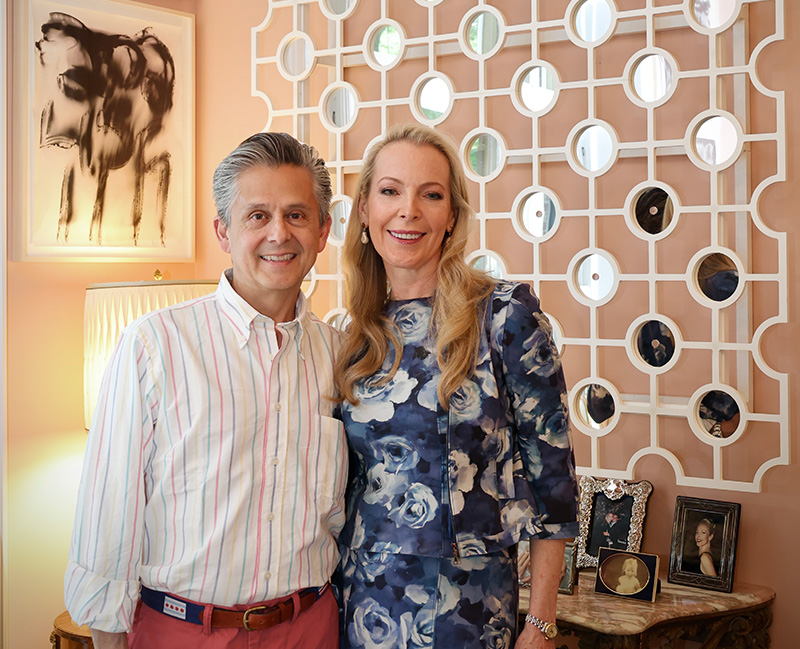
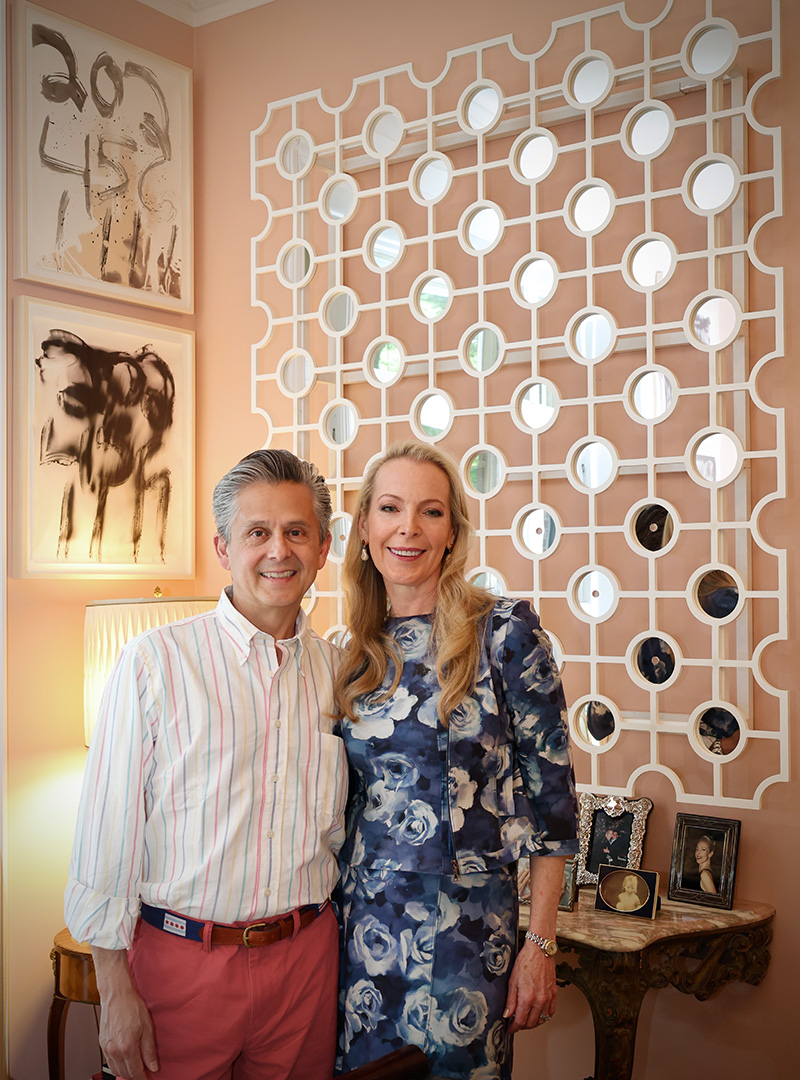
José and Macol Cerda in front of a sculptural work by Edra Soto. Over José’s shoulder are two works by Jason Lazarus. Macol is wearing a dress by Maria Pinto.
By GINNY VAN ALYEA
José and Macol Cerda’s home sits in a historic section of Jackson Blvd. in Chicago. From the street it gives the impression of a lovely older house, offering warm, inviting light and a respite from the beginning of a rainstorm. Inside the art collection that the couple has built together is as much a part of their home as the stained glass windows and historic fixtures. Theirs is a home that tells a generational story of a family’s life shaped by curiosity, history and hospitality.
*
On a quiet stretch of the city, in an otherwise busy confluence of neighborhoods, the Cerdas’ 1880s house sits among a row of remarkably preserved historic homes—a reminder of a formative chapter in Chicago’s history. It’s the kind of block that surprises even longtime Chicagoans. Tucked just beyond the bustle of downtown and near a congested medical district, the home’s brick facade is almost hidden behind a low iron gate and mature trees unfurling into full summer. It’s a home that has yet to give any clues about what’s inside.
After I am cheerfully greeted by Macol and José, looking around their front hall I observe a large-scale modern painting, antique furniture, works on paper featuring embroidery, and at the base of an historic staircase that centers the first floor, an imposing sculpture by Rodrigo Ímaz, Blueticue, a combination of Blue Demon, a well-known Mexican wrestler, and Coatlicue, the Aztec earth goddess. In the adjacent living room, it takes me a minute to register the mix. Among the paintings, art books and glittering objects are vintage family photographs and portraits spanning generations, comfortably sitting in conversation with works by established and emerging contemporary artists. Furniture inherited from relatives from Texas shares space with recognizable acquisitions from Chicago galleries and international art fairs. Expertly wrought artwork by the couple’s creative children hangs naturally alongside museum-exhibited artists. Nothing feels staged, yet everything feels intentionally layered over many years.
Ask José or Macol about almost anything—a painting, a table, a ceramic vessel, an old photograph—and the answer doesn’t dwell on where they bought it. Instead, it begins with a story about a connection with a person – a family member, artist, fellow collector or house guest who shared a work of art as well as imparted a memory.
*
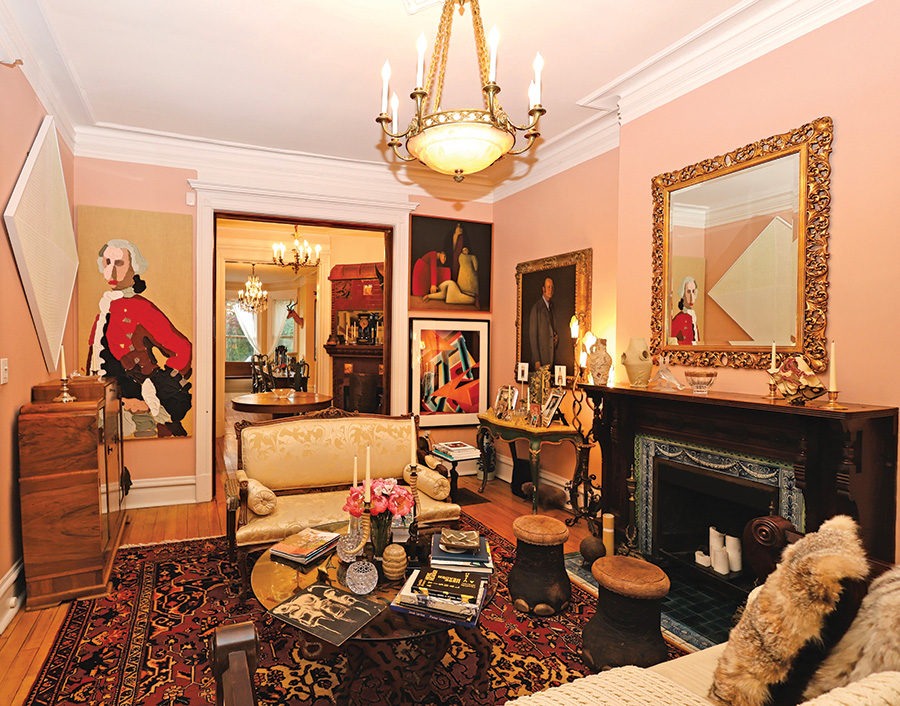
The Cerdas’ living room features contemporary art by many artists from Chicago as well as many family heirlooms and antiques. All photos by CGN.
Although José grew up in Chicago and Macol spent her childhood between Texas and New York, the city they now call home wasn’t always part of the plan. After college and graduate school, both built their early professional lives in Washington, D.C., where they met, married and began imagining what they wanted their future to look like.
They considered leaving Washington to return to José’s hometown, and they made an unusual list—not of neighborhoods, but of community qualities. They wanted an old house with character, enough room to eventually raise a family, and to be close to downtown while still feeling part of a neighborhood. Living in Georgetown had taught them the pleasures of historic architecture, but also its limitations. Their charming row house in D.C. offered aesthetic benefits along with very little space for living, let alone art.
Chicago, they hoped, might offer both.
“We fell in love with the block,” José recalls. They moved into the house in December 2004, believing they had found the setting where they would build the next chapter of their lives. What they couldn’t have predicted was how closely the house itself would shape their approach to collecting.
Macol’s mother began sending family furniture, paintings and heirlooms, some of which had been waiting in storage for years. A truck arrived filled with pieces carrying decades of family history. Rather than furnishing the house with newly purchased furniture, the Cerdas began surrounding themselves with objects that already held meaning.
At first, they imagined restoring the interiors much as they might have appeared when the house was built nearly 140 years prior. José, an enthusiastic student of Chicago history, was captivated by the neighborhood’s place in the city’s development. This stretch of the Near West Side, he explains, was once among Chicago’s most desirable residential districts before population shifts and new development transformed the city. Much of that architectural history disappeared over time, making blocks like theirs increasingly rare and all the more surprising to encounter today.
The original plan to update and fill the home was museum-like in its specificity: assemble period furnishings, antique carpets and family heirlooms that would reflect the home’s Victorian origins.
“But once we got doing that,” José says, “we got more interested in art.”
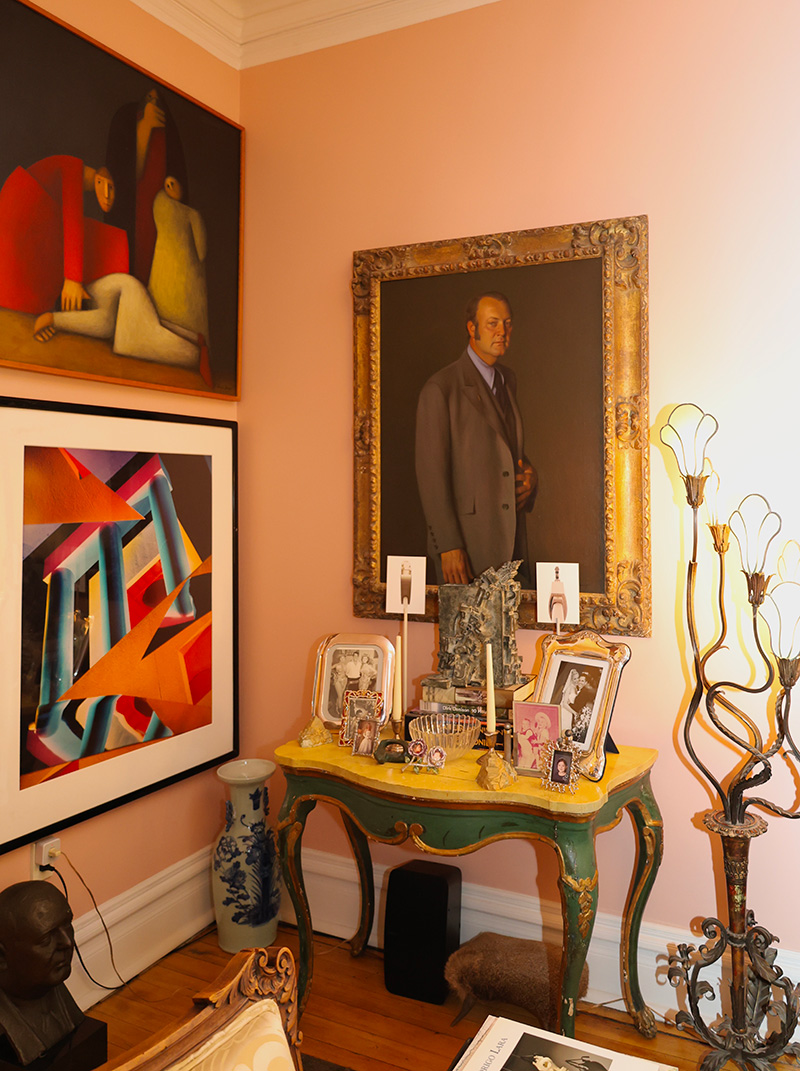
A mix of family images blends well with art by artists from Chicago and elsewhere.
Instead of recreating the past for the home, the house became a living document of the present.
When I ask whether collecting has always been a shared pursuit, both José and Macol answer without hesitation. While each may respond differently to a particular work, the decisions have always been collaborative.
“We research the works and the artists,” Macol explains. “We have many works from artists that we know, either here in Chicago or elsewhere, but we make the decisions on our collecting together.”
As their collection has grown over the past two decades, so has their family. Their two daughters have grown up surrounded by artists, gallery exhibitions, museum visits and art fairs. Not surprisingly, they have begun contributing their own opinions as well.
“There are some pieces we’ve purchased because the girls like them. They’re family purchases. We’ve dragged them to galleries and art shows for all of their lives,” José says with a laugh.
Macol adds that both children have developed an appreciation for creativity in their own way, with their oldest daughter especially interested in making art herself. “She won the visual arts award at her high school,” José says. “She’s really into process and creation.”
Looking around the house, that appreciation seems almost inevitable, considering each room offers another opportunity to stop, ask a question and hear more about a painting, sculpture or a piece of furniture. Before long, our conversation shifts from how Macol and José collect to what makes this collection so personal.
“There’s a story behind everything,” José says.
*
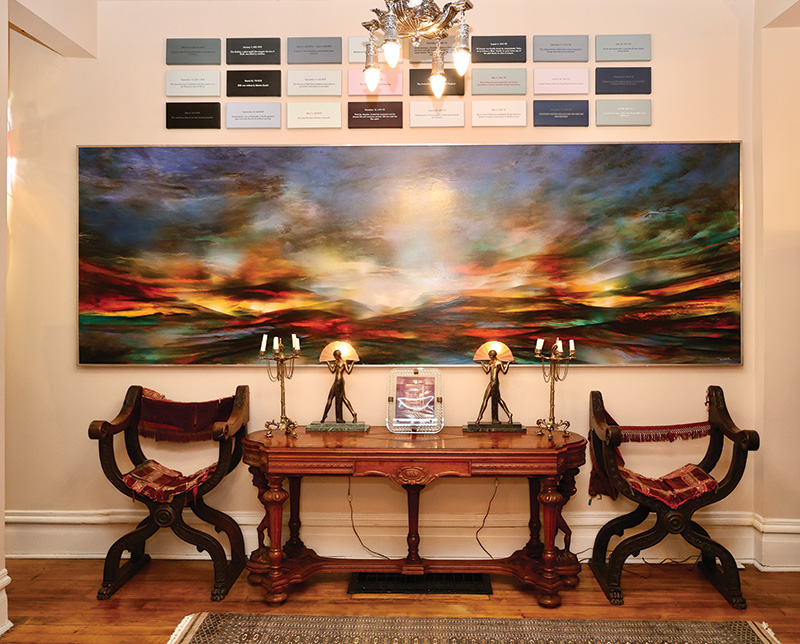
A 14–foot wide painting by Leonardo Nierman belonged to Macol’s family and was the background for milestones of her youth. The tradition has continued for José and Macol’s daughters. Also pictured is A Fake History of Humanity by Octavio Abúndez from CURRO Gallery in Guadalajara, Mexico.
Portraits, sculpture, furniture and decorative objects all carry their own histories, and each has found a place alongside works by contemporary artists. Macol points out a number of objects and images near where we are seated that she says came from her family’s collection.
“My family always supported living artists and bought their work,” she explains. “I was really fortunate to grow up around that vibrancy and their interests.”
She pauses in front of portraits of her father as well as several black-and-white photographs of her mother—pictured in one with singer Dean Martin—who, she says, was once a model and actress who danced in Las Vegas. Pointing out two substantial busts placed on the floor by the fireplace, “They were so heavy they were pulling the mantel down,” she says with a laugh. “We finally replaced my great-great-grandfather with Michelle Grabner’s geometric painting. We always wanted to keep the family portraits with the art, but we had nowhere to put [Michelle’s] painting.”
Looking around the room, it’s striking to see works by José Lerma, Michelle Grabner, Edra Soto and Barbara Kasten – artists José says are from “our Chicago period” – sharing the walls with generations of family portraits and heirlooms.
The same layering extends beyond contemporary art. Architectural fragments, antique light fixtures and even inherited animal mounts from Macol’s parents’ many international travels years ago add texture and interest while inviting closer inspection.
“When we first moved into this house and had so many things from my family,” Macol reflects, “we jokingly referred to it as the Stewart Family Museum. I think now it’s really become the Cerda Family Museum.”
“Having those things was our initial grounding,” José says. “It’s not like we decorated it. We have all these things that we’ve accumulated, our kids’ artwork, things her mom and dad bought. That’s how we filled it out. And for most people, that’s life. That’s how you put things together.”
*
For the Cerdas, collecting has unfolded much the same way. Rather than setting out to build a collection around a particular movement or medium, they have built it through years of curiosity, friendships and a deep engagement with Chicago’s arts community.
Their first purchase together came soon after moving to Chicago.
“Our wedding anniversary always fell around Art Chicago,” Macol says. “It’s where we bought our first piece together.”
Annual visits to the fair soon became part of their routine, while gallery openings, museum exhibitions, artist studios and nonprofit events also began to fill their calendar, introducing them to a growing network of artists and gallerists who would shape the collection over the next two decades.
“The Chicago art scene and its vibrancy are very important to us,” Macol says. “It’s also really important culturally for the city of Chicago, so it’s something we enjoy supporting and are invested in, whether that’s the individual artist and their career, the galleries and their ecosystem, or the various arts groups here.”
While they have purchased work from galleries across the country and internationally, Chicago galleries remain at the center of their collecting life.
“We’ve spent a lot of time going to different openings, seeing new work, discovering artists we didn’t know about or catching up on artists we’ve been following,” Macol says.
José credits much of that approach to his own professional background.
“I used to work in politics and government,” he says. “I am a huge believer that relationships are everything. I think a lot of the fun for us in art has been building relationships with artists, with galleries, with real people.”
One of their newest acquisitions grew directly from one of those relationships. The couple met the owner of Art Latinou in Mexico City, Mexico during her first appearance at EXPO CHICAGO. Before returning to the fair the owner called José and Macol to say she would be back in town so they could meet for dinner. She ended up introducing them to one of the gallery’s artists, Otto Martín Moreno. Another evening together followed, and eventually so did a new work of art, El Mundo se Construye.
“The art wasn’t something we planned to buy,” José says. “We bought a piece from the artist because we got to know him as well as his work.”
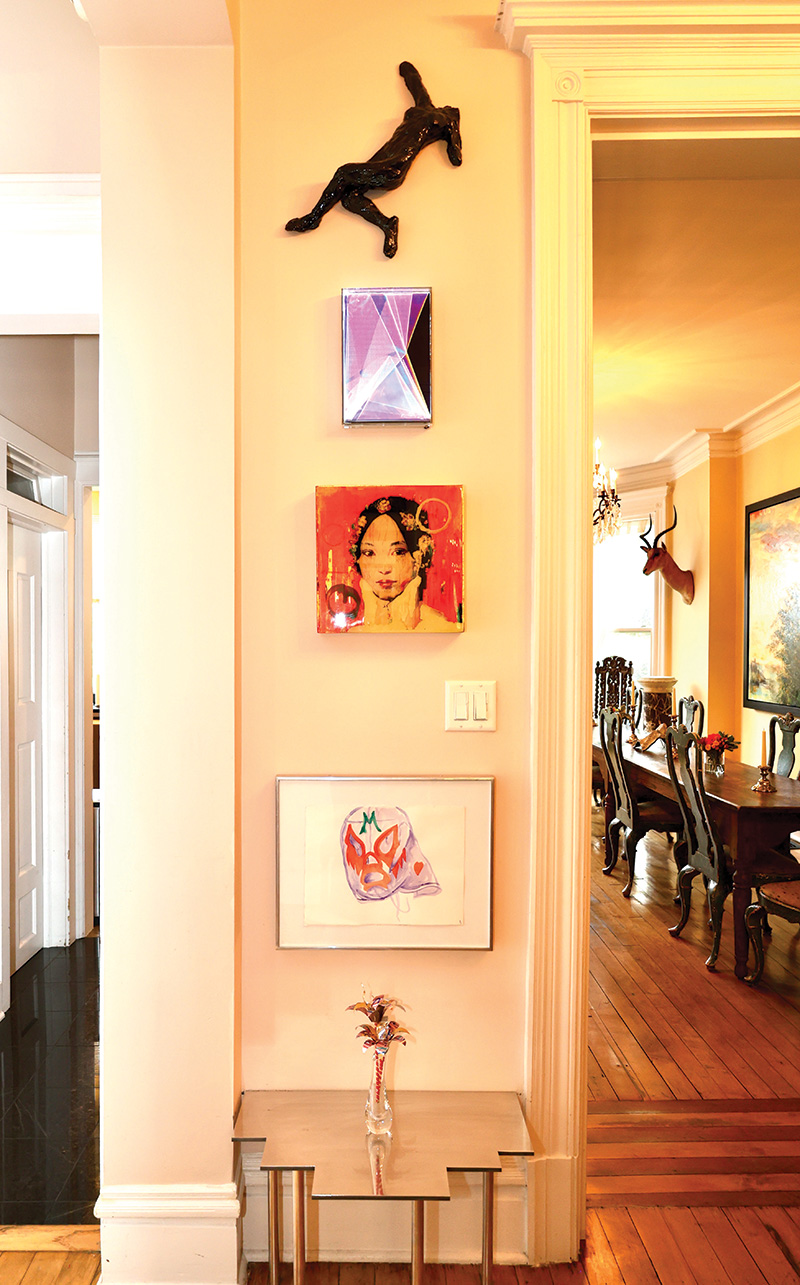
Pictured above from top to bottom: Rodrigo Lara Zendejas, untitled; Jeroen Nelemans, To be Crystal Clear – #10; Hung Liu, Red Wash – Series II; Salomón Huerta, untitled; Jonathan Nesci, 100 Variations Table – #99.
*
Both describe the years before the pandemic as an especially vibrant time for them in Chicago’s art community. Gallery openings overlapped with museum programs, artists gathered after exhibitions, and organizations such as the Renaissance Society, the Society for Contemporary Art and the Chicago Artists Coalition became regular destinations.
“There was a period when we got to know a lot of young artists really well,” José recalls. “We’d socialize with them, spend time together, go to events they were throwing. It wasn’t just buying the work and hanging it. It became this whole group of relationships.”
“We worked with galleries in New York and Mexico too,” José says. “But the Chicago galleries really became our mainstays.”
Macol reflects on how collecting has a way of feeding itself. “The more you’re in it,” she says, “the more you want to collect. The more people you know, the more you learn, the more you’re exposed to.”
José points out another example of how a relationship with an artist has stayed with him as he stops beside a large-scale work by Edra Soto.
“This is a piece that Edra had several years ago at El Museo del Barrio in New York,” he says. “It was right before Edra became…Edra.”
The Cerdas knew Soto before her work entered their home, when she was documenting Garfield Park through photography. They followed her career as her practice evolved and she gained national recognition.
“Edra was also the one who turned me on to a book about Latinx artists, and that opened up a whole group I became really interested in. I continue to follow Mexican and Cuban artists, since that’s also my background.”
Across the room hangs Michelle Grabner’s quietly geometric canvas, its subtle gingham pattern shifting almost imperceptibly with the changing light. Nearby, José Lerma’s monumental portrait of Antonio de Ulloa y de la Torre-Guiral, the first Spanish governor of Louisiana, commands another wall, its thick impasto layered onto a burlap–covered wooden door contrasting with Grabner’s restrained surface. José first saw the portrait by Lerma at DePaul Art Museum’s LatinXAmerican exhibition in 2021. “I loved that show. It had work by more than 40 artists, and there were several pieces I was crazy about,” he says. “This particular piece was displayed with three others like it, against a backdrop, on an entire wall of the exhibit.”
José assumed the work had sold, only to come across it again two years later at Kavi Gupta Gallery in Chicago. “I thought somebody had bought it, and then I saw it again,” he says. “We were able to get it. We love that piece.” The couple was spared the lasting regret of art that got away for good.
Together this collection of work by artists well known in Chicago could easily dominate the room, yet they sit comfortably among inherited antiques, family portraits and decorative objects from many places and times that have lived with the family for generations. It is an arrangement that probably shouldn’t work, but somehow does.
Nearby, José points to a photograph by Jason Lazarus, whom they met through Andrew Rafacz’s gallery in Chicago. The work was made after the White House comment line was temporarily shut down during Donald Trump’s first administration. Lazarus incorporated the telephone number, 202-456-1111, into the image by working directly on photographic paper.
“In the show there was a wall of 20 or more of them,” José says. “I wanted to recreate that wall.”
Having worked in the White House during several administrations, José is drawn to pieces with connections to politics, government and the history of the presidency.
Art shares nearly every surface in the room. Macol points to a bronze sculpture, Composition Avec Des Lettres by Boris Zaborov, made from a stack of books and pieces of type. She remembers it as the last work of art she bought without José, many years ago, as a birthday present for him.
Another playful work is a ceramic vessel by Jeremy Foy, who combines baseball and pottery. Foy would throw clay pots and swiftly arrange them and pitch handmade ceramic baseballs at them so that the ball would break through one side of the vessel and emerge through the other, leaving the action permanently suspended once the clay was fired. Foy’s technique and experimentation appealed to them, as did the idea of freezing a particular instant of force and movement.
“You can still see the lines from the baseball in the pottery,” Macol says.
Their own earliest purchases together are more traditional than many of the works they collect now. Two encaustic paintings hang near one another, made by Carmelo Blandino, with whom they have stayed in contact through the years.
“They are different and not necessarily something we would buy today,” Macol says. “But at the time, we were negotiating our tastes and seeing lots of things together. We loved the technique.”
José points first to the brighter work and then to its darker companion. “We used to say this one, Vista di Monticchielo, is radiant and glorious, like Macol. The other one, Ultimo Sospiro in Giallo, is dark and brooding, like me. They complement each other.”
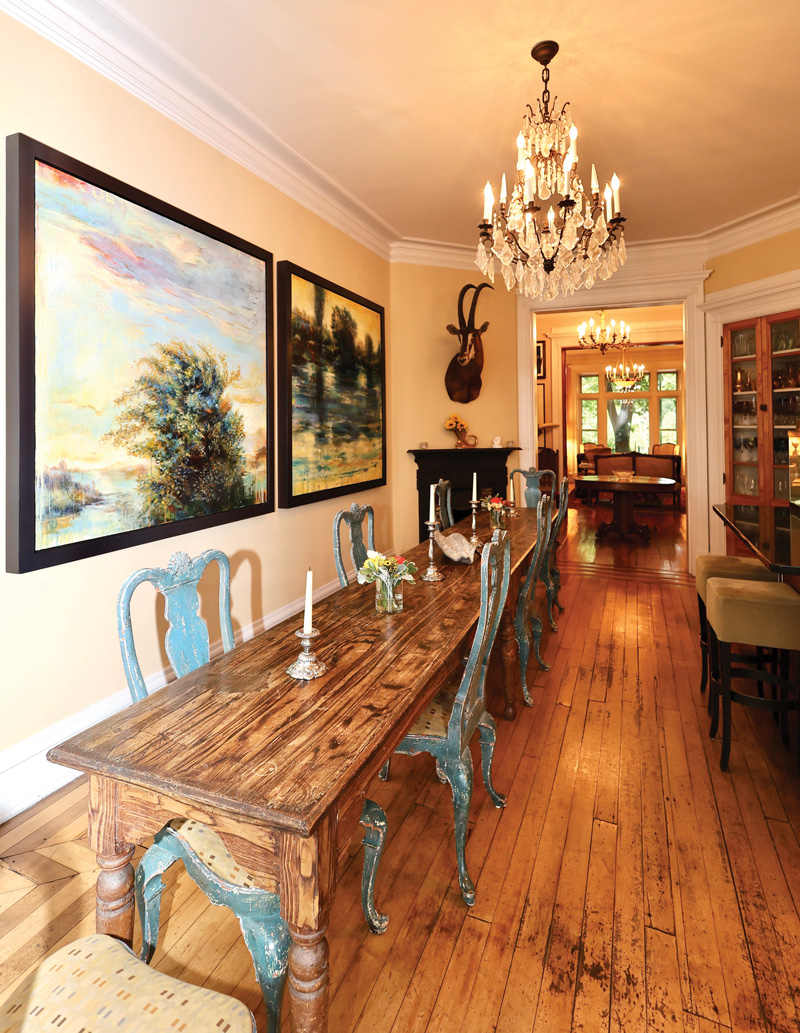
Macol’s father purchased their dining room table in Galveston, Texas from a men’s clothing store. A pair of encaustic paintings by Carmelo Blandino hangs above it, one of the couple’s earliest joint purchases. Pictured on the left: Vista di Monticchielo; on the right: Ultimo Sospiro in Giallo.
*
A set of sculptural hammers in the Cerdas’ kitchen is the work they recently purchased at EXPO CHICAGO after having dinner with the gallerist from Mexico City. At EXPO the artist, Otto Martín Moreno, displayed 25 hammers together. The heads are commercially produced, while the handles were carved by hand. Unexpected curves appear rigid, yet the wood has a remarkably soft surface.
“It honestly wasn’t the kind of thing we were looking to buy,” Macol says. “But we met the artist and enjoyed spending time with him. When we put them in the kitchen, we thought, ‘What a great piece for this place where we’ve never had any art.’”
Turning around, I notice a remarkably long, narrow dining table. Like so much else in the house, it arrived with a history already attached.
Macol explains, “This was a men’s shirts table at a clothing store in Galveston, Texas. It’s 14 feet long and it’s where they put out bolts of fabric. When my father was a young bachelor living in Galveston and the department store was closing, they were selling everything, and he bought it. During my childhood in Princeton, New Jersey, it was our dining table. For a while when we lived in Dallas, my mother had it as a kind of headboard behind her bed with lamps and sculptures and different things on it. When we moved to Chicago it was perfect for this long narrow dining room.”
It is easy to imagine this table filled with food and lively company. The house may contain museum-quality works, but it is clearly meant to be lived in. Art appears above kitchen counters and beside doorways. Sculptures occupy corners that might otherwise remain empty. Nothing seems separated from the practical business of family life.
A combination of process, experimentation and transformation appears repeatedly throughout the collection. The Cerdas are often interested not only in what an artwork depicts, but also in how it came into being.
On a table displaying an array of art and personal items is an assembly of what look like stones. The artist, Leander Mienardus Knust, who is interested in environmental topics, was inspired after noticing quantities of Styrofoam washing up near the studio where he was working by the mouth of the East River in New York City. Knust observed how the synthetic material weathered like stone but much more quickly, so he started collecting it. José adds that what makes these fabricated stones so dynamic is the movement imparted by the artist by adding the components that make cellphones vibrate. He created thousands of stones that move against each other in real time, further eroding each surface down to smaller particles.
The effect of all these works together is not chronological. A 19th-century portrait may appear beside an artwork made only a few years ago. A traditional piece of furniture supports an experimental sculpture. Works from Chicago share space with pieces connected to Mexico, Cuba, China and other parts of the world, allowing unexpected visual relationships to emerge that are testaments to how tastes build and evolve over time.
“We’ve changed,” Macol says. “Our tastes have changed, and what we’re interested in has changed.”
The early encaustic works remain on the walls not because they represent the collection as it exists today, but because they represent the people José and Macol were when they began collecting together.
“They’re part of our story,” José says.
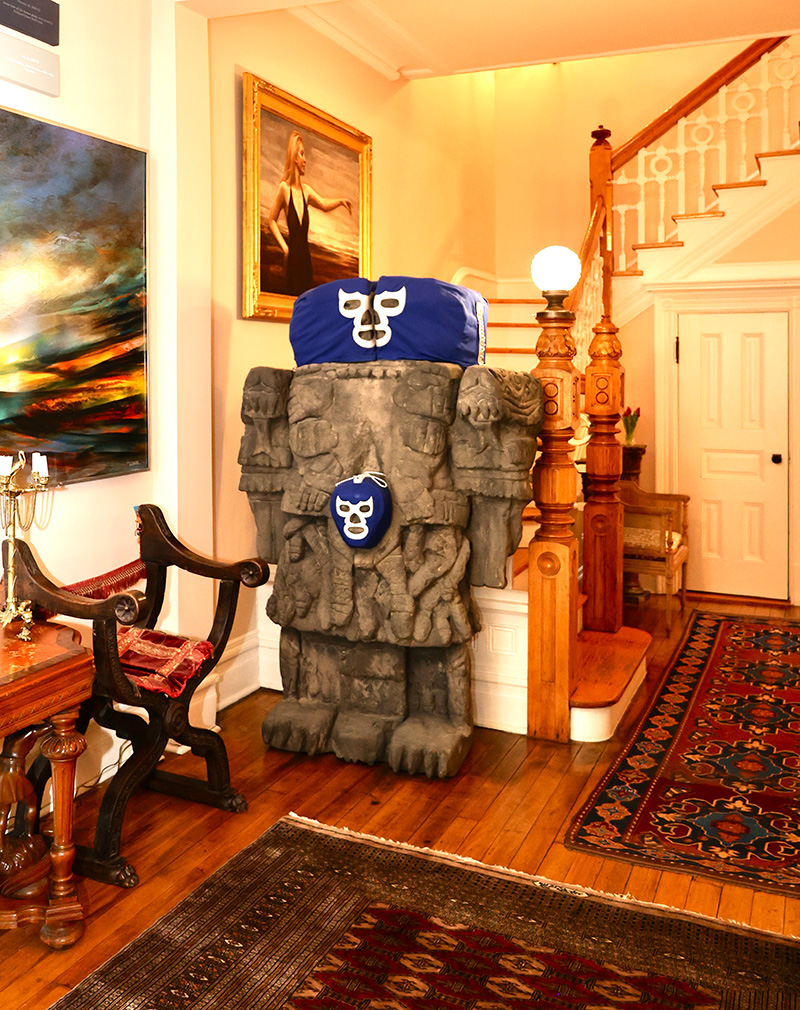
Pictured in the Cerdas’ front hall is Rodrigo Ímaz’s Bluticue, from Art Latinou in Mexico City, Mexico.
*
The Cerdas do not speak about any single method for knowing when to buy. “We talk about it,” Macol says. “We research the artist. We think about where the work might fit, although sometimes we don’t know where it will go until we bring it home.”
José admits that finding space has become more complicated. “There are not that many empty walls left.”
Still, neither seems ready to declare the collection finished.
The possibility of what happens to the collection in the future is not treated with great solemnity. José and Macol hope their daughters will want some of the works, but they also understand that the next generation will make its own choices.
José and Macol speak about their daughters with pride, especially when describing the distinct ways each has responded to growing up around art.
One is particularly interested in process and making. The other may respond more strongly to the social experience of museums, galleries and travel. Both have developed confidence in expressing what they like and dislike.
“They have opinions,” José says, smiling. A work may enter the house because one of the girls feels strongly about it, becoming part of a collection that is increasingly shared across generations.
After all, the house itself was shaped by objects inherited from Macol’s family and then rearranged according to a new family’s life. Pieces were moved, reinterpreted and placed beside art that previous generations could not have imagined.
By the end of our visit, I have lost track of how many works we have discussed. One object leads to another, then to a memory. The art is significant, but it is rarely the final point of the story.
Instead, the works serve as reminders of the people José and Macol have known, the places they have visited, the topics that interest them and the life they have built together.
The historic house has become a vessel for all of it: family history carried north from Texas, the beginning of a life together on the East Coast, two decades of engagement with Chicago artists, traces of political life, friendships made through galleries and museums, and the creativity of two daughters growing up among it all.
José and Macol may jokingly call it the Cerda Family Museum, but life inside the house is always active and changing, piece by piece. The collection continues to expand, the daughters grow up, and the stories attached to the objects accumulate and keep each other company.
#