A New Kind of Museum: A Stand-Out Space Opens in Indianapolis
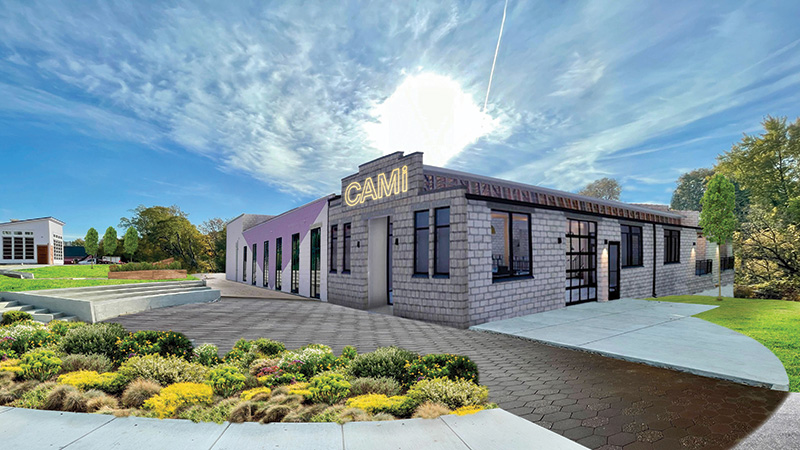
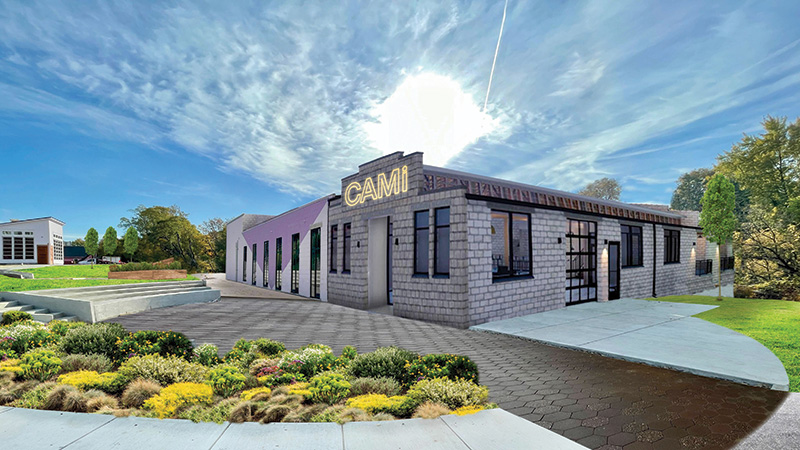
A rendering of the exterior of the main building of CAMi
This interview is from CGN's Spring/Summer 2026 issue. Purchase a print copy or subscribe.
By BIANCA BOVA
More than 20 years in the making, the Contemporary Art Museum Indianapolis is finally preparing to open its doors, just as the festivities of May get underway in the city.
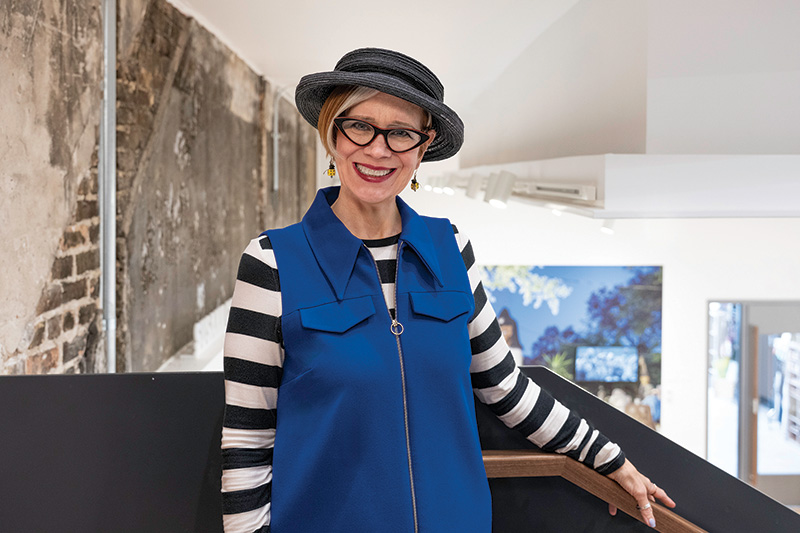
“We didn’t intend on becoming a museum when we started out,” says Shauta Marsh, CAMI’s Director and Chief Curator. She is also the museum’s co-founder, along with her husband Jim Walker, a longtime journalist and teacher who serves as its Executive Director.
“We were just working as part of a group of artists living in Indianapolis, and there were certain things that weren’t happening here that we wanted to see happen. So we tried to make them happen.”
To say that the couple has made them happen is an understatement. In 2004, they started Big Car Collaborative as an artist-led nonprofit focused on active programming in public spaces, creative placemaking for communities, and socially engaged art. They operated in the city’s Fountain Square neighborhood for nearly a decade, before expanding to neighboring Lafayette Square, where they opened Service Center. Their first major adaptive-reuse project site, it was situated in the former automotive tire service center of a defunct Sears department store.
“The tire center had been empty for several years,” notes Marsh. “We talked to the landlord and were able to use the space in exchange for covering operating expenses like lights and trash removal, and fixing the space up. Of course, it was still a tire center, so it was less about white box shows, and more about social practice art projects. Being in Lafayette Square–which is less residential than where we were in Fountain Square, more of a business district–we became kind of a destination space. So we naturally became more event-driven, though we did continue to have exhibitions. We did a show with Found magazine, we had more music and performance-related events, we had, at one point, a bunch of skateboarders who came in and built all these ramps and did their thing, all at Service Center. We also built what we called the Pizza Garden. We installed a pizza oven, and built this big raised-bed garden where we grew everything you would need to make a pizza. We held this end-of-the-year harvest, where we made the pizza from scratch, ground our own wheat for the crust and everything.”
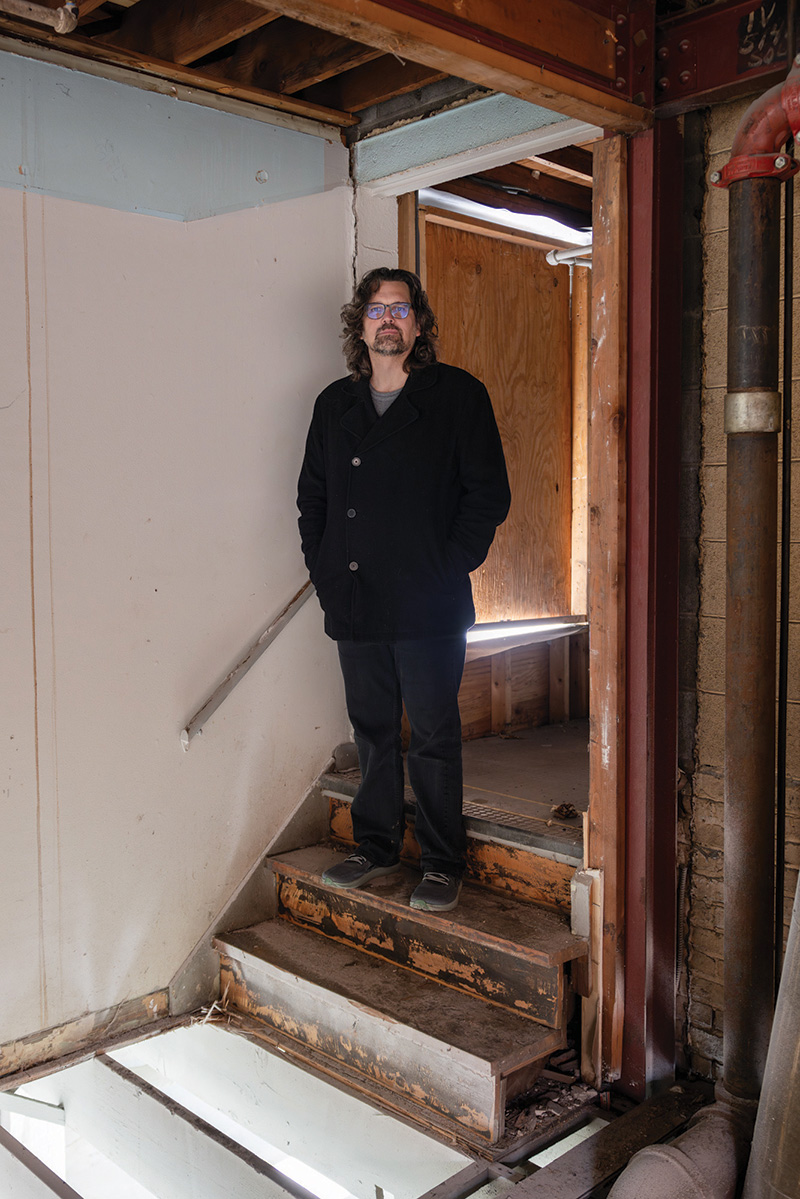
CAMI co-founder Jim Walker
In 2014, as Big Car Collaborative reached the milestone of a decade in operations, Service Center closed its doors. The property was to be returned to use as a commercial business unit. Around the same time, Marsh and Walker moved their family to the Garfield Park neighborhood, a historic residential community situated along a 150-acre park south of downtown Indianapolis.
“We started thinking about a new place that we could have the organization again, this time in our own neighborhood, because that was the other thing–if you’re working with community, it goes better if you’re working in the neighborhood you live in, and if a majority of the artists that work with the organization are living in the neighborhood you’re working in. When we started looking, we came across this building that was boarded up and we were like, ‘What’s going on with this? It doesn’t look too bad. We could do something like we did at Service Center with this, it needs only a moderate amount of work to be usable,’” Marsh continues, conceding “We were also tired of moving Big Car around. We really wanted our own space.”
They found it on Cruft Street, in what would become Tube Factory Art Space. With the support of noted cultural philanthropist George Seybert, President and CEO of Tube Processing Corporation, a manufacturer in the aerospace and energy sectors, and his wife Diane, Big Car was able to realize their vision of a new kind of art space, opening the following year with a series of commissioned exhibitions.
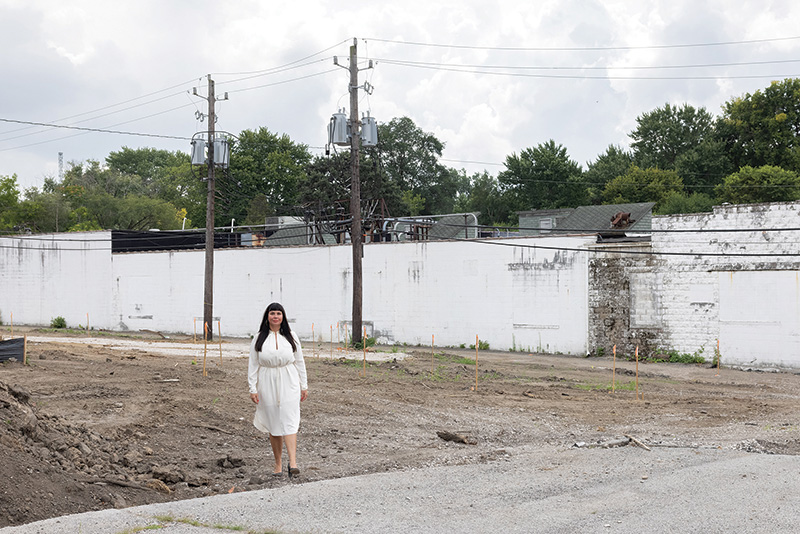
CAMI co-founder Shauta Marsh during site construction
“George and Diane, they are long time supporters of art in the city, they had helped build the Indianapolis Art Center. George had grown up in the neighborhood, and he was excited to see what we would do at the space. We had a proven track record at that point, and they had faith in what we were doing.”
After getting Tube Factory up and running came Big Car’s first long-term and short-term artist residency homes, which made use of vacant properties that neighbored the building along Cruft Street.
“Artists are, a lot of times, blamed for gentrification, but they’re also victims of it,” acknowledges Marsh, “They’re really just looking for somewhere affordable. Other people see what they’re doing and say, ‘These people are really cool. I want to live around these cool people, too.’ and then the cycle starts all over. We saw that happen a few times, and we were a part of it. We don’t have the ability–or the money–to fix those problems, we can’t stop or solve gentrification ourselves. But we felt we could do a little bit of something, which is how we ended up developing the artist housing. Artists fill out a survey–we don’t do income or credit checks–and we gauge if they’re a good fit based off of their answers about working in the community. Part of participating is committing sixteen hours a month to the community. That 16 hours can be almost anything: reading a book about social practice art, researching the history of the area, volunteering, attending neighborhood meetings. This helps, as we really want to demystify contemporary art. A lot of the general public have this idea about artists, that they’re standoffish, that they’re unapproachable, that they’re moody and all these things. That’s not always true. So we also wanted to help ensure the public, when they’re in contact with artists, have this experience that’s positive. People are more open to art than each other a lot of times. When you have an artist out there sharing their work, people become curious, and they’ll talk to each other. Then they start to see each other as a person, and it can help reduce the polarization that we’re seeing in society. It makes them more open to the idea of people that they might have thought they don’t like.”
Tube Factory also became the home of WQRT 99.1FM, a low-watt radio station.
“The opportunity actually came along for us to have the station when we were between physical spaces,” recalls Marsh, “We were always interested in sound art and in experimental radio, and we think of the radio station as another type of space, as another means of exhibition.”
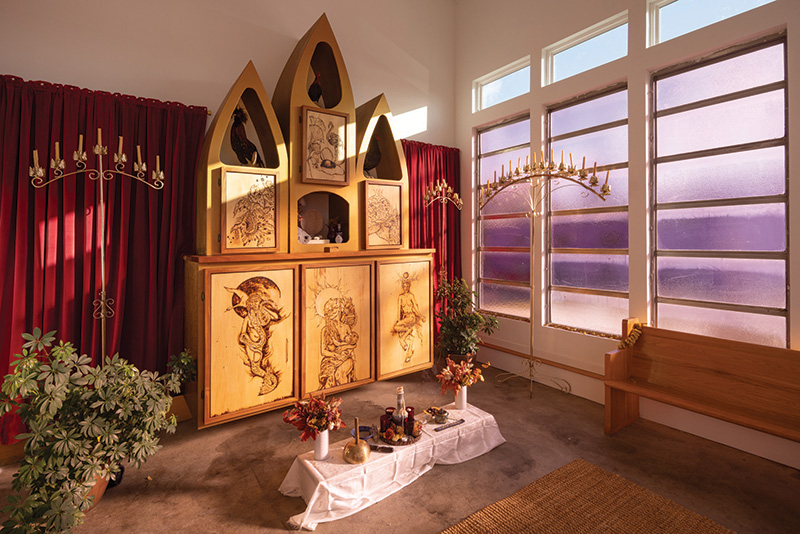
Chicken Chapel of Love, window view
From there, Marsh and Walker continued to develop their vision for a holistic arts campus on the property. Finally, in 2023, construction began on the 40,000 square-foot main building that would become the Contemporary Art Museum Indianapolis. Accompanying it on the surrounding five acres are the original Tube Factory Space; the radio station’s headquarters; eighteen new artists’ studios; six new exhibition galleries; a suite of five storefronts available to owners of creative small businesses; eighteen affordable homes for long-term and visiting artist residents; a performing arts space; a culinary arts area; a sculpture park; and The Chicken Chapel of Love, “a sacred art project” initiated by Marsh that includes works by Nasreen Khan, Julie Xiao, Justin Cooper, Jason Gray, and, Rachel Leah Cohn, with its own commissions of art, performance, music, and poems on-going.
Taken as a whole, the campus represents thirteen million dollars in total investment on Cruft Street, making it one of the the most significant culturally-driven adaptive reuse projects in the city. With this dramatic increase in space, programming, and financial commitment came the decision to formalize a name change, and establish the campus as a museum.
“I’m a lover of museums, first of all, I want to say that,” acknowledges Marsh, “but museums have problems, they’re imperfect, they always need improvement. We are–we have always been–artist-run. To this day, our staff are artists and we try to ensure that they have opportunities to exhibit and continue to be artists. We don’t want artists to have to take jobs to make a living and then give up what maybe they went to school for, or what they wanted to do initially, what gives meaning to them. We are an artist-run space, but one that’s decided it’s time to institutionalize.”
With that institutionalization, the Contemporary Art Museum Indianapolis takes its rightful place in a legacy that has been establishing itself in the city for years. It is a legacy of generous attitudes towards defining what a museum space can be; and one that has yielded sprawling, highly activated institutional campuses throughout the entire city.
Newfields, perhaps the best known of these campus museums, on the North side of the city, is home, most prominently, to the Indianapolis Museum of Art, a well-respected one hundred forty-two year old collecting institution. Also situated on its one hundred fifty-two acre compound is Fairbanks Park, which encompasses a thirty-five acre lake, woodlands, wetlands, and the largest native pollinator meadow in the region; The Garden, a fifty-two acre horticultural park; the historic Lilly House; and the Elder Greenhouse, an active conservatory dating from the 1920’s.
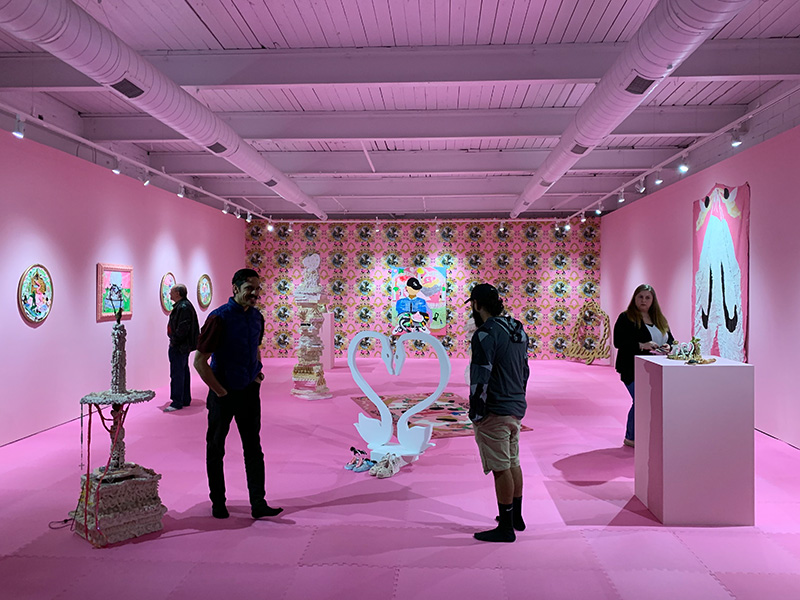
Yvette Mayorga's work installed at CAMI
In the city’s Broad Ripple neighborhood, the Indy Art Center sits along the White River. Founded in 1934 as the Indianapolis Art League through funds from the Works Project Administration, it has long been an access point to both art and nature in the heart of the city. Today its campus is anchored by a Michael Graves-designed building, which houses the Marilyn K. Glick School of Art, complete with an auditorium, classrooms and studios for adult and childhood education programs, exhibition galleries, a library, and a sculpture garden that follows the river trail.
Meanwhile on the near eastside, the city’s younger and more experimental artists find purchase in the Factory Arts District, the onetime home of legendary automotive engineering and manufacturing giant Schwitzer, sited on a sixteen acre industrial complex. The complex contains commercial galleries, artist studios, private car collections, restaurants, event spaces, and vintage shops, oriented contiguously in a labyrinthine series of open-ended industrial corridors that themselves play host to monthly parties and social events.
Even the Indianapolis Motor Speedway Museum, fresh off of a 60 million dollar renovation (and as much if not more of destination for visitors to the city than all of the aforementioned institutions combined) is, in its own right, not just an archival repository for the sport that made the city famous, but a kind of campus museum, sitting as it does in the shadow of the track’s pagoda control tower.
This context, when lent to CAMI on the eve of its grand opening, leaves the new museum poised to cement itself as a cornerstone of this uniquely Hoosier model for the placement of modern cultural institutions in civic life. It is a model that draws on a natural tendency towards granting the broadest possible latitude to defining the scope of an institution; a nimbleness that allows for adaptation to the resources at hand, itself born of a kind of Midwestern pragmatism; and a legacy of labor, with that labor itself rooted in a legacy of love for work worth doing.
“You know,” reflects Marsh, “everybody here always says, ‘We don’t have the ocean, we don’t have the mountains,’ you know, all that stuff. But we have this cultural landscape, and maybe that’s the thing we have that sets us apart–regionally–in this world.”