A Poem for Deep Thinkers: Rashid Johnson Returns to Chicago
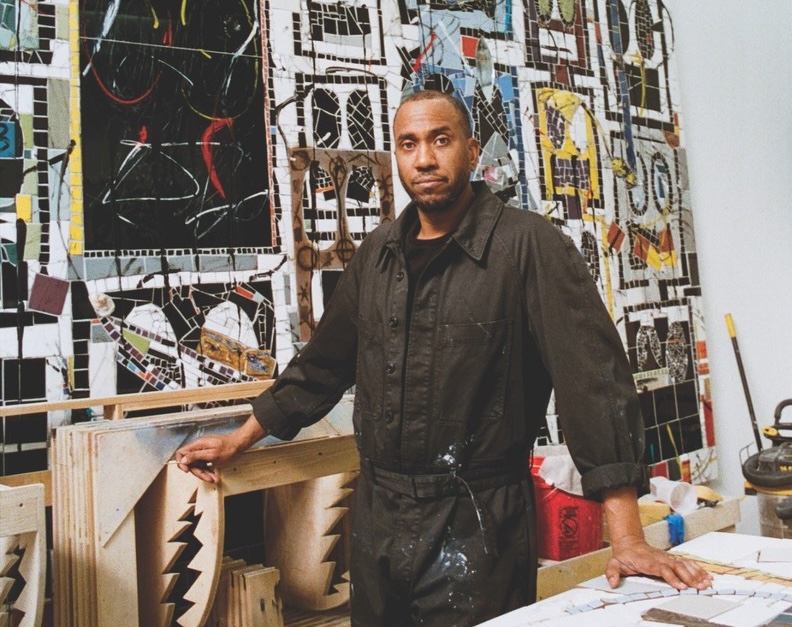
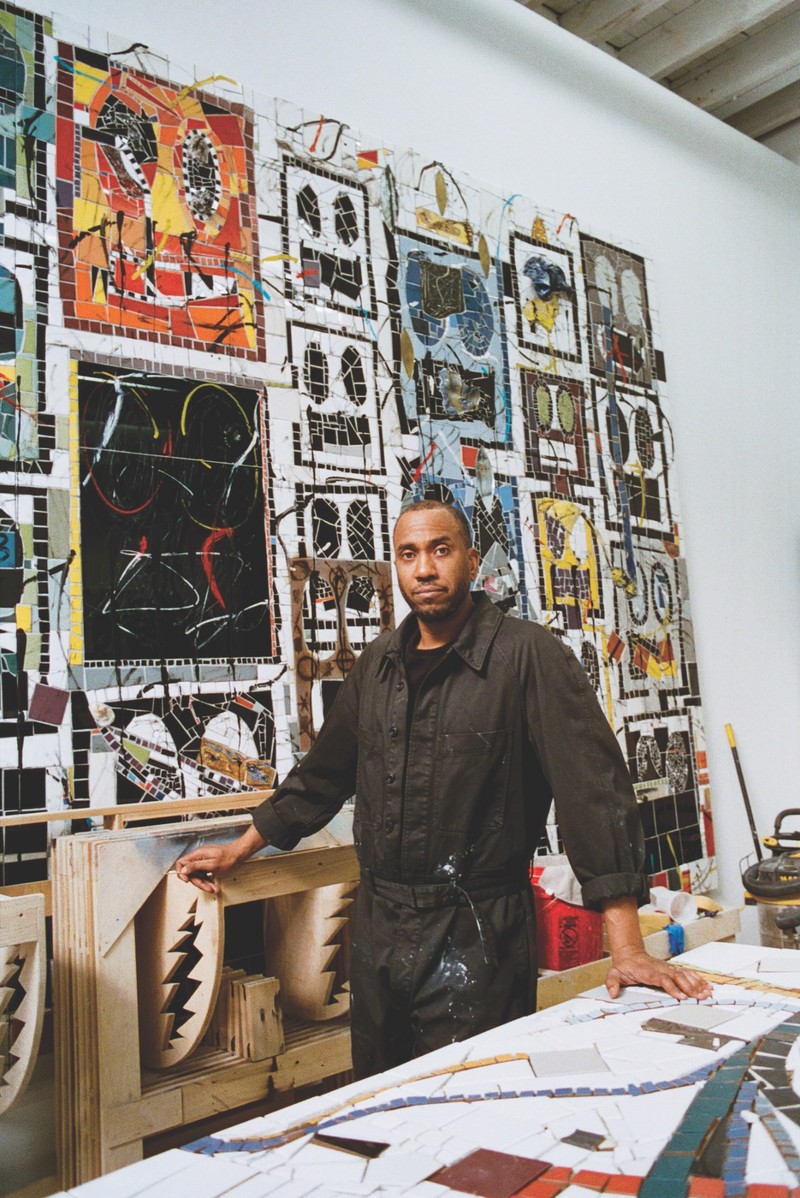
Rashid Johnson at his studio in Brooklyn, New York, 2024. Credit: Sabrina Santiago.
This interview is CGN's Fall 2026 cover interview. Purchase a copy or subscribe.
By SUSAN GESCHEIDLE
Chicago native Rashid Johnson brings his 30-year survey, A Poem for Deep Thinkers, home this November. Opening November 7, 2026, the exhibition at the Museum of Contemporary Art Chicago follows stops at New York’s Solomon R. Guggenheim Museum and the Modern Art Museum of Fort Worth.
Susan Gescheidle: You move fluidly between photography, painting, sculpture, and large-scale architecture. What is the underlying anchor connecting these mediums across this 30-year trajectory?
Rashid Johnson: That’s a big question. The lack of medium specificity in my project is born of curiosity and an ambition for problem-solving, but simultaneously recognizing that art is a horrible vehicle for that. Art is intended to allow space for exploration. It’s dynamic and unspecific. Shifting, exploring, and different outlets provide me opportunity. That’s why my work doesn’t fit easily into a simple diagnosis.
SG: The architecture of the MCA Chicago, the Guggenheim, and the Modern Art Museum of Fort Worth shapes visitor movement differently. How will this spatial shift affect your early Columbia College work compared to your massive current installations?
RJ: The MCA is a great facilitator for what happens in the later work. The Guggenheim is an interesting space because the lower parts of the rotunda are built for smaller works, which allowed my earlier Columbia College photography to shine. Contemporary spaces like Fort Worth and the MCA make you face different obstacles around smaller objects. They make you gather them, build structures and narratives, and sometimes use salons to occupy the space effectively. It presents different challenges, but also opportunities.
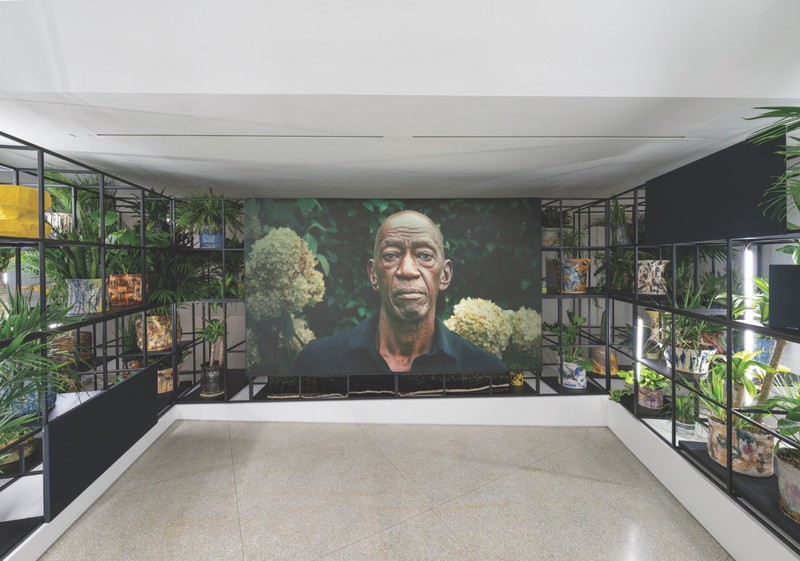
Rashid Johnson, Sanguine, 2025. Installation view: Rashid Johnson: A Poem for Deep Thinkers; April 18, 2025–January 18, 2026;
Solomon R. Guggenheim Museum, New York. Photograph by David Heald. © Solomon R. Guggenheim Foundation, New York. Courtesy of the artist.
SG: Materials like black soap, shea butter, books, and plants became central to your mid-career shift. Do these elements change in meaning over time, or do they serve as a growing vocabulary for new spaces?
RJ: I think a bit of both. Materials have a vocabulary unto themselves and a way they become legible to each individual viewer. Your relationship with plants, or whether materials are familiar or foreign, is going to dictate how you read my project.
For example, if you grew up with shea butter—applying it or seeing it sold on the streets—you may have a different sense of it than someone coming to it for the first time. The language belonging to the material continues to inform how an audience engages with it. I love that aspect; it’s quite rewarding.
The other opportunity is looking at the materials through my biography. You recognize them as foreign to you, but familiar to me, allowing you to read the work as both an insider and outsider. I’m excited by the way people translate the materials through their own experiences, but simultaneously imagine my relationship to them.
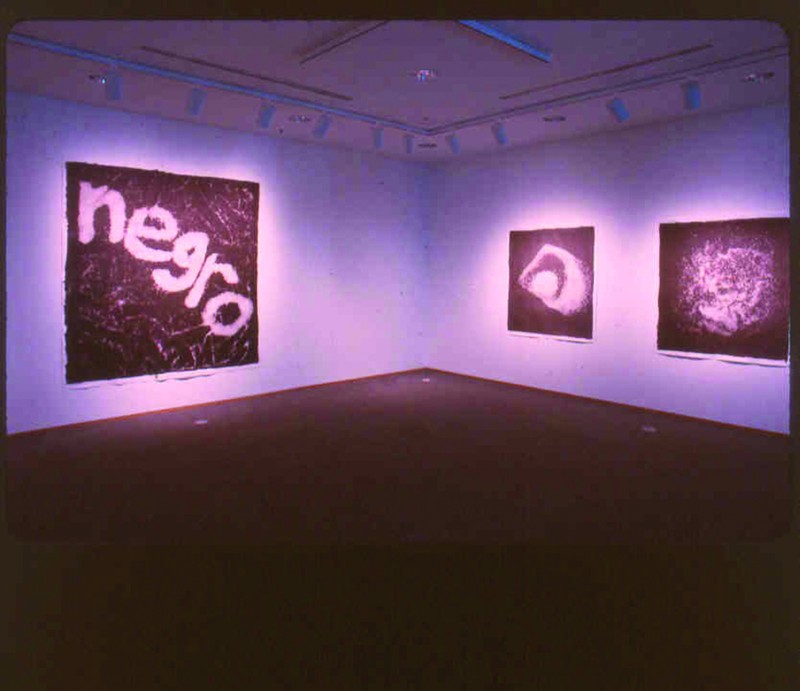
Installation view: Museum of Contemporary Art Chicago, ‘12x12: New Artist/New Work,’ 2002, Chicago, IL. Courtesy of the artist.
SG: How has your core group of early Chicago benefactors and collectors sustained your work over the last 30 years?
RJ: My early benefactors and collectors in Chicago played an enormous role in creating space for me to make work, and they continue to give me hope in how patronage can be an effective partnership. When I was leaving Chicago, I approached supporters Paul Gray, Evan Boris and Monique Meloche, Dan Berger, and others to ask for a loan to be paid off with future artwork in order to help me transition to New York. They facilitated that.
The patronage and enthusiasm for local artists is enormous in Chicago; it’s an important part of the city’s character. The way those early patrons imagined their relationship with me is the criterion I use to judge the quality of people who acquire my work today.
SG: What do you hope a new generation of collectors discovers in your art today?
RJ: I hope a new generation feels energized, entertained, and curious about how my project translates personal experience into illustrated objects, material investigations, and a way of imagining the world. I hope they use my practice as a launchpad to explore their own enthusiasm for art and feel open to the curious opportunities it provides.
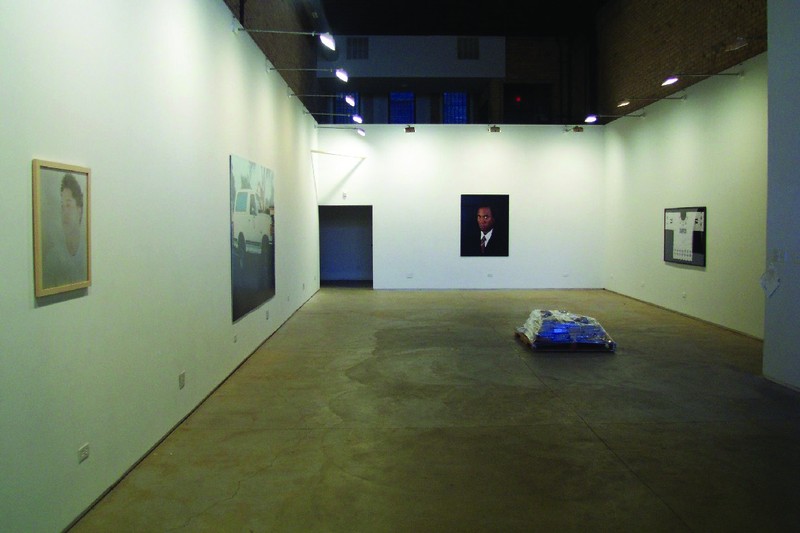
Installation view: Rashid Johnson: ‘The Rise and Fall of the Proper Negro,’ 2003, Chicago, IL. Courtesy of the artist and Monique Meloche Gallery.
SG: You and your former partner, fellow artist Sheree Hovsepian, launched the residency at Casa Gracia on Menorca with no required deliverables or exhibition. What kind of creatives are you hoping to attract to this pressure-free environment? And is this yet another way of giving back to the artistic community?
RJ: We’re hoping to attract good ones. We want people who share our enthusiasm for art, who contribute to discourse, and who are modern—the kinds of people who don’t avert their eyes and who understand the challenges of being a maker in a complicated world. We want thinkers and writers.
I’ve been so widely supported and nourished by a community of practitioners, collectors, and curators that I see this as an opportunity to pay it forward. I want to continue to provide opportunities—mirroring the ones I had, while having the ambition to provide the kinds of opportunities I wish I’d had.
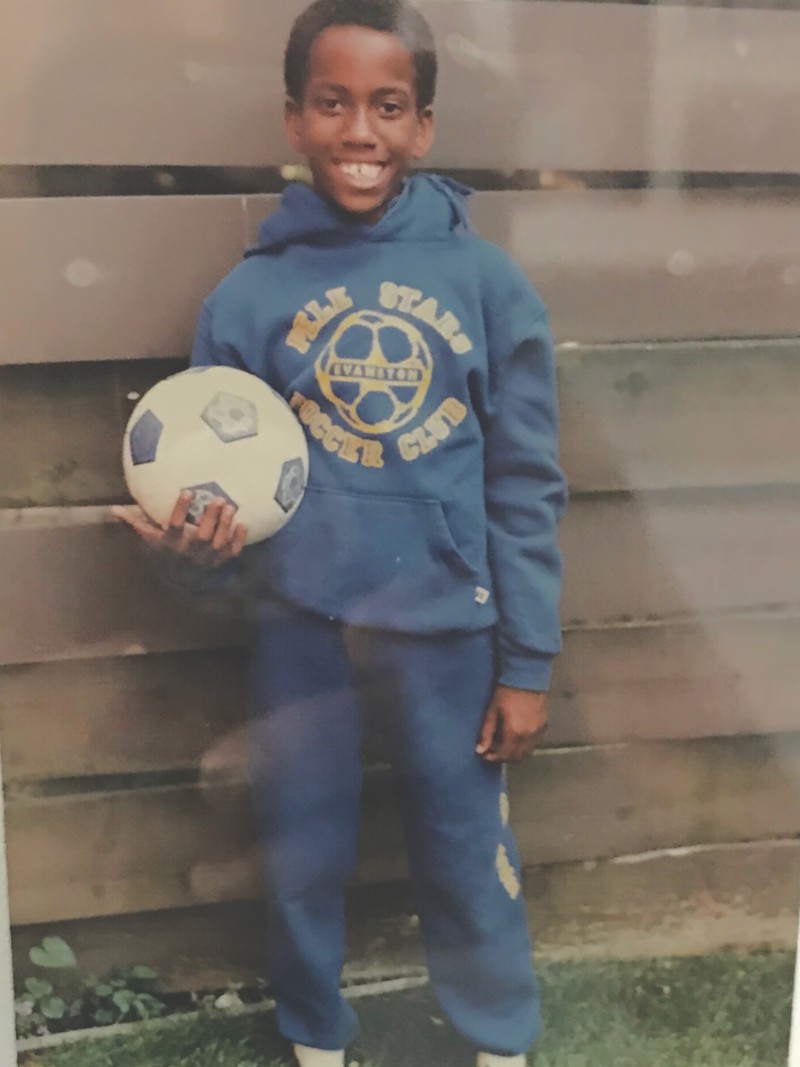
Rashid Johnson during his childhood in Chicago, IL. Courtesy of the artist.
SG: You are from Evanston and went to Evanston Township High School, just like my kids did. Raised by a mother who was an African history scholar in a home steeped in Du Bois and Baraka, how did that deep Afrocentric grounding and Evanston’s activist community shape your worldview?
RJ: It shaped it dramatically. Growing up as a child of academics in a family that prioritized critical engagement keeps that history at the forefront of my work. It drives my references and the questions my projects ask.
Evanston is a special town. Its diversity, complexity, and proximity to Chicago force you to ask deep questions. More recently, its push to be at the forefront of reparations aligns perfectly with the values I associate with the community—values like restorative justice and making wrongs right. Evanston shaped me in ways that were vital to my development, and I’m incredibly proud to be from there.
SG: Second part of that question, and most important: Do you still agree “It’s a great day to be a Wildkit”?
RJ: Every day is “a great day to be a Wildkit!” The high school was so important to my development and my understanding of the world, and so I’m still proud to be an Evanstonian.
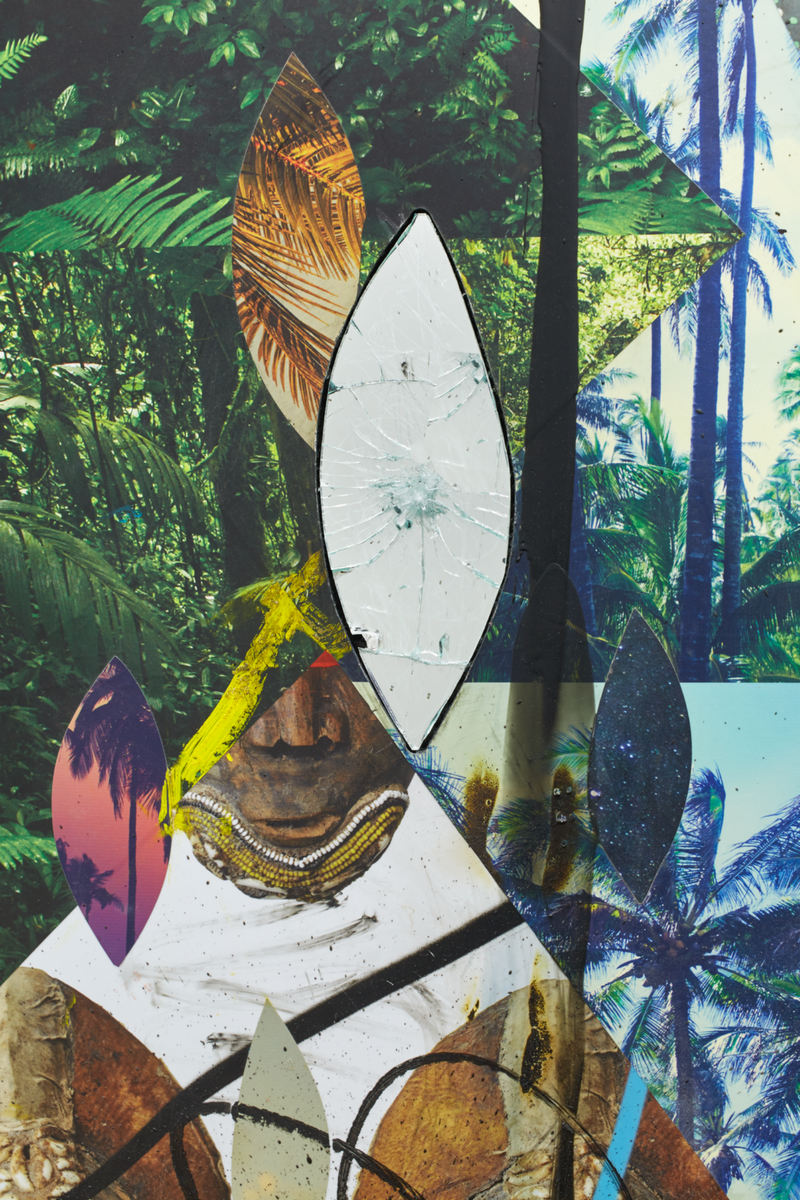
Rashid Johnson, Untitled Escape Collage, 2018 (detail). Ceramic tile, mirror tile, branded red oak flooring, vinyl, spray enamel, oil stick, black soap, wax, 97 × 121 × 2.25 in. (246.38 × 307.34 × 5.72 cm). Collection of Kathy and Mitchell Jacobson X.2025.88 © Rashid Johnson, 2025. Photo: Martin Parsekian
SG: You were only 23 when Thelma Golden curated your work into Freestyle at the Studio Museum in Harlem. You’ve been open about the anxiety that followed the sudden spotlight. What words of wisdom do you have for young artists experiencing a sudden breakout?
RJ: I was always dealing with some anxiety, but the spotlight gave me space to reflect. It’s something I’m proud of, happy to have experienced, and I’m even happier to have navigated things that, at a certain stage, I wasn’t even ready for.
What I would say is keep your eye on the prize. Don’t believe the hype. Continue to fight, work, and focus on the qualities of your project. Think about it as a long-term opportunity, not a short one.
SG: That Harlem breakout proved the power of institutional backing. Today, you aggressively champion younger artists to galleries and collectors. How did your own path shape your approach to mentoring the next generation?
RJ: I came up at a time when a number of important people developing their positions in the cultural landscape provided opportunities for me. They educated me through their words, teaching, and action—people like Thelma Golden. Watching how she navigated the landscape of contemporary art, I paid attention. I tried to be present, and wanted to be a vehicle. If you continue to prioritize what matters most to you as a practitioner, you’ll be served by it long term.
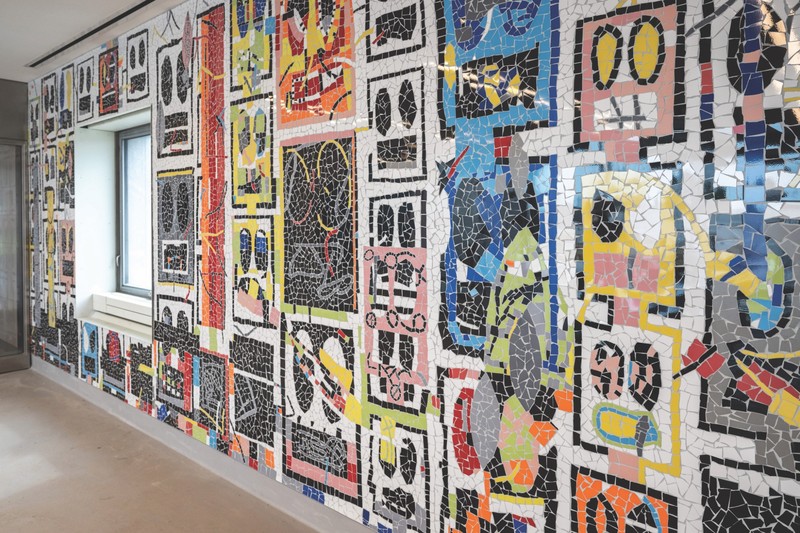
Rashid Johnson, ‘Broken Crowd “The President’s Audience,”’ 2026, at The Obama Presidential Center, Chicago, IL. Credit: The Obama Foundation.
SG: Your commission for the new Obama Presidential Center here in Chicago is a massive milestone. Tying your work to the civic legacy of the first Black president must be an incredible honor. Did you get a personal phone call from President Obama? What did this request for art mean to you emotionally?
RJ: I did not get a personal call from the president, but I know that he is aware of my work, and we’ve had several discussions in the past. I was also able to walk through my Guggenheim retrospective with the first lady, Michelle. They have shown themselves to be such incredible, thoughtful patrons in the way they relate to and platform artists.
So, I was extremely proud to be included, especially as a native son. Of the presidents I’ve witnessed, he is the most sincere, thoughtful, engaged, and sophisticated leader I can think of in my years paying attention to political life. I’m just proud to be part of something that I think has a lot of integrity.
SG: Your mosaic, Broken Crowd, lives inside the Center’s teaching kitchen rather than on a traditional museum wall. Since these commissions are site-specific, how did you choose this space, and what does a community hub add to the meaning of the artwork?
RJ: I love the utility of the space, and I love the idea that it’s going to be employed by people who live nearby and visitors who have the ambition to explore and learn. My project is so committed to intellectual and actionable curiosity.
The fact that my installation lives in a space that creates room for learning, exploration, and development—and even thinking of it colloquially, the idea of cooking, like how do you cook up something, how do you conjure something? For it to share space with those ideas is fundamentally in line with how my practice aspires to engage an audience. So, for me, that was the spot.
SG: Personal question here: You and your son, Julius, share a birthday, which inspired your artwork, Soul Painting “Birthday Boys.” He’s 15 now—does a 30-year museum survey buy you any “cool dad” currency with him?
RJ: Zero. He is the person least impressed with me that I’ve come across. I may be some people’s favorite artist, but I’m not even sure I’m his.
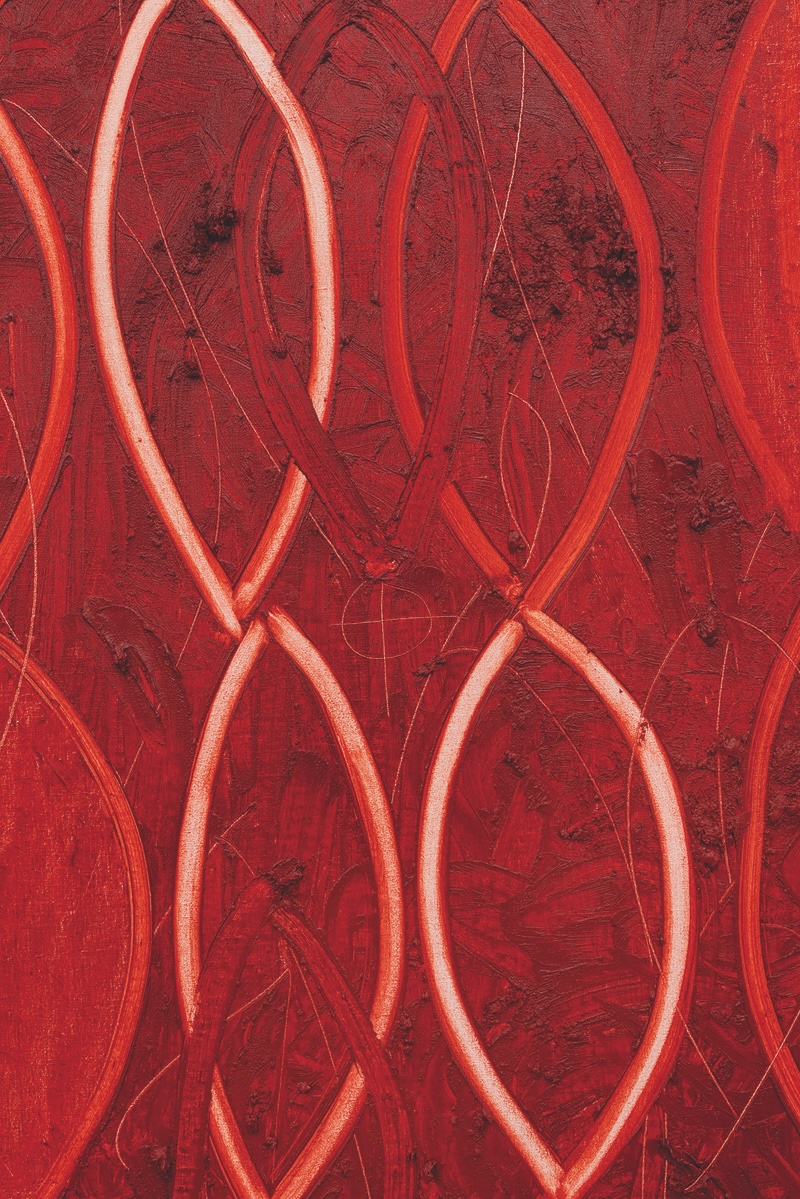
Rashid Johnson, God Painting “The Spirit”, 2025 (detail). Oil on linen. Private Collection. © Rashid Johnson, 2025. Courtesy of the artist and Hauser & Wirth. Photography by: Stephanie Powell
SG: Before we wrap up, if you could show your work anywhere in the world, where would it be and why?
RJ: If I could show my work anywhere in the world, it would be—real answer—the Museum of Contemporary Art Chicago. And I’ll tell you why. It’s the museum that opened its arms to me first. It’s the one that not only brought me in as a practitioner, but brought me in as a student and as a young person—giving me space to think about what art could be, introducing me to things that I now love that I wasn’t sure what they were, and giving my curiosity space and opportunity to be challenged, to explore, and to see things with different eyes.
On top of that, it continues to be such a special place. I’m a boy from Chicago, and it gives me an opportunity to welcome in people who followed my journey from start to finish. In the vein of Woody Allen’s film Deconstructing Harry, I get to see everybody. When I’m there and everybody gets to see me, that’s enough reward.
SG: Looking ahead, where do you see your practice evolving next?
RJ: As a practitioner who’s also a sober man, I try to take it one day at a time, so I don’t look too far ahead. If I knew where my practice was going, I’m probably going in the wrong direction. I’ll know more tomorrow, so you can ask me then.
#
Rashid Johnson: A Poem for Deep Thinkers
Museum of Contemporary Art Chicago
Saturday, Nov 07, 2026–Sunday, Apr 25, 2027