Artist to Artist: Spending Time With Francis Bacon’s Figure With Meat at the Art Institute
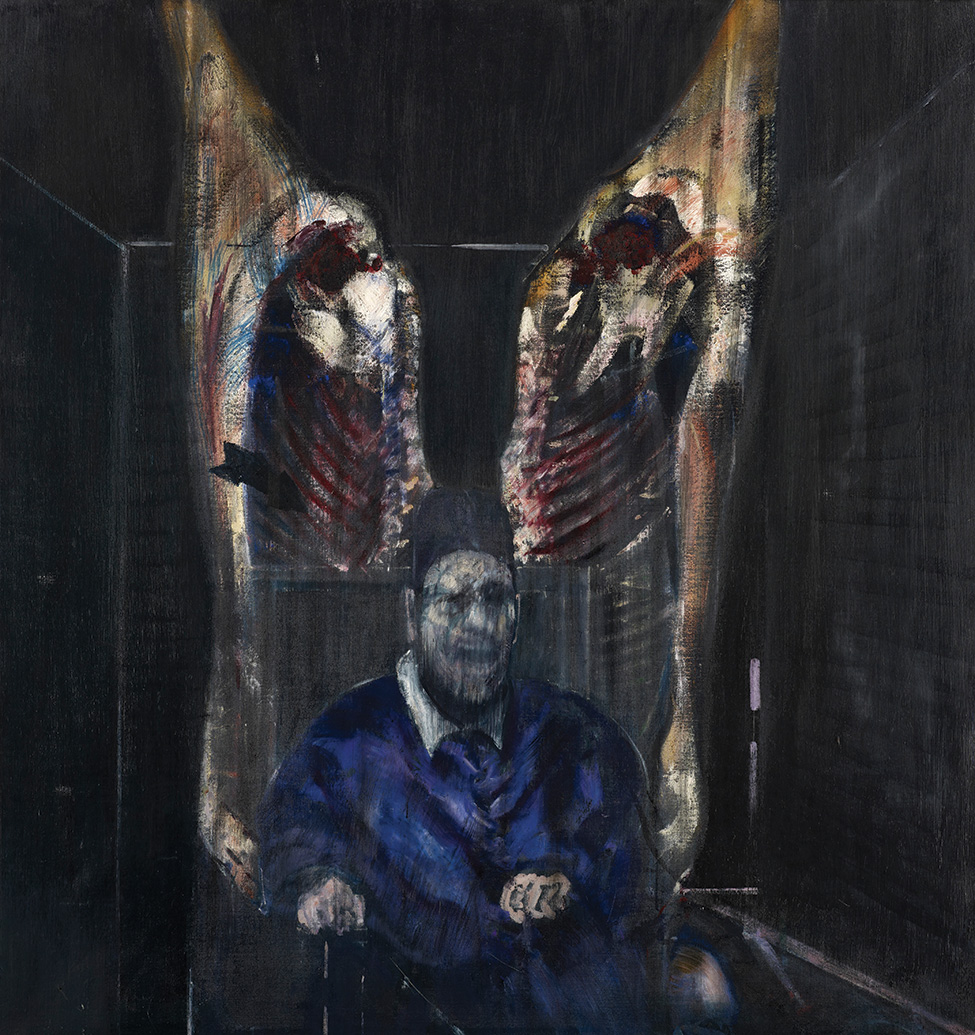
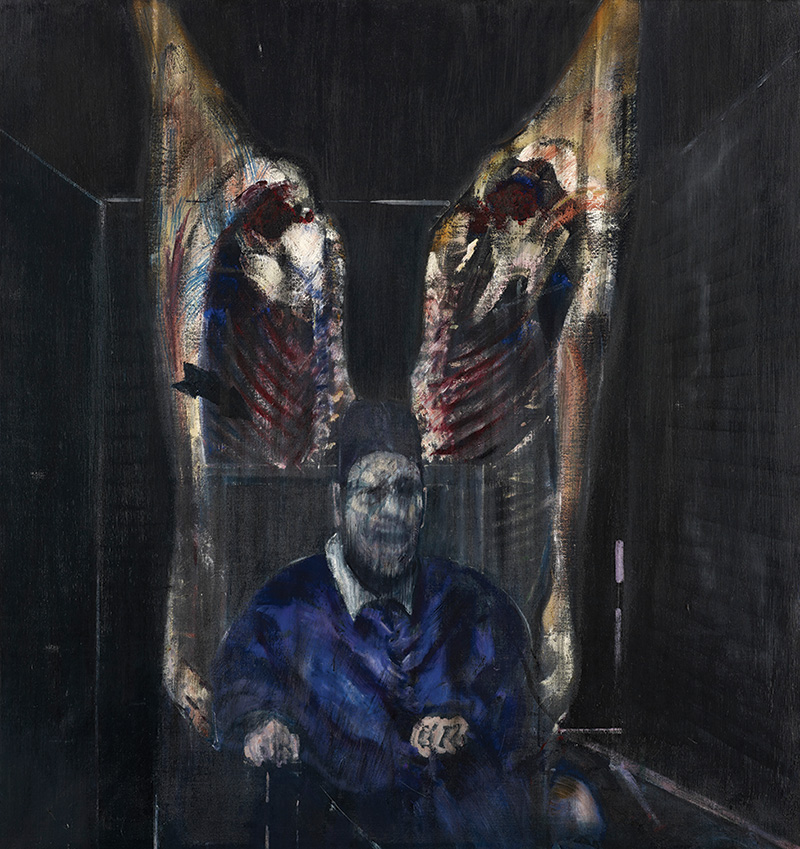
Francis Bacon, Figure with Meat, oil on canvas, 1954. Without frame: 129.9 × 121.9 cm (51 3/16 × 48 in.); 129.9 × 122 cm (51 1/8 × 48 in.) Harriott A. Fox Fund. © 2016 Estate of Francis Bacon. All rights reserved. / ARS, New York / DACS, London
By MAC PIERCE
In a version of Children of Men in which culture has consolidated and that which is valuable degrades, this is my Guernica. In this scenario my home has a few Richters, maybe a Goya from his Black Paintings, but Figure with Meat hangs alone in the living room. It is a vile painting that evokes dark truths, transfixing anyone that views it with its awful beauty.
The figure appears to sit alone in featureless room composed of black walls that engulf the central figure. To the right of the figure is a wall that does not end at the furthest plane at the end of the room, implying that there is an exit to this space, forever out of view. Standing in front of this painting, I got the sense that the room may have had another treatment. Instead, the walls had been painted over with black reinforced by the uneven treatment of the seams between floor and ceiling. It’s an intentional application, with brushstrokes working towards a vanishing point instead of a consistent unidirectional application. It is a space without place – a nowhere that could be any sort of dungeon / blacksite / void - with the only way out is forever inaccessible. You are stuck with the figure and that figure is screaming.
The face and hands of the pontiff that occupies the center of the frame are the color of dead flesh, grey with hints of colors that suggest other features. Its head is grotesque, a lopsided nose and lips drawn back over a slack mouth, one eye fully open but rendered as a pit and the other swollen closed like that of a boxer. It is not the face of a corpse laid gently to rest; violence has been enacted upon it. The rigor mortise of an image committed to dried paint set this pope so that it is locked looking at the viewer, all while it occupies the regal pose of a dignitary – seated in a ghostly throne with one arm crossing its lap. The robes of the pope are brighter than the figure, a deep unfaded blue unfitting the state of decay of the wearer. It’s discordant and to hazard a few guesses, could be gesturing at any number of things – the ways in which ideology and systems will outlive their creators, or simply how even the holiest of holies on earth – the voice of God on earth – will rot.
Which is why, shadowing the figure like a pair of wings, the hanging sides of a slaughtered animal drive home that there is no life in this frame. Whatever it was, it is another living thing that has had violence enacted upon it, eviscerated and bifurcated, freshly having crossed the boundary in which a corpse instead becomes meat. Through the suspended meat, Bacon also depicts the most vibrant flesh as that which is unquestionably dead. The space between the gristle of the ribs is the crimson of fresh blood. The skin on the exterior is warm, having not yet gone grey. Between which elements is a visible underpainted layer of cobalt blue – more vibrant beyond the indigo of the papal robes. It has a purity to it, depicting something recognizable in an otherwise ghostly composition while also imparting a value judgement – the meat is real, while the figure of ideology is rotten.
In the end though, this whole piece is allusion – even the most highly rendered object in the frame is blurred. Areas of the composition that may have been detailed appear to have had the broad side of a paint knife dragged over them while other aspects are constituted by blocks of color. The whole work has fuzzy edges of a dream (nightmare), if not for the graphic icon taking the form of an arrow pointing directly at the head of the seated pope. It’s another discordant addition, flexing the scene into something altogether different. The highlighting of an object through the use of a pointing arrow is the sort of addition usually reserved for didactic purposes, and within a composition as veiled in its intent as Figure with Meat, its meaning becomes further muddled. Is it a reference to the notation given to images attached to text ‘Figure A’? Or maybe it’s drawing from a heritage of forensic imagery – crime scene photographs where grisly details are called out with drawn arrows? Whatever the reason, it is pointed at the head of the pope, making sure the focus of the painting returns to the screaming face no matter where else on the painting the eye goes.
It’s a grotesque image, but refreshingly one that doesn’t hide behind any sort of pleasantries to try and make itself more appealing. So much of the modern culture of images exists in a state where images act simultaneously as expression and advertising. Social media companies have captured most of the vehicles by which photos are shared, and through their very structure preference images that do not challenge the viewer. Depictions of disturbing or otherwise off-putting content are downranked in algorithmic feeds and substituted with unchallenging content that appeals to users and advertisers. Viral images gain velocity precisely because thay can be understood at a glance. Figure with Meat actively resists this; its intentions are nebulous, if understandable at all. It is not an image that brings joy. Instead, it allows the viewer to be uncomfortable without shirking away – and it is all the better for it.
Francis Bacon’s Figure with Meat, is on view at the Art Institute of Chicago in the Modern Wing, Gallery 398 • artic.edu
#