Bad at Sports at 21: Before Everyone Had a Podcast, Chicago had This
This interview is part of CGN's Fall 2026 issue. Purchase a copy or subscribe.
By SUSAN GESCHEIDLE
Launched in 2005 by Duncan MacKenzie, Richard Holland, and Amanda Browder, the legendary art podcast Bad at Sports is turning 21. If you were around the scene back then, you remember this trio of brilliant, sharp, and irreverent creatives who added dynamic intellectual energy to the city’s art dialogue. I spoke with Duncan to revisit the podcast’s early days, trace its evolution, and understand its impact today.
Susan Gescheidle: Let’s go back to 2005. How did the idea for Bad at Sports come together, and who named it?
Duncan MacKenzie: Friendship and building lives around contemporary art is the real story of how Bad at Sports became a thing. The origin starts with Richard Holland, a marriage proposal, the Suburban, and a few drinks.
Richard and I became friends at the 2003 Stray Show. While drinking, I accidentally blurted out that I was going to ask my girlfriend to marry me—and immediately tried to take it back. He demanded a quarter, explaining that it meant I had him on retainer and, as a lawyer and an artist, he was legally obligated to keep quiet. Realizing we worked in the same building, we resolved to meet after work to discuss exhibitions.
While working on an exhibition at Michelle Grabner’s Suburban, we learned a handful of people were making “radio show-like” audio programs distributed as large MP3s. Of the 3,000 or so of these existing on Earth (per Adam Carolla’s early distribution numbers), none addressed contemporary art. It was a whimsical thing to do: make an audio program about things we are supposed to experience visually and bodily. It removed the most obvious thing in the content to address it through artistic intent, humor, philosophy, viewer reception, system status, and curatorial context. In doing it that way, the conversation becomes the thing, the artists become central, and the artwork bears fruit as a subject of contemplation, narrative, and experience.
As we walked to Richard’s attic to record Episode 4, we ran into Amanda Browder and “press-ganged” her into joining us. It was a massive moment of serendipity that crystallized Bad at Sports. A few weeks later, Brian Andrews formed the “San Francisco Bureau,” setting our format for the first several years.
The name is another story. In our first graduate seminar with legendary curator Mark Pascal, he asked SAIC’s first-year print grads why they were there. It was an obvious feint to disabuse us of our naivety, so nobody answered. I looked around theatrically and said, “I don’t know, Mark, maybe we are all just bad at sports?” It wasn’t the answer he was looking for, but five years later it was exactly the name Richard and I were looking for to set a tone—light, a little real, a lot confusing, and just repellent enough that folks would have to be interested to figure out what we were about. We wanted to embrace contemporary art pretension and skewer it (and ourselves) at the same time.
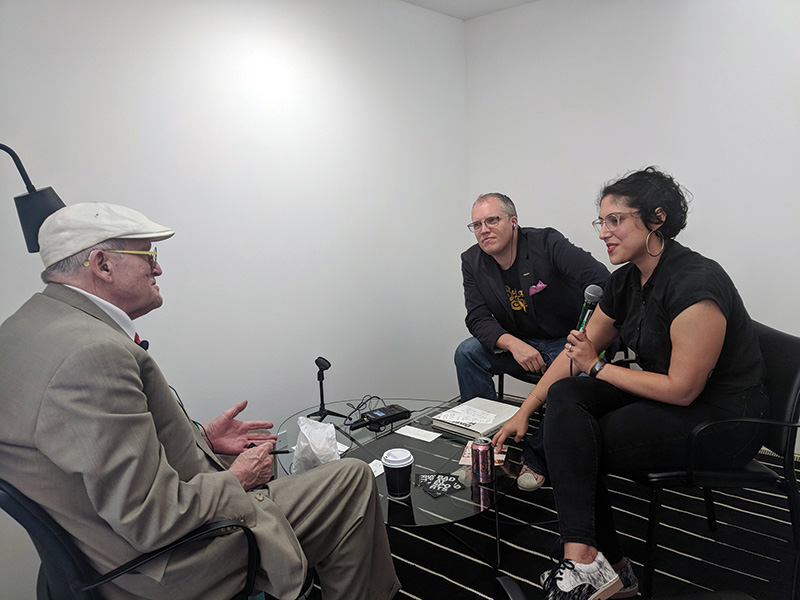
The one where Bad at Sports interviewed David Hockney.
SG: Whose brainchild was the audio format? Did you foresee a 21-year commitment?
DM: The impulse was twofold. Richard and I were trying to find something to listen to that would enrich our studio time. We came from practices requiring repetitive tasks, and we also wanted to document a scene getting less attention than it deserved. We had no idea what we were doing. There were no models. We borrowed from radio, bar and studio talk, magazines, and graduate seminars…but really, it was an adventure. We still lack infrastructure because we have never been planning a future; we have just been trying to do “a now”. So many projects get hung up on the things that can make the “work” work for them and forget that the “work” is the thing that must work before it can work for you. We approached the thing we make like an artist approaches their studio: we started and kept letting the project lead us.
SG: Was the goal simply to review gallery shows or to capture the art world’s wider, raw conversations?
DM: When Amanda joined the show we figured it out. We thought we would pull an artist in to talk “smack” about what we had seen that weekend. But we had so much fun with Amanda that we started to see how we could engage the whole art world through the concerns of individual artists. It allowed us to constantly learn and grow while tracing the curves of the art world’s discourse. It completely reshaped our original notion. Brian and the SF crew expanded it to partnering with organizations like Art Practical.
SG: Where did that very first episode take place? Was it with Chris Cook, curator from the Sioux City Art Center?
DM: Yes. We did it a couple of days before it dropped, on what felt like the hottest day ever, in the hottest attic. Chris Cook was an outstanding guest, but it was hot, beer was involved, and I kept trying to bait him into arguments about modern art. We recorded for 90 minutes, and the episode was cut to something like 35. Richard claims he only cut my hectoring and pointed jokes about minimalism. Chris was a good sport—he is now the ED at the Bemis Center—but he is reluctant to get back on mic.
The second episode needs to be reissued. It is an interview with Chris Sperandio about a pilot show he made for Fox. They were unhappy that it had not gone through their lawyers first. I think we should put it out as a limited-release vinyl record.
SG: Was the project easier to manage when it was a small core group, or do you prefer this mesh, “well-oiled machine”?
DM: That is funny to think about. It always feels like being in a band—but one where you never really know who will show up for practice… or the gig. We only meant to have an independent voice in the art world and be beholden to the artwork itself. That has sometimes been a blessing and sometimes a curse.
I think everyone who has ever worked with us has been mad at everyone else who has ever worked with us; but like any good band, we are just as much family as friends. We are always there to pick up the phone for one another, and the ethic of the project is about showing up and contributing. Everyone connected is still welcome where we are. No one would call us a “well-oiled machine,” but we are a bunch of folks who are serious and care about what we do.
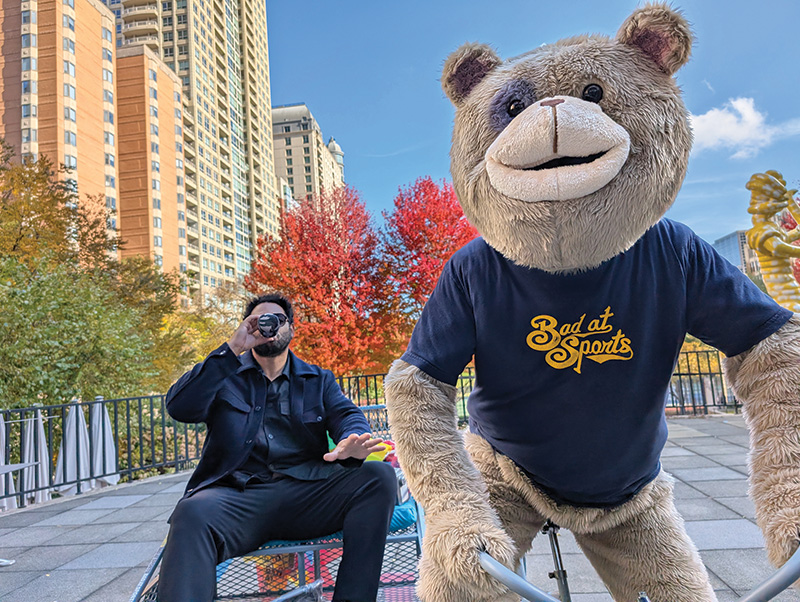
Tony Lewis and Baddie on the Terrace of the MCA during a recording session in 2025.
SG: In 2006, you added Christopher Hudgens for the website and Mark Staff-Brandl for a footprint in Europe. Did that expansion happen naturally?
DM: Like natural growth, we didn’t know how to control or dictate it; we learned along the way. Christopher Hudgens has been an incredible bedrock for the website. Mark joined us for a while because he loved what we were doing and wanted to contribute. Because of what Brian was doing in SF, what Amanda did in NYC, and the work of a few others, we actively tried to court a network model where we could share a different kind of art world than you get in Artforum or Frieze. In lots of ways, it worked amazingly for many years, but the core was always Chicago and the Midwest.
SG: Looking at the local ecosystem—the galleries, art schools, fairs, non-profit and public spaces, curators, and critics—what has gotten better, what has gotten worse, and what is completely different?
DM: This could be a whole interview, but there is a catch-22 here. Everything that has gotten better has also changed or taken away something great. The best thing is that we have more access to art than we could have imagined in 2005. The downside is that there is so much of it, and it is often overwhelming and underfunded. In 2005, we had a broken but stable model of the art “business.” In 2026, we have a lot of legacy models that need to be reassessed, but we are all afraid the sky is falling, so we stick with what we know.
We need to rethink the value arguments contemporary art makes to its audience. For me, it is always the same: this is a space of experimental culture. A safe space to ask questions, take unpopular stands, and “fuck around and find out.” It’s the space in which we expose ourselves to the unknown and the unknown exposes itself to us. It shouldn’t be—but can’t help but be—a place where we build ourselves as idea brands that “co-lab” with institutions to cross-expose our audiences. What artists do for humans is too important for that.
SG: What does Chicago’s art scene do exceptionally well that outsiders—especially in New York, LA, and global art hubs—still don’t understand?
DM: I always think that this is a byproduct of Chicago-based collectors wanting their NYC friends to recognize and admire their newly acquired works without having to justify their tastes. In general, I think we do a decent job of supporting our scene, but I would love to see us have the confidence that LA does and just say, “What NYC doesn’t know won’t hurt them.” We incubate and train the country’s best talent; we need to give them more to stay for than part-time teaching jobs and an incredible scene. Sales would help.
SG: Has your episode length changed over the years to keep up with how people consume digital media today?
DM: We always try to keep it to about an hour, but that is totally flexible. If the conversation is going somewhere, I never want it to stop, but you also want to be conscious of the audience. That said, it seems almost impossible to do what we did 21 years ago. The social media requirements, the need for constant engagement, video, editing—it would have been too much to wrangle at one time.
SG: Did you ever anticipate that Bad at Sports would step in front of the camera?
DM: We never mean to. There is something magical about a voice going out and finding someone. I don’t know that we need a face; the works we talk about are the face. We are “Muppets” that exist to get ideas out. Plus, I have learned that if you make a mean joke, criticize someone’s artwork, or get something wrong, those folks’ friends never forget. Artists themselves are fairly forgiving.
SG: In 2007, you dedicated Episode 79 to the West Loop—including the Chris Verene show at my gallery, gescheidle. The show notes explicitly tease you for repeatedly butchering his name on air.
DM: Yes, and I am sorry. I remember and feel shame for every single incorrect moment of the last 21 years. I am fortunate to live in a community that has been accepting of my—and our—quirks. It has been a delight. Hopefully, we made some friends and some enemies. Either way, we loved you and all of it.
SG: You’ve evolved from irreverent commentators into trusted mainstays. How has that journey shifted your approach to honesty?
DM: In the early days, we got a lot of hate mail. Our value then was honesty: we weren’t in anyone’s pocket, and we said what we meant. It didn’t mean we weren’t wrong sometimes, but we were giving a raw and real reaction. It was quite different from writing reviews.
When reviewing, you sit with the work, balance internal and external concerns, measure the venue, consider the gallery’s reputation, consult other writers, and look at precedents. But when you are in the space, you react to a work like it is another creature. You react viscerally, bringing reason and experience to the object to vibe-check it. It is messy but honest, and a product of direct engagement. I think that is rare, and the audience and artists understood. That said, a number of partners and friends threatened us with bodily violence—but it is art, so that seemed bonkers. To date, only two of us have been punched over reviews.
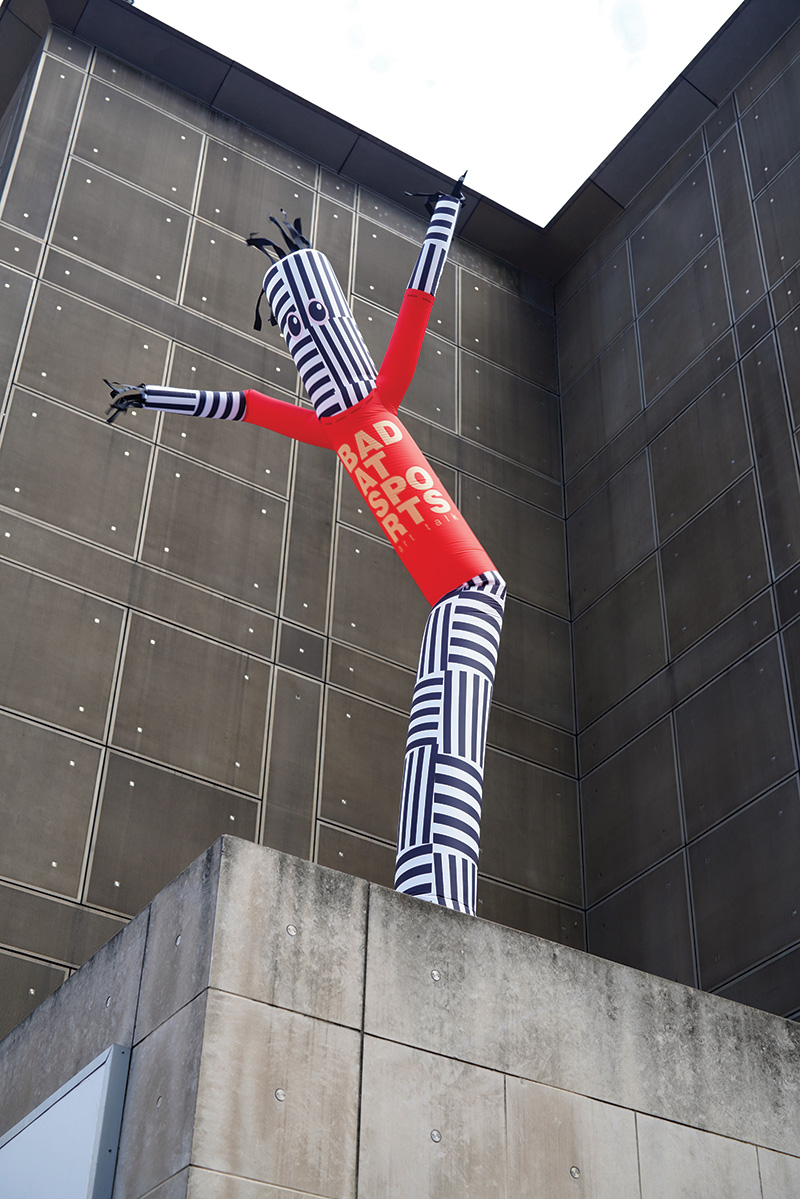
BAS atop the MCA
SG: If you were forced to pick just one single episode as the most important or culturally significant conversation you’ve ever hosted, what would it be?
DM: Interesting question, and hard to answer. The interviews with Tony Fitzpatrick were important because we got a slightly different Tony than we got most of the time. Our interview with Kerry James Marshall was also important and incredibly revealing. Actually, everything in the first five years is amazing because no one was savvy enough to know what we were doing, so we got more honesty. I remember chatting with people from NYC where it felt like an hour-long pitch. A great interview is a conversation that is hard to leave, and that is what we chase now.
SG: Where is the most unique, bizarre, or flat-out fun space you have ever recorded an episode?
DM: We did a series with apexart in NYC where we would do interviews in destabilizing or transitory places. Amanda did one between two stalls in a decommissioned NYC school bathroom. I flew an artist to Chicago, met him for two hours of beer pong, and sent him back to the airport. His experience of Chicago was two taxis and one room. They were bizarre and fun. For VOLTA NY, we installed a bed and did 24 interviews over three days, John-and-Yoko style. Mat Gleason was super fun.
SG: What is the most unexpected geographic location where someone is downloading the podcast?
DM: I maintain a strict rule against checking metrics. We want the work to be the thing. That said, it has been fascinating to see the global reach of the show and just how many folks have spent time with us over the last 21 years.
SG: What platforms do you personally turn to?
DM: Obviously, Chicago Gallery News. But The Visualist is a longtime collaborator and an invaluable artist-run resource. I completely trust Mike and Meg to point us all toward an interesting future.
I am hopeful about the impact Gertie will have, or Mottley as an art-first PR firm.
One of the things I hope for with the next generation is that they see ways to help existing projects—and, where there is not a thing, that they go ahead and make the thing that should be there.
SG: How did your relationship with Ed Marszewski and Lumpen Radio come about?
DM: Ed is a fellow traveler. We grew up in this art scene together, alongside Andrew Rafacz, Western Exhibitions, threewalls, Roots & Culture, a generation of artists, and a score of projects no longer with us. Ed and BAS have been vital parts of this artist-run community, and we remain deeply connected and supportive of one another.
More directly, when Ed started WLPN, we had coffee and he explained that he was opening a radio station for us. Then Logan said if we did it live, there was no expectation to edit. We will do anything Ed asks because he is one of us, and he has never let us down.
SG: Keeping an arts project alive for 21 years is a miracle. How is the podcast funded, and has an angel donor ever dropped a massive bag of cash?
DM: We are super open to an angel donor. We have lofty ideas for Season Two. Season One was held together with duct tape, goodwill, and glue. You can find our merch at badatsports.threadless.com
SG: Did King LeBron actually fund the podcast, or is this just elite clickbait?
DM: We are attempting to preserve the anonymity of our donors. I am horrified to hear that this has leaked.
SG: Have you ever had to issue a genuine apology to someone for an episode that went too far or was just plain mean?
DM: I like to think we are never mean and that, when we punch, we punch up. That said, in retrospect, “up” is a matter of perspective, and maybe it wasn’t what we thought it was. We were a little hard on Sterling Ruby and Rashid Johnson. I remember apologizing to Rashid in a Miami bar one night. He got it. Sterling, on the other hand, went out of his way to upset one of us and be dramatically uncool about it. It was disappointing, given his compound in LA.
SG: What’s the next milestone?
DM: I can’t speak for everyone—maybe for our current team: Ryan Peter Miller, Brian Andrews, and permanent guest host Jesse Malmed—but I love it. This has been one of the greatest trips ever.
SG: Richard Holland traded BAS for real estate, and Amanda Browder has an art practice and studio in Brooklyn. Do you three still stay in touch?
DM: Richard is my real estate agent and neighbor. Amanda exploded out of Bad at Sports and has gone on to fortune and glory through building-sized installations and spectacularly colorful artworks. We all hang out every time we can track her down, and Richard and I get together whenever time allows. I am sure both will be present on October 3 at the MCA when we record the last six episodes of Season One. Episodes 999, 998, 997, 996, 995, 994… Not that I am counting. I fucking love Chicago. There is no better art city—or city city—in North America. I can’t imagine anyone wanting to be anywhere but here.
#