Falling In Love: How Collector Kate Neisser Discovers Art
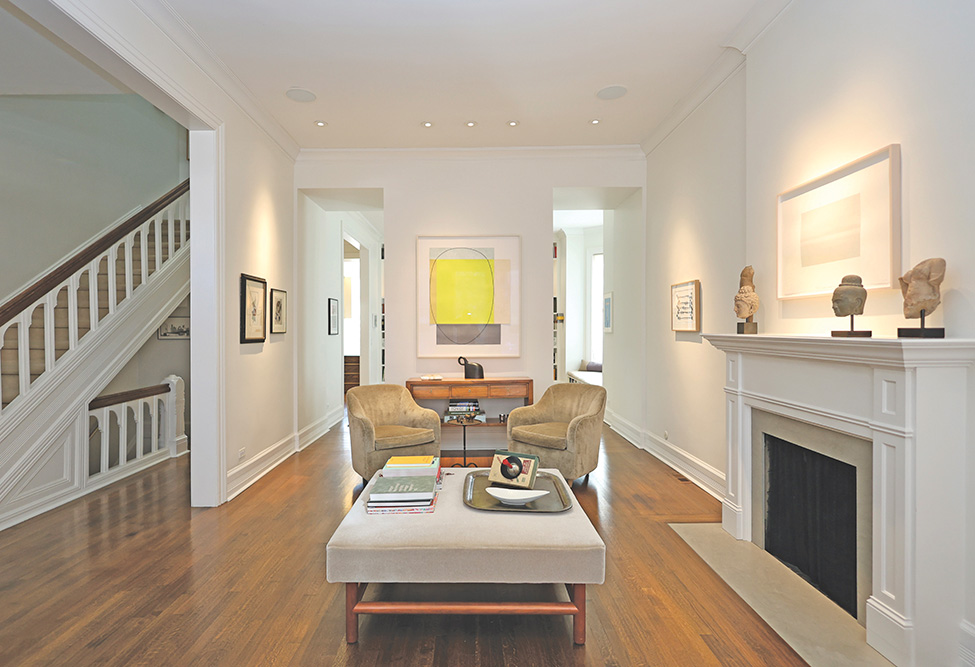
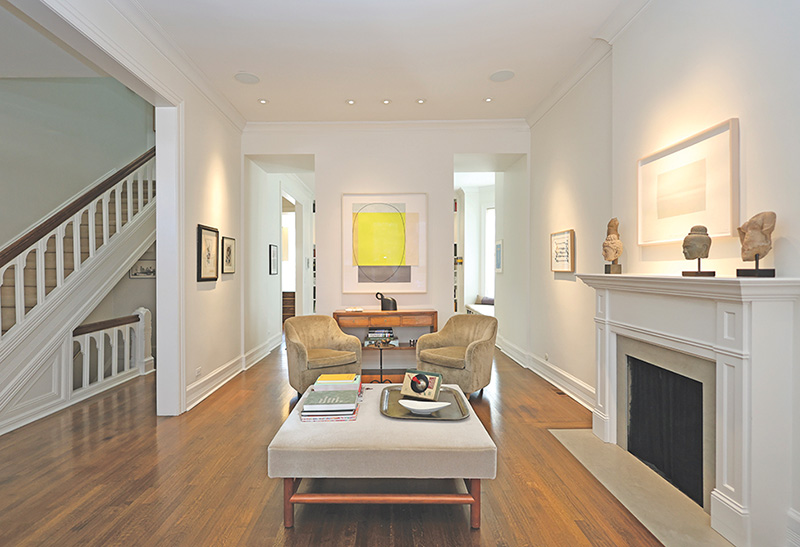
Neisser’s minimalist living room in her 19th Century home. All photos by CGN.
This feature appears in CGN's spring/summer 2026 issue. To purchase a copy or subscribe click here.
By GINNY VAN ALYEA
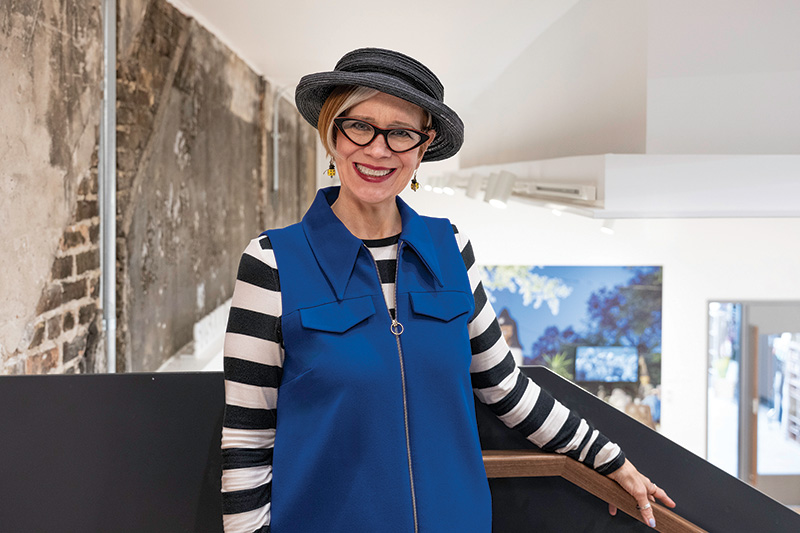
Some art collections live in grand, purpose-built spaces. Others come together more organically over time, shaped by travel, taste, and different chapters of life. One I had the chance to see this winter fills the walls and shelves of Kate Neisser’s sunny, 19th Century, Lincoln Park row house, reflecting a personal and generational affection for living with art in the city of Chicago.
Most collections I visit offer a window into someone’s passions and personality. Occasionally, though, they can feel more assembled than lived with — technically sound but missing a certain ease. Neisser’s collection feels as relaxed and welcoming as she is. The art doesn’t feel staged. It feels at home.
Following is our conversation, edited for clarity.
*
CGN: Are you from Chicago?
Kate Neisser: I’ve lived elsewhere, but I’m very much of Chicago having grown up about a block away from here in a similar house.
CGN: When you saw this house, what did you think?
KN: I fell in love with it immediately, it simply felt like home. It’s neither too big, nor too small—it’s just right.
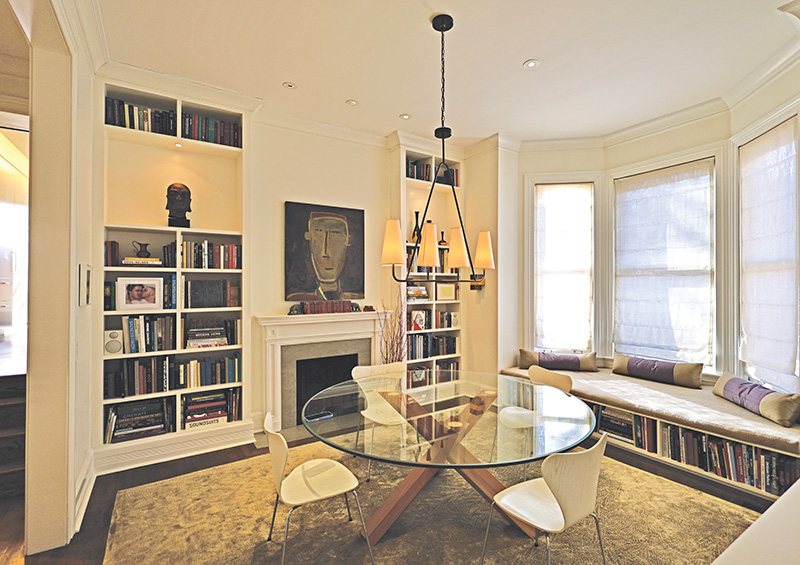
A view of Neisser’s dining room.
Above the fireplace is a painting by Canadian artist James Brown. On the wall to the right of bookcase, sculpture by Richard Nonas.
CGN: Today it’s quite modern inside, with some original details. Did you do any renovations?
KN: Before we moved in 1999, we made adjustments that aligned with our taste and way of living. For instance, we customized a long kitchen banquet with drawers beneath for toys and built book shelves in the dining room. What better dinner partners than the characters populating books and the authors who created them?
CGN: When you updated the house, was it with art in mind?
KN: Definitely. We removed the picture moldings because they can distract from art hanging within their confines, and we also changed out the lighting so it wasn’t so much decorative as it was conducive to enhancing work. Art is always in the back of my mind, if not at the forefront.
CGN: You grew up around art—and you’re from a collecting family.
KN: We should start with the fact that I was named after my grandmother’s closest friend curator Katharine Kuh. And some of my earliest memories are of the original MCA store where my mother was the first book buyer. xI’d spend school holidays miscalculating the change from transactions at the cash register or coloring at a desk in the cave-like office. To this day I’m not sure it didn’t have a dirt floor. That’s a question for store founders Rhona Hoffman, Dorie Sternberg and Helyn Goldenberg. I actually remember Helyn telling me that one of my drawings looked like a Dubuffet. Imagine the impression that leaves on an eight-year-old.
CGN: Did you wonder who Dubuffet was?
KN: If memory serves, Helyn showed me a picture of the artist’s work. From then on, every time I see a Dubuffet, I think of Helyn. In fact, to me, art is as much about the work as it is about the people who’ve taught me how to see and appreciate it.
CGN: How else do you think your parents influenced your interest in art and eventually collecting?
KN: My parents derived a great deal of joy from collecting and learning together. They also set a terrific example for me in terms of building relationships with people who are on the same art journey.
CGN: Did they get started together or separately?
KN: Before he met my mother, my father collected antique maps from Asia and Japanese block prints many of which hang in this house. My mother always had an amazing eye. Together, they explored the Chicago art scene and developed a collection.
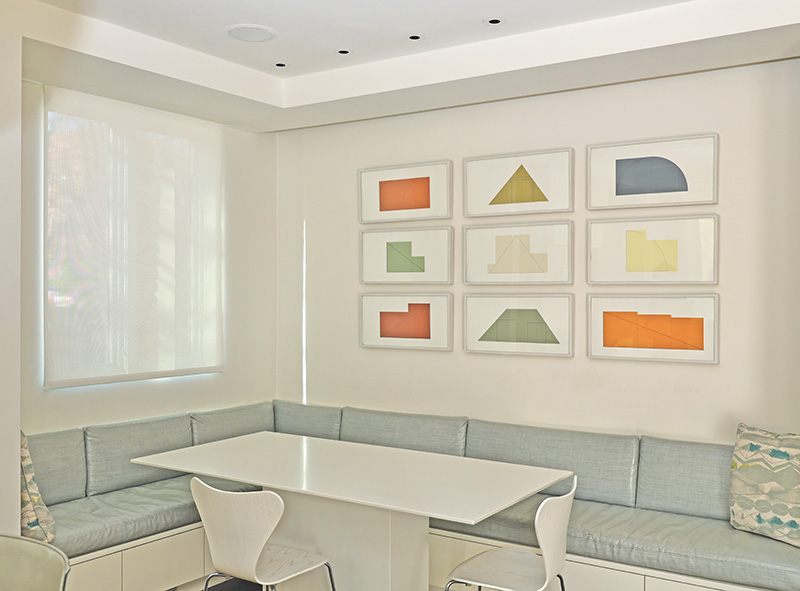
Works by Robert Mangold installed in Neisser’s kitchen.
CGN: When did your interest become more focused?
KN: While I collect contemporary art, there isn’t a rigid focus. I have a profound appreciation for art of all types though my collecting was oriented by living with the art in my childhood home and then later my mother’s stunning collection of minimalist work. I like what I like because it touches me.
CGN: So you’re not trying to fill in some to-dos.
KN: No to-dos. None.
CGN: You’ve mentioned that sometimes when you encounter a work of art you feel, “I really have to have this.”
KN: Yes. Falling in love is probably the factor that contributes most to an acquisition. When I fall in love with something, that’s it. I’m a relatively restrained person, so when I have that feeling — that’s the one— I go with it.
CGN: Does that happen often?
KN: It’s more frequent than a lightning strike but certainly not hard to keep up with.
When I pass on a potential purchase, I’m gratified knowing it’s out there and that other people are deriving pleasure from it. I think art should be shared.
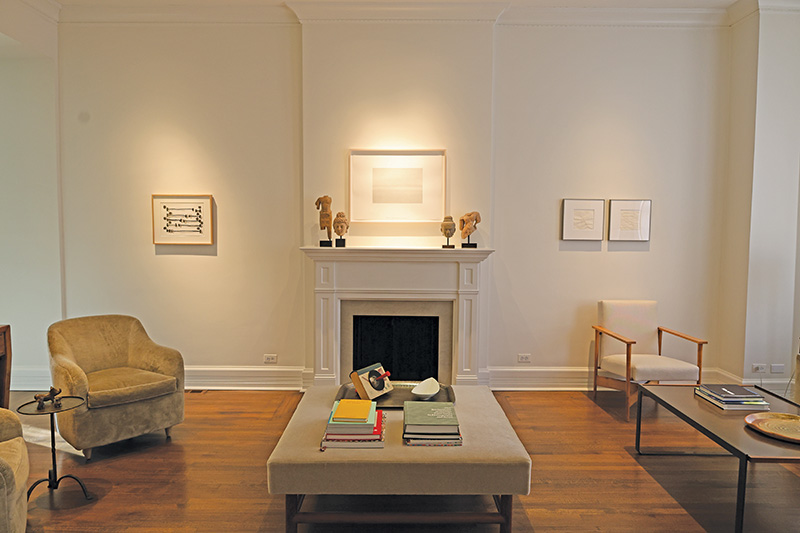
Another living room view.
*
CGN: You support many organizations and institutions in Chicago, including the Art Institute of Chicago, and the Design Museum of Chicago. It sounds like your parents made friends by supporting art and artists and that you have too.
KN: Through my involvement, I’ve met some of my favorite people who were with me at an art fair or gallery when I made a purchase. The art you see here is about those relationships, too. And I’m always happy to support young artists and young people. Both of my kids are professional musicians and this house is still full of their friends who, passing through town, keep me open, interested and fueled.
CGN: How much time do you spend outside of Chicago?
KN: I spend the summer and winter in Aspen, so I’m here six months out of the year.
CGN: Are you involved in the art community in Aspen?
KN: In Aspen I’m more of an outdoor dog. Though I periodically stop by the galleries or the museum, I’m generally on skis, a bike or hiking.
Beyond that, I travel. I went to Japan last May, which blew my mind and then met my kids in London in July. I love going to museums and galleries with them. It’s amazing to see what they’re drawn to, what they notice, and what they respond to.
CGN: Being from Chicago and connected to the arts for your whole life, how do you see the arc of the contemporary scene here right now, especially considering a new generation of galleries, some transitions from the old guard, and new ways of doing things?
KN: It’s a thrill to be in Chicago. There’s art literally coming out of the walls in nearly every neighborhood with buildings punctuated with murals and parks dotted by public art. In terms of the gallery scene, it’s evolving at an accelerated pace with multiple transitions.
And with those transitions, there’s also the loss of great galleries like Rhona Hoffman. I feel like I grew up there. I dated Rhona’s son, and I worked for her one summer. There will never be another Rhona. We’re in a different time. And I love the idea of younger people trying their hand and seeing what sticks.
It’s also a completely different period because there’s so much online consumption. The hooks are going to have to be different for a gallery to have longevity.
CGN: There have been conversations for years about the Chicago collecting community and whether galleries can rely on the local collector base.
KN: Yes, but I think there’s a lot to be said about Chicago as a community. To me, the galleries that will enjoy the most success will be those that serve as community centers—places that feel open, where people can engage in discourse. Not only for collectors, but for visual artists, musicians, writers, and designers.
*
CGN: Can you talk a little bit about the Design Museum of Chicago and your relationship to it, since it’s a newer museum here?
KN: DMoC isn’t just a design museum as in, ‘I love your Arne Jacobsen chair.” It’s also about elevating design born and bred in Chicago. It can be house music, an urban garden in Garfield Park or something in Ukrainian Village. The Design Museum is about makers and communities, and how that affects the design ecosystem in Chicago — graphic design, typography, beer — you name it.
And it not only features “good” design, but it also examines “bad” design in order to consider what invites people in? What pushes people out?
*
CGN: You’re drawn to conceptual pieces and minimalist works. What draws you to that aesthetic?
KN: I’m fascinated by how a simple angle or curve can evoke a feeling and create depth in space. There’s something tender and oddly human to me about minimalism.
CGN: Tell me about these [geometric] pieces in your kitchen?
KN: These are a set of works by Robert Mangold, whom I love. They’re at once architectural and extremely human with each one feeling a little bit “off.”
CGN: It almost recalls a family portrait—there are nine single works, but they’re all related.
KN: They are all related, and each is perfect in its own peculiarity.
CGN: Were you able to choose the installation?
KN: I did. It was so long ago that I’m not sure what made me do it that way. Maybe the color, maybe the shapes. You could spend forever rearranging them. But I chose the placement of everything in this house. It has to do with intuition and what feels aligned with something I feel. These particular works have been here for 12 years now. I see them so much that sometimes they’re just part of the wall, part of the woodwork.
CGN: Do you move things around or reinstall works?
KN: Well, there’s a Rodney Graham in our house in Aspen—an upside-down tree. Last winter I’d been in the house for about a week and one of my kids called at 11:00 pm to ask if it was still there. I said, “Of course, I would have noticed if it weren’t.”
He said, “No, I really don’t think it’s there.”
I didn’t want to get up, but I went to the kitchen and discovered that he and his friend had turned it right-side-up from its intended inversion. He and I laughed until we cried.
So sometimes you live with something for so long, you know it’s there—it feels right knowing it’s there. But you don’t always notice it in the way you think you do.
CGN: Once you realized it was actually upside down, did you turn it back?
KN: I certainly did!
*
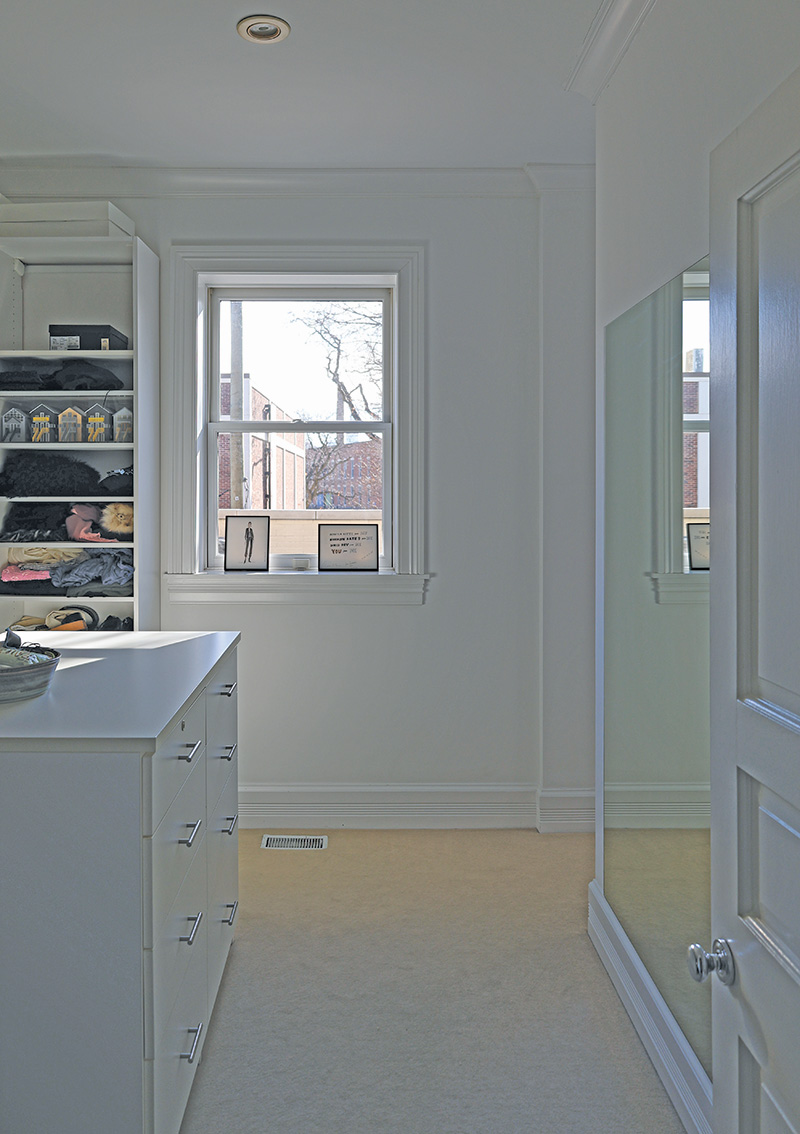
Works are tucked into private spaces as well as public in Neisser's home.
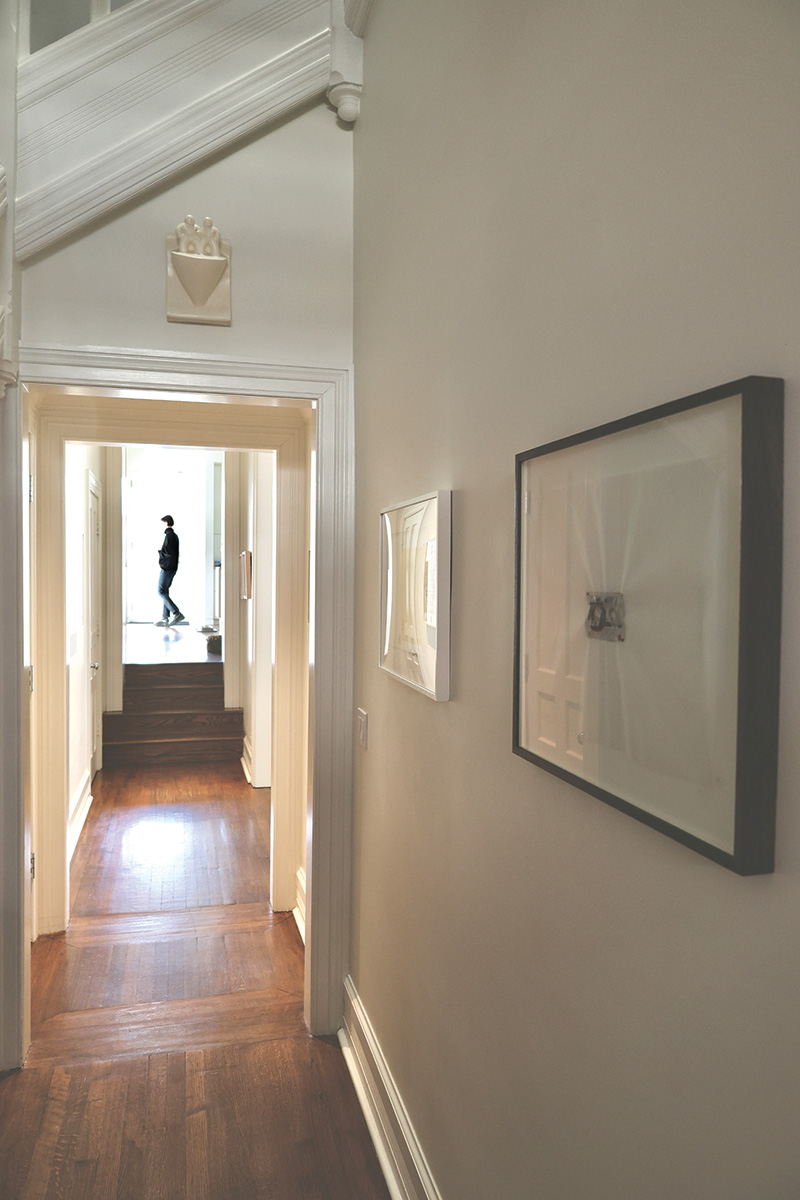
Neisser led me on a tour of her home, sharing details about small sculptures tucked among books, antiques placed on fireplace mantels, works on paper installed in stairwells, and even a book wrapped in clear plastic by the artist Christo. Ambling through her home, she shared stories about why certain works are placed in specific spots, as well as how she came to acquire much of her art.
Art occupies prime wall space beyond the entertaining areas. It complements the fashion in Neisser’s dressing room, welcomes her children home when they return to visit, and populates every hallway. Altogether, there is a loosely cohesive contemporary mixture of faces and architectural shapes in the art Neisser has acquired, displayed symbiotically with older pieces such as maps and prints her father loved.
CGN: You have a lot more than art displayed in your dining room, and I know you are also a writer. Tell me about these bookshelves.
KN: I love books. I love the idea of the people who are in books, the people who own books. It’s another way of populating the house with history and stories. I’m not too picky about how things are displayed—I love having a bit of “past” in the bookcase. It becomes part of the family.
CGN: Bookshelves can invite people to spend time examining all that is displayed on them.
KN: This sculpture, which looks like wood but is metal, is by Richard Nonas. My mom and I bought that together. I think Rhona had it at EXPO—maybe 2016. We both fell in love with it.
CGN: Tell me about this drawing.
KN: This is by Hannah Wilke who had spent much of her career photographing her body which, I understand, was quite sexy. The drawing was made after a cancer diagnosis and treatment that left her somewhat disfigured. I think it’s beautiful and achingly human. I found it on an acquisition trip in New York with the Society for Contemporary Art (SCA). We walked into the Andrea Rosen Gallery and Andrea turned to [Art Institute of Chicago President and Director] James Rondeau and said, “Oh, I wanted to show this one to Judith.” I didn’t know who Judith was, but I loved it and wanted it. It turned out she was actually thinking of it for my mother’s collection.
CGN: Was your mother was still alive?
KN: Yes. And she loved it, too.
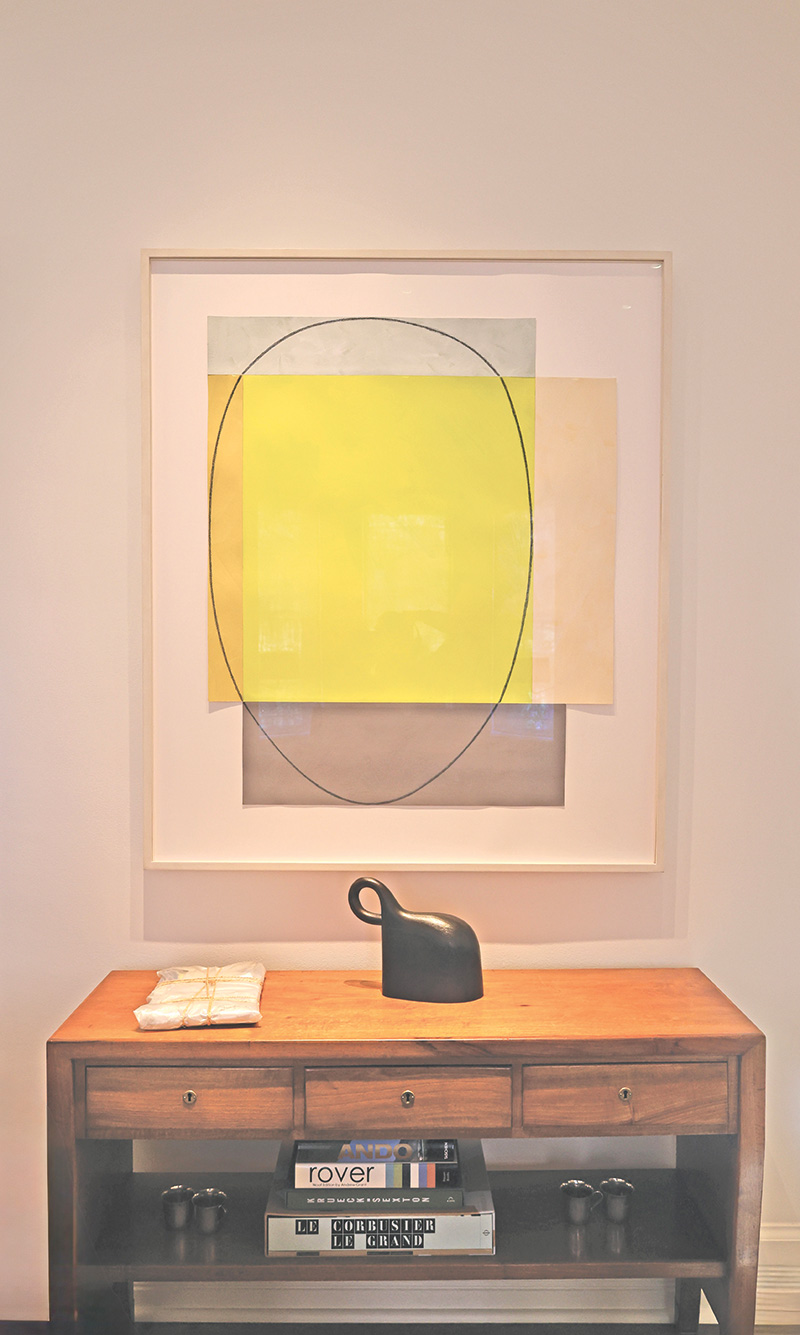
Above: on table: a Christo wrapped Chicago magazine; a sculpture by Martin Puryear.
On wall: a work by Robert Mangold that Neisser says reminds her of the shape of her father’s face.
CGN: I see more geometric shapes, as well as more round or oval shapes. Are they connected to architecture or design for you?
KN: They’re connected to both.
CGN: They also recall the fondness for people you mentioned. What about this face in the dining room?
KN: Right. This was from my parents collection by the Canadian artist James Brown.
CGN: He has such a great expression — the narrowing of the eyes, there is this sense he is observing or judging what is actually going on.
KN: I just think he’s hilarious. It reminds me of a novel by Roald Dahl called, “My Uncle Oswald.” He belongs here overseeing the mantle like some august self-important relative.
CGN: I think people sometimes assume minimalism has to feel hard or spare, but these works aren’t — they’re beautifully soft and many are also fun.
KN: Right. Some people may see restraint, but I see sheer beauty.
#