Getting Head(y): "Throat" by KC Crow Maddux at Tala
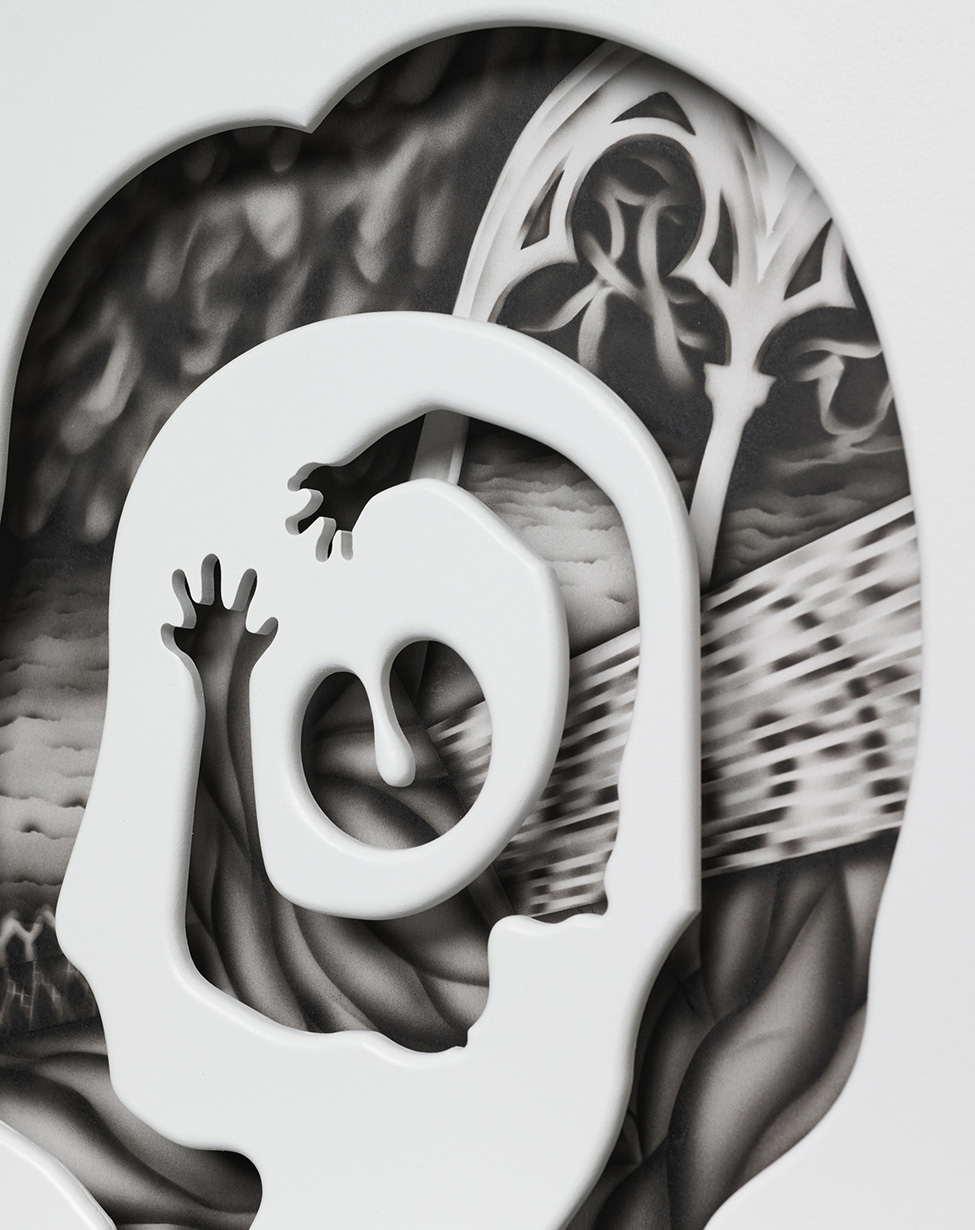

Installation view of Throat. Photo by Robert Chase Heishman for Bob.
By MAC PIERCE
Illusions and allusions. A play across the shades of gray. Smooth surfaces and careful entrances. This is the dance of communication, the grammar of the sensual, and the visual language that KC Crow Maddux employs in the recently opened exhibition “Throat” at Tala gallery in Chicago. Curated by Susan Gescheidle, the artworks of “Throat” form a cohesive body of work that articulates the body in flux.
The seven artworks in the show take the form of mid-sized wall-mounted dioramas consisting of smooth shallow frames that each bear cutouts in the shape of appendages (and other bits) of the human body in contour. Looking into the openings of each frame, the viewer sees collages of layered airbrush paintings on paper. Formally, the painting depicts abstracted greyscale motifs, composed in a way to illude a traditional depiction of depth. Which isn’t to say that these pieces come across as flat; the depth between the front plane of the box and the stacked paintings imparts perspective as the viewer investigates the cutouts. The contents of these paintings vary widely, with some containing suggestions of meteorological phenomena and others bearing distinct architectural motifs. Additionally, there are several details not immediately apparent that add to the refinement of this work. A detail that I particularly appreciated was the selected embellishing of some areas of the cutout through rounded edges, a small gesture that tickled the sculptor in me. Another was the high degree of finish on the construction of the box, leaving no visible panel gaps to distract from the content of the work. Content that, despite its sparing palette, is deftly composed.
Through the sparing openings of the frame and their flat white treatment, Maddux draws the viewer to investigate the interior of the diorama, working through a confused mess of limbs to make out the overall composition. It is work that allows itself to be revealed to the viewer by denying apprehension from afar. You have to be close. You must look into the hole, if only to see what’s inside. The limited palette also works in favor of the content – it’s also a direct denial of the binary; whereby smooth gradients of tone allow for oscillation along a binary that resists bifurcated opposites. In addition, by restricting the whole work to shades of grey, the painted elements are bold without being overwhelming up close. It’s the distinction between the intimate vs. the explicit; inviting the viewer in close as opposed to demanding the viewer pay attention. The very structure of the work reinforcing this feeling–the prominent exterior frames that reference the outward body, while the contents of the diorama, a series of stack pieces of paper, a material classically used to convey the printed word–depicts abstractions of content that suggest an interior domain at the edge of language.

KC Crow Maddux, The Garden, 2025 – Acrylic, Wood, Paper, Museum Acrylic – 24” x 19” x 1.5” - Photo by Tala
In sitting with the work, my attention lingered on the openings in the diorama boxes. The average tone of the interior paintings skews towards darker values, which contrast well with the stark white of the box. The shape of the cutouts is unique to each diorama, but all feature repeating motifs of naked limbs, spiraling and entangled, distinct and too frequent to belong to any singular body. Attached to the messes of limbs are other recognizable profiles, like occasional pairs of breasts or the open gullet featuring dangling uvula, after the show’s namesake. Feet, hands, arms, legs, breasts, lips, throats – parts of bodies that never fully resolve into any individual, suggesting multiple bodies or plural identities.
Maddux’s artist statement states that he views these works as being “about being trapped in signification,” a claim supported by the work through the illusory way it employs signs. The work is descriptive without being prescriptive, poetry not prose. Each piece takes on an inherent plurality, reflective of an artist who has defined gender on their own terms. Maddux, who is trans, has composed work that deploys sleight of hand against strict classifications – it is paintings and sculpture, spectrums of grey, figurative without a figure. All of which is rendered deftly within expertly constructed artworks. Even the peculiarities of Tala supported this multiplicity, with the gallery being home to white walls, a reading room, storefront, and dance floor. In speaking with Maddux after seeing the work, one of the reoccurring motifs of the show came into sharp focus – that of the maw, the open throat. Each of the works in the show has it depicted as an aspect of the frame cutouts. As explained by Maddux, the throat is a highly charged area, a bidirectional passage through which the individual sustains themselves, while also being the way through which an individual externalizes their own interiority – asserting being. Those two directions allow a person to be, in both the physical the self, and the locus of the throat constitutes an area “where concept meets body.”
I struggled to find faults within the exhibition, a rare occurrence for me in a city that has a fetish for unpolished art. Almeda of Tala took a risk in working with a new-to-the-gallery curator, but the presentation of this work is precise and Gescheidle has created a tight presentation of Maddux’s art, a show that thrives in the grey areas it slyly depicts. The work is expertly crafted and thoughtfully composed, an excellent presentation by an artist who excels at his craft.
Throat
Extended through February 7, 2026
Open Th–Sa 1-6pm and by appt.
Tala
1644 W. Chicago Ave. (60622)
#

Detail of The Specter by KC Crow Maddux, 2025 – Acrylic, Wood, Paper, Museum Acrylic - Photo by Tala