The Life of an Artwork: When It All Adds Up
This is the second article in The Life of an Artwork, a three-part series about what happens to your artwork or collection over time, and what artists and collectors can do now to shape those outcomes. The series offers practical approaches to documentation, organization, valuation, and dispersal before those decisions are left to family members, executors, or chance.

By Mary E. Longe
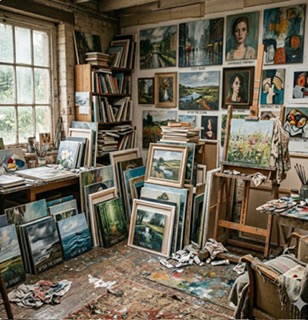
What happens to all of it? An artist walks into an overflowing studio. A collector no longer has space on a wall.
The accumulation reflects years of effort, but not necessarily a clear sense of what belongs and what does not. For artists, work from different periods sits side by side, early pieces, recent work, finished paintings, unresolved ideas, some documented, some not, some clearly part of a larger direction, others less certain.
For collectors, the pattern is similar. Collections may include fine art acquired for aesthetic, cultural, or investment value, works traded at art fairs or auctions, alongside works bought at craft fairs, postcards, turtle art, inherited family objects, or specialty collections built over decades. Not every piece carries the same weight. Some remain meaningful, others harder to place or explain, with records that are scattered or incomplete.
And sometimes, it becomes someone else’s problem, family members or executors left with all of it and no clear direction.
For artists and collectors, this is where a system becomes necessary, not optional. An inventory, whether in Excel or a platform like ArtworkArchive, needs to track each work with title, date, dimensions, medium, images, current location, and status, sold, placed, leased, donated, or in storage. Inventory numbers attached to the back of the work, consistent file names, and matching image folders make it possible to identify work later without relying on memory alone.
Documentation is what preserves provenance. Receipts, invoices, exhibition histories, contracts, correspondence, certificates, and installation photographs should remain with the record of the work. Collectors should keep records of where and when a piece was acquired, while artists should maintain notes about series, exhibitions, and ownership history. If a work cannot be identified later, neither can its history, authorship, or value.
The records themselves also need a system. Spreadsheets, cloud folders, external drives, printed binders, or shared estate files all work if they are organized consistently and backed up. The goal is not complexity. It is making sure someone else can understand the work without the artist or collector standing beside it.
What happens to all of it is not answered by keeping work in place, unless the artist is deliberately holding it as part of a shift in direction.
Inventorying a body of work or collection creates the opportunity to determine and document plans or suggestions for what happens next, which works can be sold, gifted, inherited, donated, archived, reworked, or removed from circulation entirely. It is also the practical moment to assess condition, noting damage, fading, framing issues, missing information, or conservation needs before problems worsen or records are lost. Artists may also identify unfinished or unrepresentative work that should not continue outward.
These decisions apply differently to artists and collectors, but they depend on the same thing: knowing what exists, where it is, and what accompanies it. Without that structure, even strong work tends to remain in place, not by intention, but by default.
Digital work requires the same level of attention. Files should be named consistently, backed up, and linked to the same information as physical work, title, date, format, dimensions or duration, and version. Where the work exists matters just as much, on a hard drive, in cloud storage, on a platform, or, in the case of NFTs, on a blockchain with associated wallet and contract details. Passwords, access instructions, and ownership records should be preserved as carefully as the files themselves.
If the question is being asked because the artist is downsizing or closing an art practice, the business side must be inventoried as well. This includes documenting revenue sources, commissions, consignment and licensing agreements, leases, teaching contracts, grants, outstanding obligations, client and gallery relationships, digital accounts, equipment, supplies, furniture, and other assets or responsibilities connected to the work. Executors and family members will rarely understand the full scope of an art practice without clear records and written guidance.
This process does not have to be done alone. Art history students can assist with organizing and documenting inventories, professional conservators may help assess condition and identify needed remediation, and professional appraisers can help establish realistic values and determine what matters most. The University of Chicago, Northwestern University, University of Illinois Chicago, Loyola University Chicago, and the School of the Art Institute of Chicago have art history programs where students may be found locally.
What happens to all of it ultimately depends on whether the work can still be identified, documented, and understood years from now. Without that, even important work becomes difficult to place, inherit, preserve, or value.
Mary E. Longe is the author of Art Legacy Compass: Managing, Downsizing and Transitioning an Artist’s Studio and Estate. She holds a certificate in Art Business from Sotheby’s Institute of Art (London), is former Executive Director, Plein Air Painters Chicago, a contributor to Plein Air Magazine and other art publications. She is the author of five published books in healthcare.
Longe is also an artist, who creates multimedia artworks with an eye on the current socio-political experience. Longe’s collage art has been critiqued in Made in Bed Magazine, and her plein air art in New City online magazine. Besides her art and writing life, Mary Longe’s professional career included twenty years working for the American Hospital Association, and 17 years, as founder and CEO of Longe Life Libraries, which designed specialty consumer health libraries for health care organizations and other businesses. She can be reached at mary.longe@gmail.com.