The Life of an Artwork: Where Value Actually Begins
This is the first article in The Life of an Artwork, a three-part series about what happens to your artwork or collection over time and what artists and collectors can do now to shape those outcomes. The series offers practical approaches to documentation, organization, valuation, and dispersal before those decisions are left to family members, executors, or chance.
By Mary E. Longe
There is a question that tends to arrive late, usually much later than anyone would prefer: what will happen to it all?
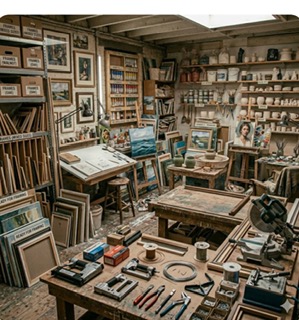
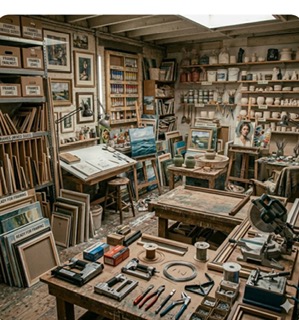
For artists, it emerges gradually. A studio crosses from productive to crowded. Finished work leans against walls, wrapped pieces disappear behind shelves, studies mix with completed work, and records of sales, exhibitions, pricing, or location become incomplete or inconsistent. Some works are signed, others are not. Photographs, provenance, and contracts may exist, in manilla or online folders, bins or a pile on a dusty taboret. At that point, the studio is no longer only a place to make work. It also requires organization, documentation, and decisions about what continues forward and what does not.
For collectors, the signs are practical. Storage fills, records are incomplete, and pieces acquired over decades can no longer be easily identified, valued, insured, or passed on. Collections may include investment level fine art, paintings bought while traveling, craft fair ceramics, vintage posters, folk art, artist made jewelry, postcards, handmade quilts, family heirlooms, or specialized collections built over decades. At that point, the collection needs more than appreciation. It needs organization, documentation, and decisions about what should remain, what should move on, and why.
For families, it arrives all at once, when a door to a studio opens and what is inside is not just objects, but decisions, what stays, what is sold, and what has value, often without clear records or guidance from either the artist or the collector.
No matter who faces it, by the time the question surfaces, the answers are rarely simple. Which is why it is worth asking earlier, at the point where almost no one thinks to ask it: in the studio, at the moment of creation.
There is a persistent belief that value is assigned later by galleries, collectors, and the market. Those forces matter, but they do not start the story. Value begins earlier, embedded in decisions that can look like routine studio practice rather than strategy. For artists, that includes the materials chosen, whether the work is signed and dated, whether pieces are photographed before leaving the studio, whether titles remain consistent, whether records are kept, and whether a body of work can still be understood years later. Even decisions that feel temporary, stacked canvases without labels, missing invoices, lost artist statements, unfinished provenance, become part of how the work is eventually understood, trusted, and valued.
Over time, these decisions accumulate into something more structured than they appear. A body of work either holds together or it does not. Collectors encounter the result of that accumulation. For artists, it means leaving behind work that can be understood without being there to explain it.
For collectors, it means keeping enough information so someone else can understand it later.
I recently visited a studio where the work was strong and clearly the result of years of effort, but the surrounding structure told a different story. Paintings were unlabeled, finished works sat beside studies, and there was no consistent record of titles, dates, or where pieces had been. When I asked about a particular work, the artist had to reconstruct its history, and without that context, even strong work becomes harder to understand and value. Artists with years of work are pressed to remember specifics.
Collectors rarely think of themselves as evaluating documentation, but it shapes their decisions, including whether a work feels right to live with and eventually pass on. It is why people buy paintings directly off the street from plein air artists, they see the work being made and feel, in real time, what the artist is expressing. When that immediacy is gone, the information around the work has to carry more of that understanding. They need the basics in a simple, usable form, a labeled work with title, date, dimensions, and medium, along with a record, whether a printed sheet, invoice, or digital file, that notes where the work has been and how it fits within a larger body of work. That clarity depends on artists providing it at the point of creation, so the work can be understood later without explanation. Galleries expect the same consistency, relying on it to present, place, and stand behind the work with confidence.
What will happen to it all is often treated as a late question, or one left to families to resolve. In practice, it has the most impact when asked earlier. Not as a constraint, but as a way of thinking about what remains.
For artists, it means leaving behind work that can be understood without you in the room.
For collectors, it means keeping enough information so the work does not lose its meaning over time.
The market will always have its influence. But it is not the starting point. The first and most consistent point of control remains the studio, whether that is a formal workspace or the sidewalk where a painting is made, it is where the work takes shape and where its meaning is first established. That is where the artist determines how the work will be understood, and where the collector’s future decisions are quietly shaped. The records collectors keep, receipts, provenance, correspondence, and installation photographs, become part of that meaning over time.
Long before anything is sold, exhibited, or inherited, the groundwork is already in place.
Or there is a gap where it should be. And that difference tends to reveal itself later, when the question finally arrives.
What will happen to it all?
Mary E. Longe is the author of Art Legacy Compass: Managing, Downsizing and Transitioning an Artist’s Studio and Estate. She holds a certificate in Art Business from Sotheby’s Institute of Art (London), is former Executive Director, Plein Air Painters Chicago, a contributor to Plein Air Magazine and other art publications. She is the author of five published books in healthcare.
Longe is also an artist, who creates multimedia artworks with an eye on the current socio-political experience. Longe’s collage art has been critiqued in Made in Bed Magazine, and her plein air art in New City online magazine. Besides her art and writing life, Mary Longe’s professional career included twenty years working for the American Hospital Association, and 17 years, as founder and CEO of Longe Life Libraries, which designed specialty consumer health libraries for health care organizations and other businesses. She can be reached at mary.longe@gmail.com.