Art at The Obama Center: Raising the Future of Art and Possibility
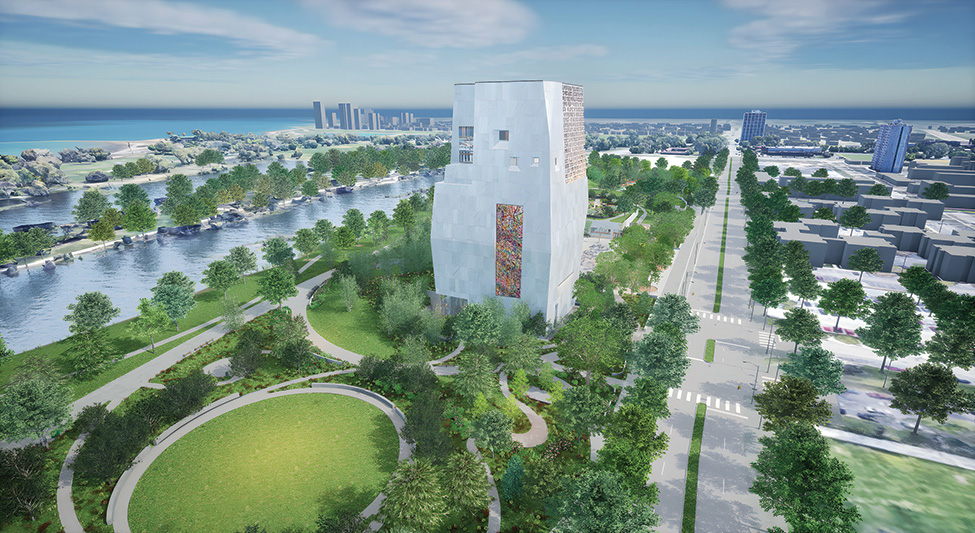
A rendering of the Obama Presidential Center site and Julie Mehretu’s commissioned artwork, an 83-foot-tall painted glass window titled Uprising of the Sun.
Image Courtesy The Obama Foundation.
This feature appears in CGN's spring/summer 2026 issue. To purchase a copy or subscribe click here.
By ALISON REILLY
The expansive, 19.3-acre Obama Presidential Center in Jackson Park will open to the public on June 19 after nearly five years of construction. The Center features an ambitious art program with more than 25 commissions of new work from some of today’s most prominent contemporary artists – like Carrie Mae Weems, Mark Bradford, Julie Mehretu, Jenny Holzer, and Richard Hunt – along with recent School of the Art Institute graduate Lindsay Adams, Washington D.C.-based artist Nekisha Durrett, and Mexican and American painter Aliza Nisenbaum. These permanent works will be installed throughout the campus. For example, Maya Lin’s Seeing Through the Universe serves as a focal point in an outdoor space dedicated to President Obama’s mother, while Mark Bradford’s immense City of the Big Shoulders scales the three-story west wall of the museum atrium. Together, the commissions articulate a vision of the Center as a cultural hub where art, civic life, and education intersect.
I spoke with Dr. Louise Bernard, Founding Director of the Obama Presidential Center Museum, and Virginia Shore, Curator of the Obama Presidential Center Art Commissions about the Center’s innovative art program. Our conversation explored how these commissions shape the institution’s identity, reflect the Obamas’ longstanding commitment to artists and arts education, and expand the possibilities of what a civic and cultural institution can achieve.
*
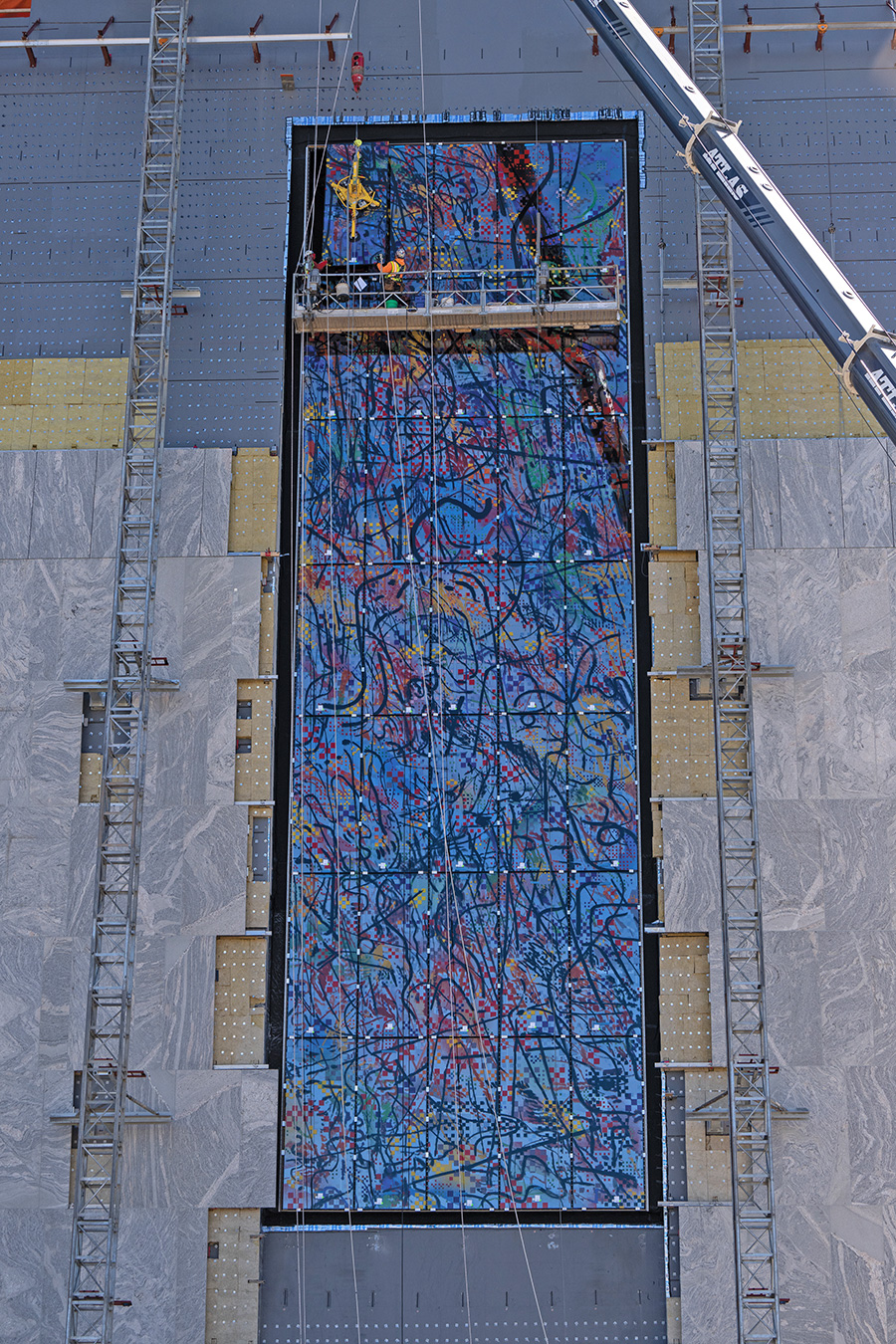
Installation in progress of Julie Mehretu’s Uprising of the Sun at the Obama Presidential Center. Image Courtesy The Obama Foundation.
CGN: How do the artist commissions for the Obama Presidential Center shape the institution’s identity compared to what we think of as a traditional presidential library?
Louise Bernard: The Obama Presidential Center is in many ways a living legacy. We think about the continued work of the Obama administration, the work that the Obamas did together in the White House, the relationship between the West Wing and the East Wing, and Mrs. Obama’s initiatives. The Obamas lifted up the importance of art, not only rehanging the collection within the White House, but really thinking about the important relationship between the arts and education. We know that there is a positive impact through arts education in terms of curricular development, the impact that it has on young people, and so that was a particular focus and emphasis for the Obamas, thinking not only about the visual arts, but the arts across disciplines. That’s something that we wanted to continue and lift up through the foundation’s mission, which is to inspire, empower, and connect people to change their world. We’re building this 19.3-acre complex rooted in community on the South Side of Chicago. We know the arts are engaging, uplifting, and energizing. We really thought about how art in public spaces can continue to foster that sense of connection and possibility.
Virginia Shore: It is a community center. It is a cultural hub. It’s a museum, library, auditorium, recording studio, cafe. It’s the first of its kind in terms of calling it a presidential center and what that means. The spaces are spectacular, and the art brings it to life in this whole other way. Each artist has a different vision, different materials, and a different focus.
CGN: When you look at the breadth of artists involved from Carrie Mae Weems to Theaster Gates to Nick Cave, is there a unifying vision that connects them? You spoke about possibility, but are there other themes that emerge from bringing these artists with very different practices together?
VS: There’s an underlying thread that connects them all. They are changemakers, civically engaged, and trying to build community. Through each one of the works, regardless of theme or material, the artists themselves are changemakers in their own right.
LB: We wanted to ensure that we had a mix of luminary figures as well as emerging artists. To your point, there is a real mix of materiality, the various practices that the artists bring to bear on very site-specific spaces. Virginia was also thinking about artists in relationship to space and scale. We were often asking artists to really push their own practice, working in materials that they hadn’t necessarily worked in before. Julie Mehretu was working in glass for the first time, which has impacted and shaped her continued practice as she’s working with new materiality around transparency or translucency. We also thought about the full range of diversity in terms of race, ethnicity, queer identity, Indigenous representation. We wanted to ensure that we had artists from Chicago with a connection back to the city and its rich history of the arts and civic engagement.
It’s also important to note that while the commissions are understood to be permanent, they’re site specific, they will have real longevity and presence at the Center. They will be activated programmatically so that they are brought to life in new ways. We really think about placing these artists in dialogue with other artists, across disciplines.
CGN: For Julie Mehretu’s work, Uprising of the Sun, what guided your decision to commission her for that significant space in the museum tower? What made her work and her approach right for the Obama Presidential Center?
VS: One of the many exciting things about working on this project was that it really became a dialogue. The President, Louise, and the team were open to my suggestions. That window wall looked like this perfect space for art to transform the museum tower and become a beacon of hope for the Center, the north facing wall of the museum. I presented a couple of ideas in terms of artists that might be able to address that window wall, and we all landed on Julie. Julie was both excited and, as she has said, a little daunted by it, because she had never worked in glass before. But there’s an incredible fabricator [Franz Mayer Studio] that I had the opportunity to work with a few times in my previous career. They are one of the most renowned artist glass makers in the world. I think that helped allay her fears as well. She was really excited by the challenge.
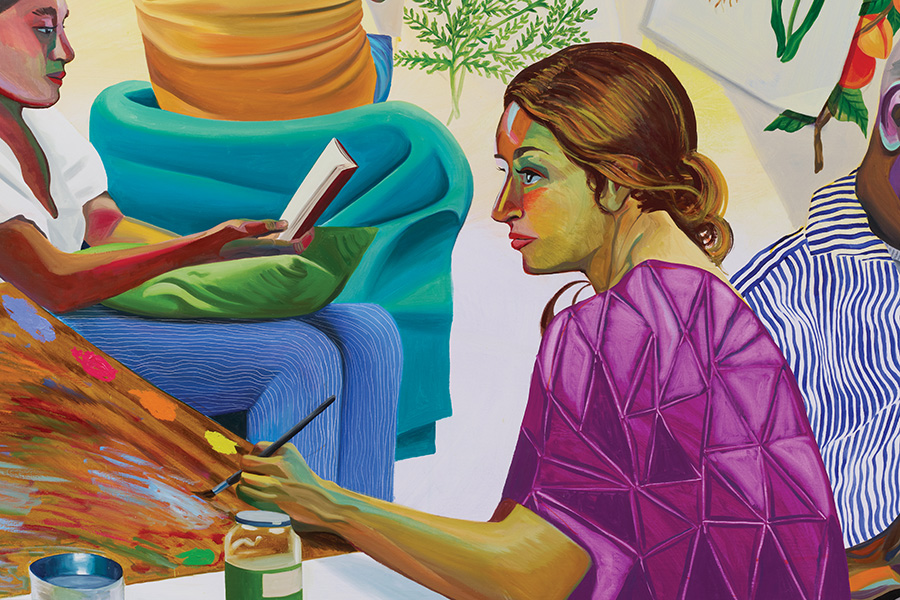
Aliza Nisenbaum, Reading Circles/ Weaving Dreams/ Seeding Futures (detail), 2025. Oil on linen. Photo by Izzy Leung. Courtesy the artist, Anton Kern gallery, and Regen Projects.
CGN: When you are commissioning someone like Mark Bradford for a monumental painting, what is the process like? Where do you begin?
VS: Mark was unique because that space inside the museum is incredibly complicated. From the ground level all the way looking up, it’s interrupted by floors and balconies jutting out, so it’s not a symmetrical space. But Mark is so fluid, he’s able to take over monumental spaces.
LB: With Mark we saw the evolution of his piece. He worked and reworked it for several years with rounds of concepting, testing, prototyping, and modeling. He built a model of the space in his studio so that he could really understand the scale and how the idea of the mapping played out–the connection between Chicago, the city and the lake. I think it’s been a remarkable journey for him. He also worked on other projects simultaneously and so his work evolved across time and these pieces spoke to each other. That was also remarkable to see.
CGN: Did anything surprise you in the way the artists responded to the Obama legacy or to Chicago itself?
VS: There are so many thoughtful concepts that we did not anticipate. Spencer Finch [Memory Landscape (Nairobi, Chicago, Honolulu, Jakarta)], the way that he incorporated the president’s story, by reading all of the President’s books and using color [in the tile wall mural installation] to connect back to place, history, and his personal memories. The artists who have been commissioned for this project have spent serious time thinking about how best to make this connection to the Center.
LB: I would add one example of the frieze, the large-scale works by Theaster Gates [To See What They Could See and American Vista in the Forum Atrium]. Theaster is local to Chicago, born and raised on the West Side, very much rooted on the South Side in terms of his artistic practice and Rebuild Foundation. But within Theaster’s practice, he thinks a lot about the figure of the Black woman, the idea of the Black Madonna, being able to lift up this idea of blackness and beauty, Black modernity is central to his practice. He is thinking through the legacy, the idea of the first Black first lady and how that resonates in terms of Mrs. Obama being born and raised in South Shore, adjacent to the Center itself. We see these references to the idea of blackness and beauty and power and presence in these wonderful archival images drawn from the Johnson Publishing Company archive and from the personal collection of Howard Simmons.
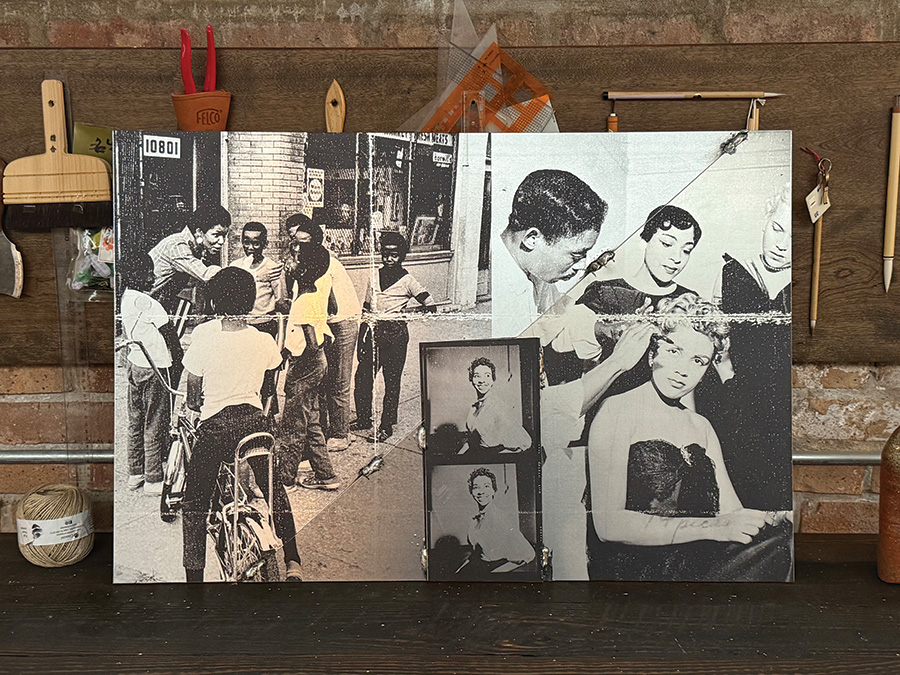
Theaster Gates, Studies for Gates’ installation at his studio in Chicago, 2025. Courtesy of Theaster Gates Studio.
CGN: You have commissioned works that are tied directly to Chicago’s cultural history, like the Gates frieze you mentioned. How did you approach selecting work that referenced Chicago and its history?
VS: There was always intent to include artists with connections to Chicago. Aliza Nisenbaum, for example, is creating this fantastic expansive mural for the public library. She works in community and shines light on people who are not always front and center through her portraiture. She spent so much time doing research about librarians, about the purpose of the libraries in Chicago, how expansive they are, thinking of it as a place for people without homes, and then what is possible inside a library and looking at it as this community space that’s free and open and a space to go and learn and feel welcome.
To an artist like Tyanna J. Buie who has done a screenprint piece [Be the Change!] inside the Forum building. She grew up in many different foster homes. Now she is the head of printmaking at RISD. She was in a Bud Billiken parade [on the South Side of Chicago] when President Obama was running for Senate, and so her work has this other history of being connected to him in this way as a young adult. There’s so many different stories like that where there’s a connection that maybe wouldn’t be anticipated.
LB: We think again about the power of place in the most dynamic sense. The Center is rooted in community. The connection to Chicago’s rich history is very much front and center. But at the same time, we tell a national story with an international reach. We’re always thinking about the synergy between the local and the global, the way in which we’re drawing people in, we’re bringing the world to the South Side and the South Side to the world. There is that exchange that takes place. I think that is embedded throughout many of the works.
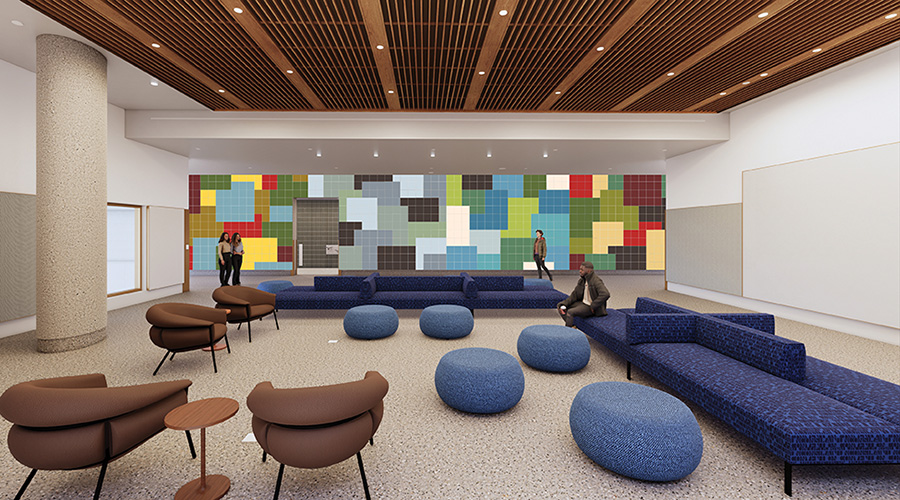
Spencer Finch, Obama Presidential Center Forum Garden Level, Rendering. Image Courtesy The Obama Foundation.
CGN: Chicago has a long history of investing in and supporting public art. I’m curious how you see the Center’s art program entering into that civic tradition.
LB: We are obviously not a traditional art museum, we’re a non-traditional platform for the arts. But we have this global reach in terms of the foundation’s international sensibility as well as a connection to the idea of locality and proximity. We have a public high school literally across the street. We think about how through our engagement with the arts, we’re also able to lift up the idea of the business of the arts, which is to say that the arts are themselves a billion-dollar, international industry, and there’s a whole ecosystem of career pathways within this industry, which continues to evolve and change over time. Through the foundation’s mission, we’re able to model for young people connections to careers they may not have anticipated and really lift the hood, so to speak, on how this particular ecosystem works. We think about the city as a school. We want to ensure that young people have a behind-the-scenes understanding of how different cultural institutions work.
CGN: In what ways does the art program reflect President Obama and Mrs. Obama’s own relationship to culture, creativity, and civic imagination?
VS: Looking back at their time during the White House and all the artists that they included, both in the residences and in the West Wing, they highlighted the arts throughout their eight years in office. There were more artists that performed in the White House during the Obama administration than at any other time. This is their legacy. It feels like an extension of their time in the White House and of the power of arts to transform possibility.
LB: We saw how the National Portrait Gallery portraits by Kehinde Wiley and Amy Sherald looked unlike any other presidential portraiture before them. Kim Sajet, who was then the director of the National Portrait Gallery, talked about the “pilgrimage effect” of those portraits, their power to draw people to the National Portrait Gallery, to the museum, to pay homage to that history and everything they represent. At the same time, President and Mrs. Obama speak about the idea of on whose shoulders we stand. They’re very mindful of the fact that their journeys were only made possible because of the many people, the movements, the milestones that came before them. The arts are tapping into that sense of possibility and collectivity, but they have a way, as we saw with the National Portrait Gallery portraits, of pushing the envelope of what is possible and how that resonates with the power of representation itself. We think of that wonderful photo of the little girl captured looking up at the Amy Sherald portrait with a sense of wonder and awe and also seeing herself reflected back.
While the President and Mrs. Obama are phenomenal figures and iconic in their own right, we always want to ensure for the museum experience that everyday people, visitors, see themselves reflected in their stories. The President began his career as a community organizer. Mrs. Obama was born and raised on the South Side. And so, again, there is that sense of possibility.
VS: The President said, “We believe that the arts and the humanities are, in many ways, reflective of our national soul. They’re central to who we are as Americans–dreamers and storytellers, and innovators and visionaries.” I feel like that says it all.
Visit obama.org