Zolla/Lieberman: A Golden Vision for a 50th Anniversary
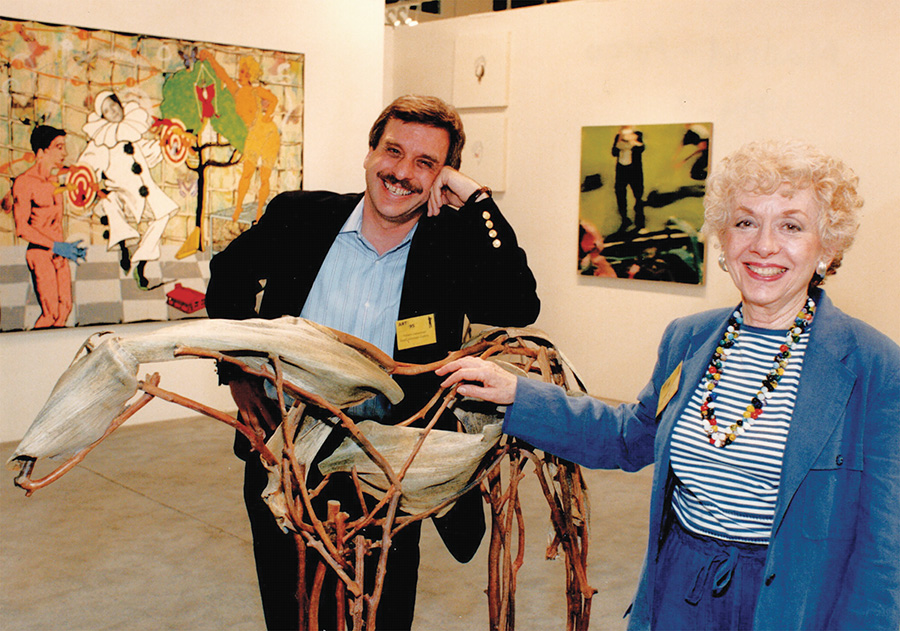
William Lieberman and Roberta Lieberman with a sculpture by Deborah Butterfield in the Zolla/Lieberman Gallery booth at Art Chicago in the 1995.
By GINNY VAN ALYEA
This spring, Zolla/Lieberman Gallery celebrates its 50th anniversary, placing it among Chicago’s longest running contemporary art galleries and the very first to open its doors in River North. William Lieberman, son of co-founder Roberta Lieberman, marks this milestone with Golden Vision – a group exhibition opening on Friday, May 1 that includes 140 artists who have contributed to Zolla/Lieberman’s artistic legacy.
That legacy began on a trip to Paris in 1964 with both Zollas and Liebermans. Roberta Lieberman was an interior designer; Bob Zolla owned a paint and wallpaper company; and their work together on residential projects in the Chicago area led to a friendship between them and their spouses. As the two couples strolled along the banks of the Seine, Bob observed tourists buying paintings at kiosks and noted that there was money to be made in art. Intrigued, Roberta replied that if they were to sell art, they would sell serious works, not souvenirs. To do that, they would need to better educate themselves.
They returned from Europe with a mission. Bob’s wife Betty, who worked at the University of Chicago’s Quadrangle Club, brought home the university’s continuing education catalog, and Bob and Roberta signed up for a contemporary art class offered at the school. When they arrived the first day, the room was empty except for instructor Harry Bouras. No one else had signed up. If they provided lunch, Bouras proposed, he would teach them privately.
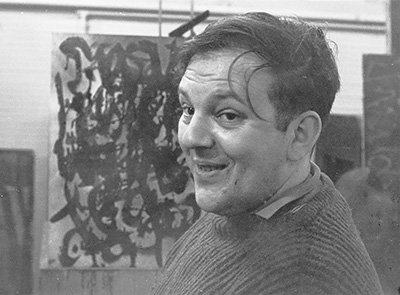
Art critic, artist and teacher Harry Bouras
Bouras was an artist, teacher and critic whose commentary was heard weekly on WFMT’s brand new Critic’s Choice program. With a spread of bread, cheese, sausage, sweets and wine, it was Bouras who introduced Roberta and Bob to the world of serious art. Eventually, he persuaded the pair to open their own gallery in the South Side coach house of Davis & Kreeger, Bob’s company at the time. Bouras contacted Noah Goldowsky – art dealer Bud Holland’s original partner in Chicago and by then a respected New York gallerist – who had access to works on paper by Franz Kline, Philip Guston and other major Abstract Expressionists. Roberta’s husband Dick offered modest financial support to get the gallery started. In a space that Roberta’s daughter Susan remembers as high-ceiled and drafty, they officially launched Zolla/Lieberman Gallery in 1966. The work they presented felt challenging – and as far removed from the Seine kiosk art as they knew it needed to be.
Nothing sold. This was, after all, the South Side of Chicago in the mid-1960s, and white flight from the city was in full swing. Persuading people to drive to a part of the city perceived as dangerous to view art turned out to be next to impossible. Zolla/Lieberman’s next move was to north to Sandburg Village, a new “urban renewal” residential development near the city’s Gold Coast. Bob and Roberta rented a retail space, hoping the location would have more appeal.
First came a solo exhibit for Bouras, the man who had encouraged them from the start. The show garnered a few sales. After that, Roberta and Bob set expectations high for a group show that included works by such Chicago artists as Morris Barazani and Joe Zucker. Susan remembers her parents deciding to serve cookies at the opening for that second show and calculating the amount based on the number of apartments in the complex. The actual turnout fell far short of expectations and “a lot of Maurice Lenell pinwheels and almond crests went into the freezer,” she recalls.
The frozen cookies outlasted Zolla/Lieberman’s Sandburg Village era. At the same time, Roberta’s husband’s juvenile furniture business was growing, as he sold cribs and car seats to State Street department stores. While helping Dick with these accounts, Roberta also showed artwork in their home in Evanston. It was a less exciting, but also a less expensive, option that gave her and Bob time to plan their next step.
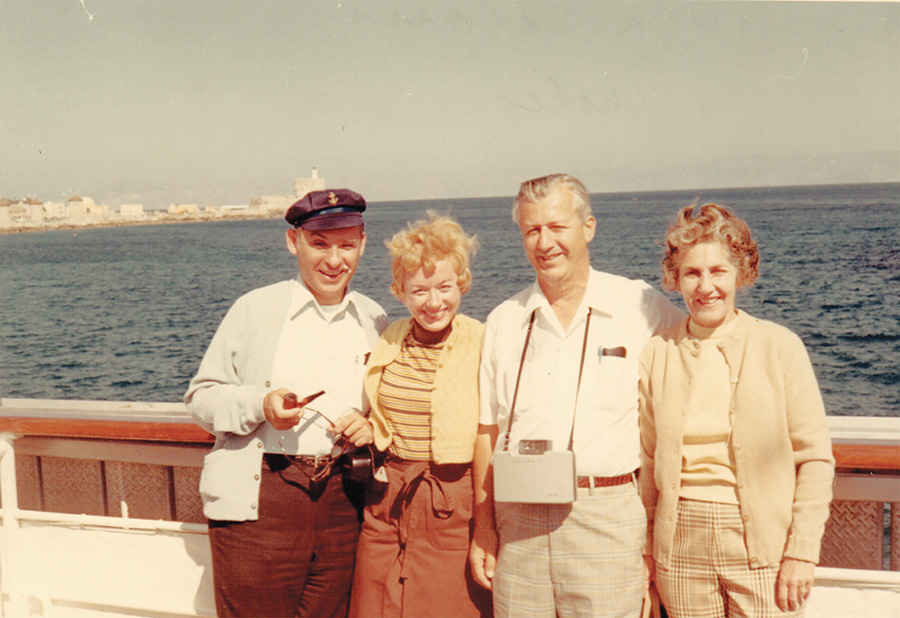
Dick and Roberta Lieberman with Bob and Betty Zolla on a trip in Europe
In September 1975, Roberta turned 50. She treated herself to a trip to visit Susan, by then a sophomore at Duke University. As they waited in line for dinner, Roberta announced that for her milestone birthday, she would open an art gallery. “But you already have a gallery,” replied her slightly confused daughter. No, she didn’t – not the kind of gallery Roberta Lieberman envisioned.
Roberta planned to use a modest sum inherited from her late father to secure a loan to open in the neglected warehouse district due west of the Gold Coast. She and Bob needed to find new artists to show in their latest gallery space. Within a few months, they went to New York and sat outside Leo Castelli’s gallery office in SoHo. Finally, after an hour’s wait, the renowned dealer emerged and the pair persuaded him to consign work to them for an inaugural show the following spring.
In March 1976, Zolla/Lieberman Gallery officially opened in a former coffee urn factory at 368 W. Huron with an Andy Warhol painting of Elizabeth Taylor, a geometric abstraction by Frank Stella, conceptual work by Carl Andre and Donald Judd, and Robert Morris’s intertwined fabric sculpture. Nothing sold. Undeterred, Roberta managed to convince Castelli to give them another show of paintings by James Rosenquist.
Susan has a faint but distinct memory of Castelli sweeping through the gallery in a full-length coat – possibly fur, probably camel-hair, but unquestionably eye-popping – as he admired the high ceilings and long unbroken stretch of exhibition space. William’s faint recollection is that Castelli got a spot of wet paint on that elegant outerwear. What remains crystal clear to both, however, is that – despite Roberta and Bob’s combination of moxie and artistic vision – the tough times continued. Not a single work in either the group or the Rosenquist show sold.
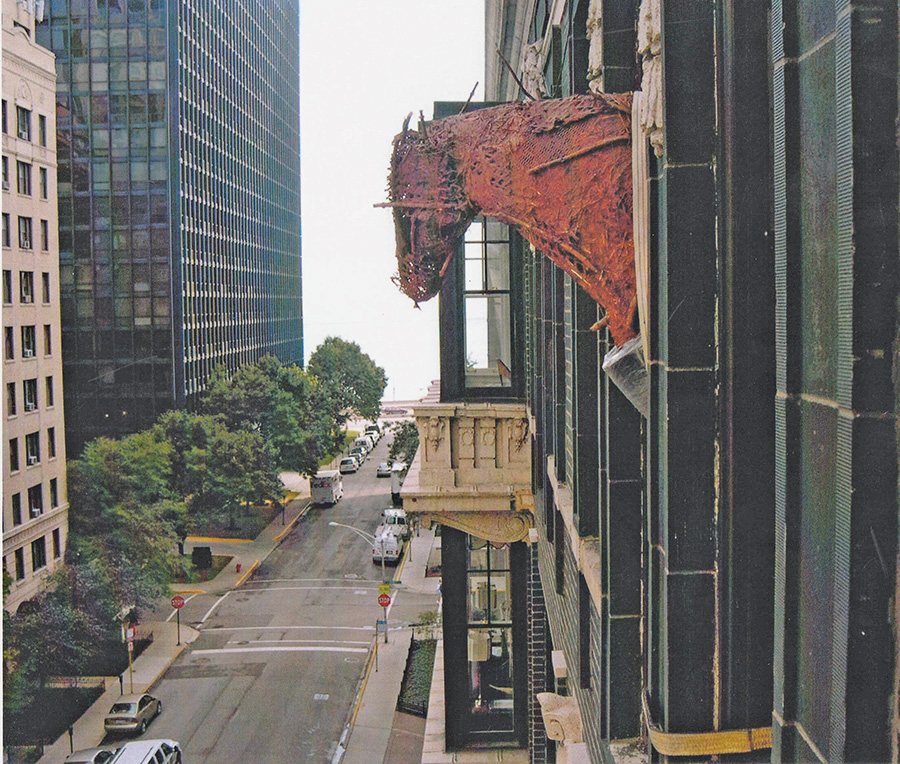
A mud and stick horse by artist Deborah Butterfield had to be moved from a downtown apartment via the window.
Despite their determination, Bob and Roberta realized that they could not fight the inclination of collectors to buy art in New York City or at established galleries like Richard Gray in Chicago on Michigan Avenue. They decided to take a short trip up to Roberta’s alma mater, the University of Wisconsin at Madison, with the general hope of finding work that was unique to the Midwest market. As they walked the halls of the art department, they stopped an artsy-looking couple and explained that they were in search of new talent.
The conversation proved to be kismet: a young woman, Deborah Butterfield, and her husband, John Buck, were both sculptors in search of Midwest representation. The couple invited Bob and Roberta to their studios nearby as well as to lunch, which turned out to mean an adventure picking fresh morel mushrooms and turning them into sandwiches. By the end of that memorable meal, Bob and Roberta made immediate plans for a summer show of Butterfield’s mud, clay and stick horse sculptures. Susan typed the price list for that summer 1976 show, recalling that the entire herd could be had for a mere $10,000. It was a few sales and some good press that led to Zolla/Lieberman’s signature relationship with Deborah Butterfield that endures to this day.
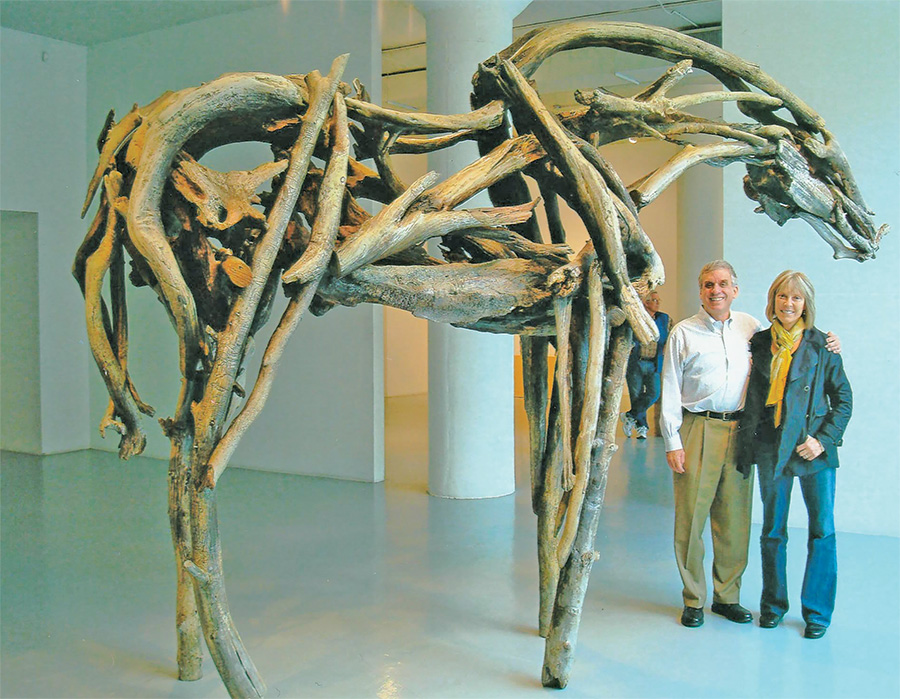
William Lieberman and Deborah Butterfield at the gallery.
The exhibit embodied Roberta and Bob’s concept of what could happen in their space. However, being products of the Great Depression they both knew they had to get the attention of the art buying public while on a strict budget. And so, together they came up with loft lunches that would attract a new kind of collector engagement at the gallery. Roberta spiced up plain egg salad with onion and mustard, Bob bought crusty loaves from nearby D’Amato’s bakery, and Betty baked distinctive brownies with white frosting with the hope of luring collectors from North Michigan Avenue galleries over to 368 W. Huron. Sometimes they’d send a cab for prospective clients, sometimes Bob would shuttle them in his car. They committed to bringing and keeping clients in the space to see the art.
Artist Buzz Spector first encountered Zolla/Lieberman when, as an M.F.A. student at the University of Chicago, he took a seminar with Harold Rosenberg, the influential art critic for The New Yorker. As one of the only MFA students with a car, Buzz gave his teacher a lift when Roberta and Bob invited him to lunch. Buzz recalls he dropped Rosenberg off, parked and began to read a book when “an immaculately dressed blonde woman rapped on the car window.” It was Roberta, insisting that he join them.
*
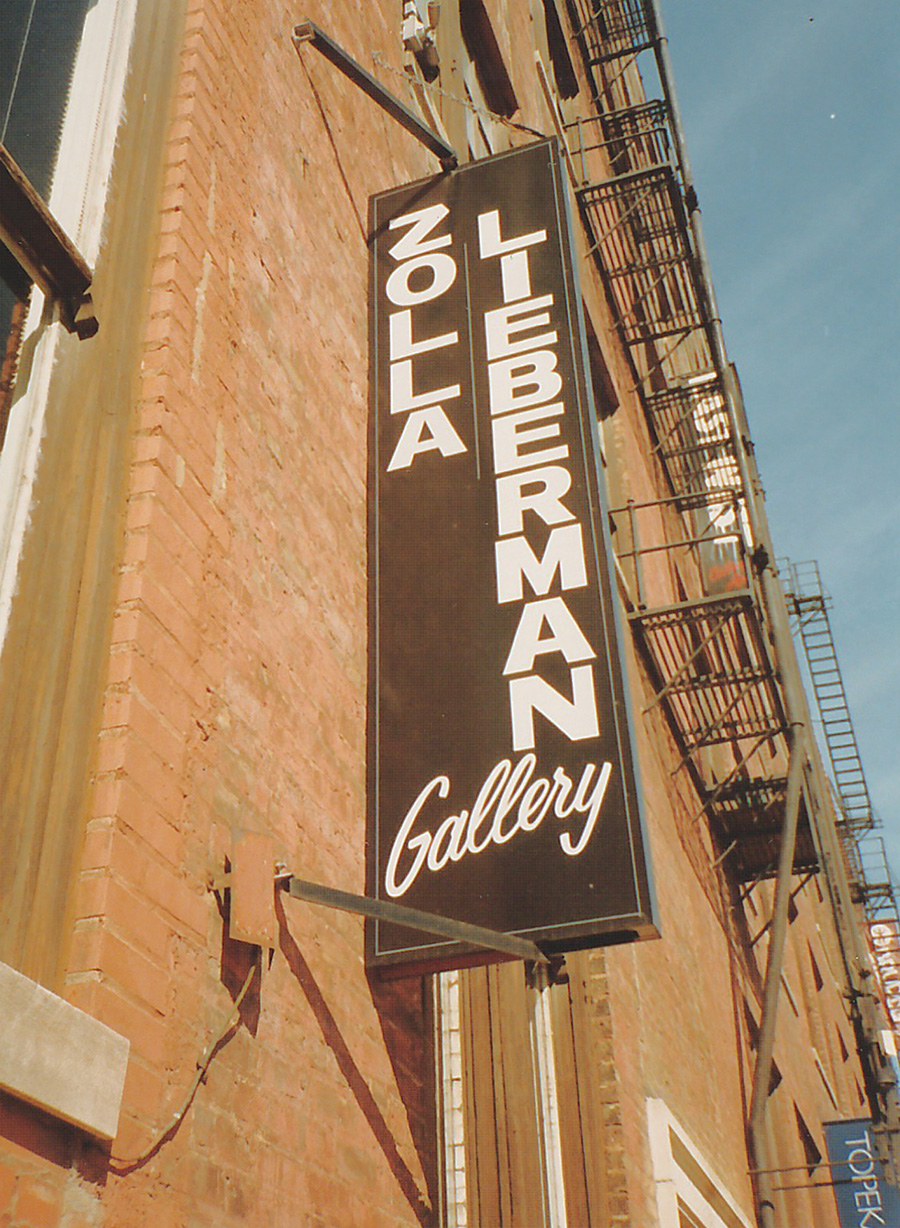
One of the gallery’s early banner signs on the building in River North.
In 1979, Zolla/Lieberman took another leap of faith and moved down the street to the ground floor of an historic loft building. Architect Walter Netsch designed the 9,000 square foot gallery, and Bob Zolla’s son Bill, a lawyer with Rudnick and Wolfe, helped craft a lease with favorable terms.
Zolla/Lieberman’s outlier days were over. Early transplants from the Michigan Avenue/Ontario Street neighborhood – including Rhona Hoffman, Donald Young, Phyllis Kind, Struve and Marianne Deson – relocated nearby. Van Straaten, Habatat, East/West and Sazama Brauer opened at 361 W. Superior. In just a few years, there were 65 galleries within three square blocks, turning a desolate district into a vibrant arts hub. Originally dubbed “SuHu” (Superior and Huron) in an obvious nod to SoHo, the area quickly designated itself as “River North” – a name coined by real estate developer Al Friedman.
With the environment changing and Roberta and Bob’s belief in their artists holding steady, they chipped away at local collector resistance. They also began connecting with curators in other cities and arranged shows by nationally recognized artists such as Michelle Stuart and Deborah Remington. Another win was securing O.K. Harris as Deborah Butterfield’s New York dealer.
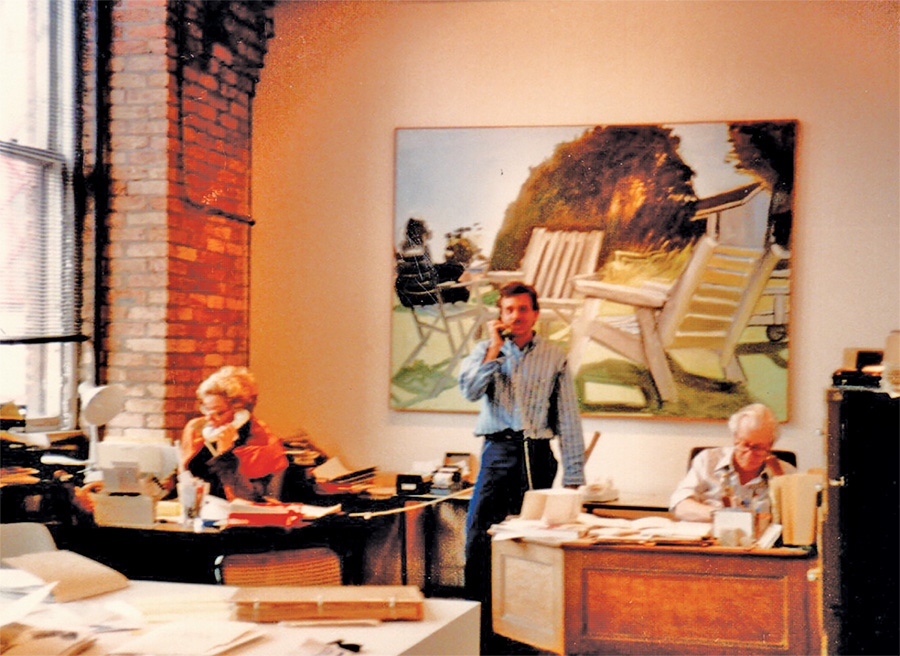
At work in the office of the gallery
Roberta and Bob needed to hire a full-time staff person to keep up with the gallery’s expansion. Judith Simon, a recent Smith College graduate, turned out to be quick with office skills as well as passionate about contemporary art. Simon spent six years at Zolla/Lieberman before leaving to get her MBA.
William, who graduated from Grand Valley State College with a degree in ceramic art, began working full time at the gallery in 1984, installing and transporting artwork. His role evolved in 1986 when Roberta offered him a chance to curate his own show. “I went to some local colleges to see the work of artists who were teaching at these places,” he explains.
With more than twice the square footage and budding national exposure, Zolla/Lieberman generated an aura of success that translated into increased sales. But filling their vast gallery with worthy exhibits was no small feat. Roberta researched, phoned and traveled to establish working relationships with dealers, curators and artists. In 1982, she arranged a show of Le Corbusier drawings, as well as exhibits by Joseph Beuys and Llyn Foulkes. The big canvases of John Alexander, Terence La Noue, Laddie John Dill and Spanish painter Chema Cobo found a home at Zolla/Lieberman. Chicago artist Terrence Karpowicz’s wood and steel sculptures, John Buck’s kinetic and bronze pieces, and Butterfield’s life size horses also had ample room.
The office was spacious enough for comfortable seating where people would gather with wine and pretzels to socialize. Among those who held court was Dennis Adrian, the chain-smoking author, curator, teacher and tastemaker. On Fridays, Chicago Tribune critic Alan Artner would often debrief with Bob – a classical music lover – on Chicago Symphony Orchestra’s Thursday night concerts. Artner would then share the latest River North news with William.
Meanwhile, in another lane, John Wilson launched the Chicago International Art Exposition at Navy Pier in 1980 – the first contemporary art fair in North America. Zolla/Lieberman and many other Chicago galleries had booths alongside galleries from around the country and the world. Zolla/Lieberman continued to participate in Art Expo, and its later iterations, for the next four decades.
During the booming economy of the 1980s, Friday night openings grew from art community gatherings into packed happy hours, where downtown office staff rubbed elbows with the cultural cognoscenti. Up and down Huron and Superior Streets, people filled galleries until early evening before finding their way to nearby restaurants.
The ‘80s fever pitch broke in the early hours of April 15, 1989, when 356 W. Huron went up in flames. Years later, the exact cause of the fire remains a mystery, but the catastrophic loss of thousands of fine artworks was instantly apparent.
At the time, Zolla/Lieberman had a solo exhibit by Chema Cobo on view in the gallery. When Roberta called the artist in Spain to tell him that his 30 paintings and pastels were now ashes, he immediately told Roberta “I love you,” and reaffirmed his commitment to the gallery. William happened to be moving from one apartment to another at the time, storing his entire personal collection in the gallery’s back room while he relocated. Everything – in addition to, of course, the work of every single artist in every other gallery in the building – was destroyed.
For a brief period, Zolla/Lieberman and other homeless galleries took refuge in temporary spaces offered by the Merchandise Mart. Many people suggested that Roberta, by then in her 60s, simply retire. “What would I do with myself?” she asked Susan. “Go on tours of other dealers’ galleries?” Instead, she, Bob and William regrouped and reopened on the top floor of the Bauer Building at Huron and Franklin. Bob negotiated generous settlements with fire insurance companies that provided Zolla/Lieberman, and its artists, with a new chapter.
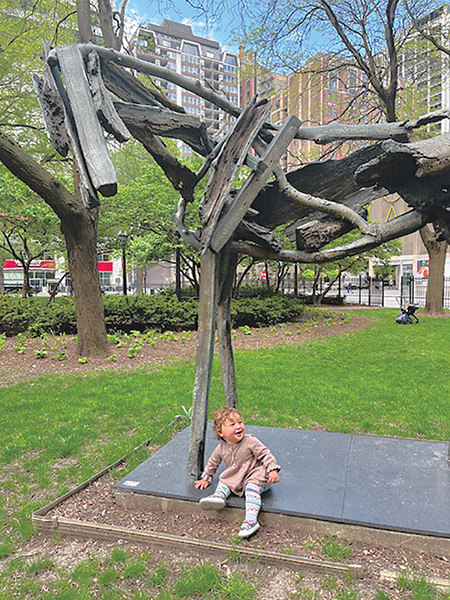
Roberta Lieberman’s great-granddaughter Esther plays on Deborah Butterfield’s sculpture Ben in Seneca Park.
In 1990, an especially gratifying project came to fruition: Museum of Contemporary Art curator Bruce Gunther worked with Zolla/Lieberman and the Eli M. Schulman Playground Reconstruction Committee to raise $100,000 to purchase a Butterfield bronze horse for Seneca Park in Streeterville. Six years later the MCA opened its new building at 220 E. Chicago Ave. directly across the street from Butterfield’s Ben. The sculpture has weathered many more years since then and remains a fixture in the neighborhood.
Despite visible achievements like the acquisition for the park, every day held challenges for Zolla/Lieberman.Their cumbersome 6th floor location did not help. When a storefront space became available on Huron Street, they moved once again. Building owners Buzz Ruttenberg and Jerry Meyer, both sympathetic to the financial struggles of selling contemporary art, facilitated a rent modification to help them.
Alcohol and gallery openings have long complemented each other. Frank Paluch, whose Perimeter Gallery opened in 1982 in River North, noted that he initially served higher-end Sauvignon Blanc at the gallery, which no one ever commented on, but when he switched to the less expensive “Three-Buck-Chuck” from Trader Joe’s, he laughed when he overheard a gallery visitor say to a friend, “They serve really good wine here.” After a sip the friend said, “This is really good! What is it?” The server replied, “Sauvignon Blanc.”
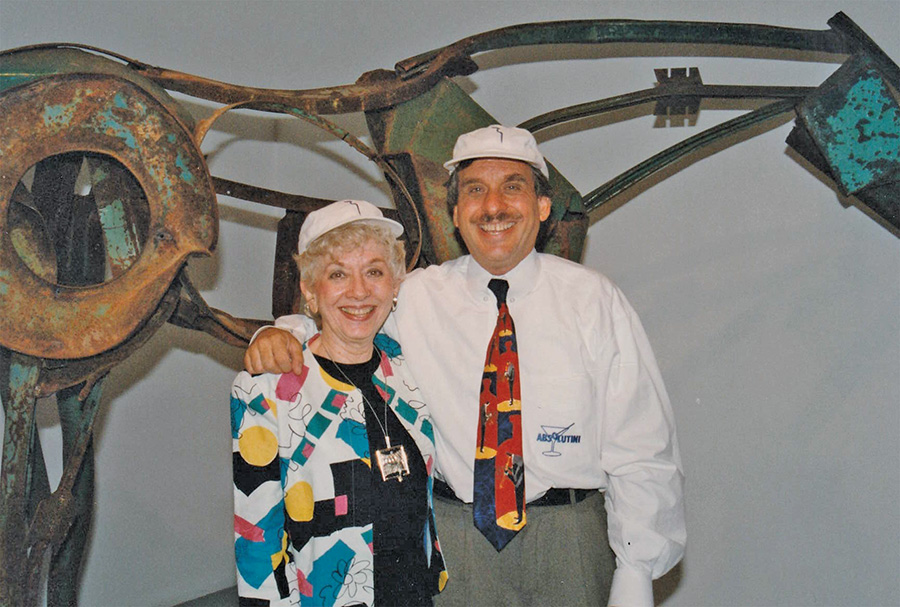
Roberta Lieberman and William Lieberman during Absolut Vision
Keeping in mind the tradition of alcohol at gallery openings, in the mid-1990s Roberta conceived an idea for a cultural event that involved vodka. According to Natalie Van Straaten, Executive Director of the Chicago Art Dealers Association (CADA) at the time, Roberta decided to approach Absolut about supporting the arts in Chicago. A corporate-gallery partnership ended up becoming a much-loved summer mainstay, Absolut Vision, a festival that drew throngs of people to galleries during a period that traditionally saw slow foot traffic and elevating the reputation of an edgy art district to a cultural destination. Starbucks, Cosmopolitan Bank and other entities with a presence in the gallery district supported Absolut Vision with plenty of free martinis alongside panel discussions and an award ceremony honoring members of the art community. Absolut Vision became a summer calendar highlight in Chicago and introduced a new audience to the galleries.
Roberta continued to engage the gallery community through Absolut Vision and beyond by serving as president of CADA from 1987–90. She oversaw the Art for AIDS auction in early 1989, guided the CADA in providing programs for young collectors and artists and inspired collegiality among dealers.
*
Bob Zolla retired from active participation in the gallery in 1997 and passed away in 1999. At the same time William Lieberman had become an established presence at the gallery, pursuing his own aesthetic as he scouted for talent and planned exhibitions, adding more figurative and narrative-focused artists like Maria Tomasula, Donald McFadyen and David Kroll.
The end of 2001 brought a double punch of bad news – the terrorist attacks on September 11th were followed by Roberta’s diagnosis of breast cancer in November. Since her own mother had survived two mastectomies and lived to be 102, Roberta remained optimistic, downplaying her illness and devoting herself to gallery activities.
In January 2004 Evanston Art Center celebrated its 75th anniversary with Roberta Lieberman: A Sharp Eye – An Art Dealer’s 40 Year Journey. The exhibition of Zolla/Lieberman artists, curated by Martha Winans Slaughter, drew hundreds. Frail and unsteady from cancer treatments, Roberta broke a hip, missed the opening and died on February 20th without ever seeing the tribute to her career. Six months later, with the help of the 42nd Ward’s longtime Alderman Burt Natarus, the corner of Franklin and Huron Streets in River North, just down the block from the gallery, was named “Honorary Roberta Lieberman Way.”
William expanded the scope of the gallery through a variety of relationships in the years following his mother’s death. The late art critic and educator James Yood was supportive of William’s artists, recognizing such talents as David Kroll, who will open his 14th solo exhibit at Zolla/Lieberman this November. The Art Institute of Chicago’s Curator of Prints and Drawings Mark Pascale has been another important presence. He included Jane Hammond in Vernon Fisher in exhibits and shared his vast knowledge of works on paper with both Roberta and William.
William credits several collectors with helping to expand and refine his own eye. “Nancy and Bob Mollers have built an amazing and important art collection and are constantly looking, travelling and reading,” says William.”I have learned a lot from them.” Also influential were the late Sandy and Mike Perlow, who took great interest in many gallery artists, among them John Buck, Susanne Doremus, William Conger and Terence LaNoue.
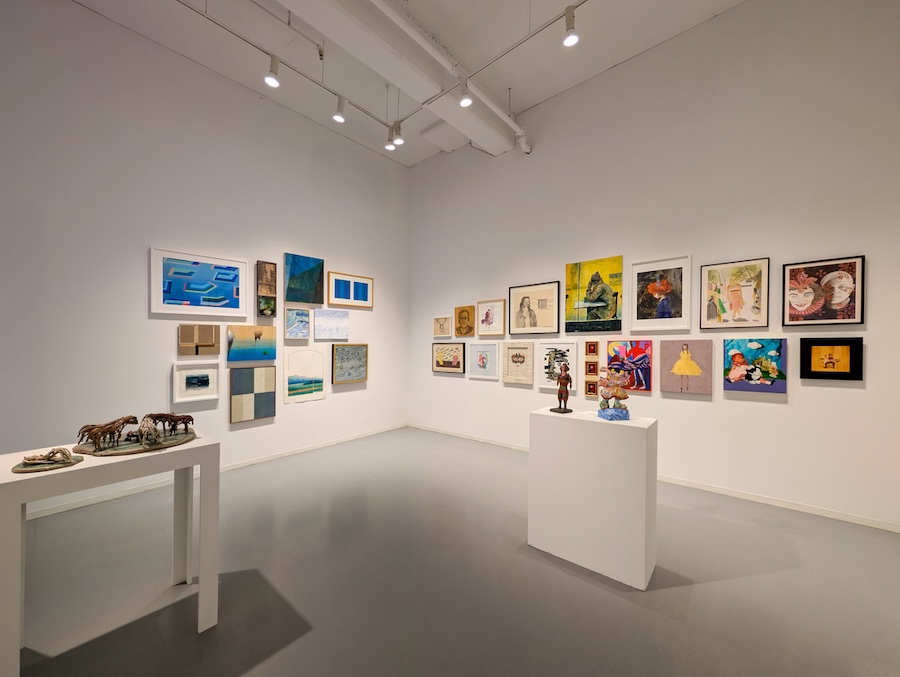
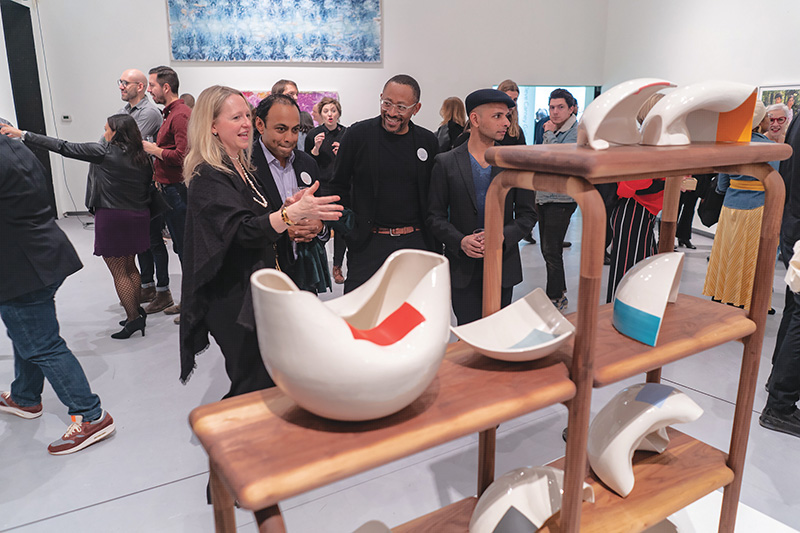
An installation view from the 2026 anniversary exhibition, Golden Vision
No recap of Zolla/Lieberman’s recent history is complete without mentioning Gallery Director Brian Gillham. Brian, a ceramics major at Northeastern Illinois University, interned at the gallery in May 2004, four months after Roberta’s death. Recommended by William’s friend and ceramics professor Dennis Lee Mitchell, Brian admits, “I was naïve and didn’t realize that the gallery was at such a turning point. Maybe I felt less pressure because I came without any expectations.”
21 years later William relies on Brian for creative problem solving, describing him as “an integral part of the gallery’s fabric.” Observes Susan, “He can install an exhibit with the eye of da Vinci and the speed of Superman.” In addition to sales, curation and logistics, Brian has also brought Zolla/Lieberman into the digital age. While William still relies on a dog-eared Rolodex, Brian has developed 21st Century communication channels and an online presence.
What strikes Brian as unique about the Golden Vision retrospective is, “It highlights Zolla/Lieberman as a legacy gallery, creating a bridge from one generation to the next. Several times I’ve moved the work of gallery artists from collector’s homes to their children’s. That we can help someone pass along cherished art is something to be proud of after 50 years.”
Even for someone as skillful as Brian, 140 works is a complex puzzle when it comes to installation. But, insists William, the high number is necessary because “Zolla/Lieberman supports artistic talent and technique from so many different angles. Golden Vision celebrates what my mother and Bob started and what Brian and I are continuing.”
#
Visit zollaliebermangallery.com
This article appears in CGN's spring/summer 2026 magazine. To purchase a print copy or subscription click here.