Demolition: Marika Thunder at M. LeBlanc
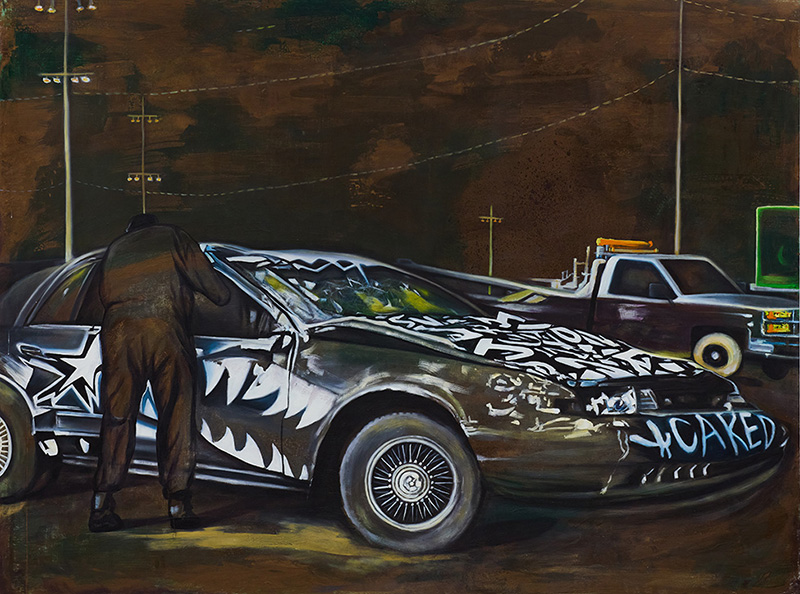
Marika Thunder, Demolition Derby (2025), metal and oil paint on aluminum, 24 x 36 in (61 x 91 cm)
By SUSAN GESCHEIDLE
Any show titled Demolition is bound to feel heavy in today’s climate. It’s hard not to think about the destructive forces around us or wonder if we’re staring down the “end times.” Fortunately, Marika Thunder’s solo debut in Chicago at M. LeBlanc pulls us back from the edge of those big, global fears. It’s a killer exploration of mechanical force—one where demolition isn’t a metaphor for global ruin, but a focus on heavy steel, machinery, and the grit of the American road.
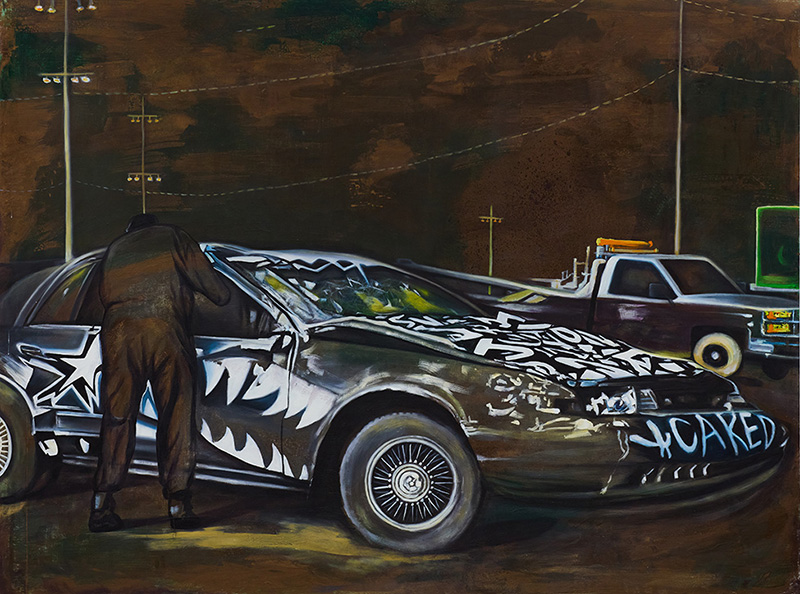
There is a badass, rebellious energy in seeing a female artist take on subjects traditionally claimed by men. Thunder, a New York-based artist born in 1998, leans into the raw, nostalgic world of graffiti-covered wreckage and the “boys’ games” thrill of a demolition derby. There’s a high-octane excitement in the idea of cars crashing, yet the paintings themselves feel surprisingly poetic and elegant. While most of the pieces in the exhibition are of abstract parts, one piece, Demolition Derby (2025), features a solitary figure leaning into a graffiti-covered car in a junkyard. It’s a beautiful, melancholic, quiet image that makes the discarded vehicle feel like it’s a story still being written.
Thunder also filmed a video playing in the back of the gallery, of a demolition derby at the Lebanon Valley Speedway--upstate New York’s famous “Valley of Speed.” This obsession with the machine suggests the Cannes-winning film Titane (2021), which touches on the erotic relationship between people and automobiles. Thunder’s paintings are undeniably sexy in this same way, making the steel look almost like skin.
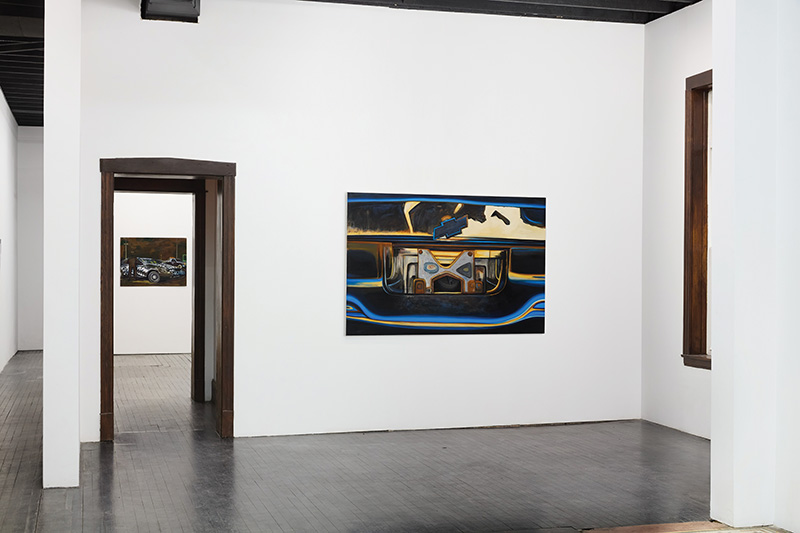
Installation view at M. LeBlanc. On wall: Marika Thunder, Egyptian Chevy (2024 -2025), oil on canvas, 48 x 72 in (122 x 183 cm). In far room: Marika Thunder, Demolition Derby, (2025), metal and oil paint on aluminum, 24 x 36 in (61 x 91 cm). Photography by Ian Vecchiotti
Thunder’s works all tap into a deep sentimental fondness for discarded things. All old objects tell a story--they are “has-beens,” whether they are old toys, vintage clothes, or, in this case, heavy American steel. Looking at these wrecks, one can’t help but wonder about their past lives: Who drove them? What road trips did they take? Were they once the pride of a driveway, driven to proms, weddings, funerals, or local parades?
There is a badass, rebellious energy in seeing a female artist take on subjects traditionally claimed by men. Thunder leans into the raw, nostalgic world of graffiti-covered wreckage and the “boys’ games” thrill of a demolition derby.
This appreciation for the soulful and the storied feels right at home at M. LeBlanc, a gallery that doesn’t shy away from deeper, darker, or more challenging work. The space has a decidedly European sensibility that adds an unexpected elegance to the grit of Thunder’s subject matter. Instead of the typical white cube, the gallery has a soulful character—from the built-in wood bench as you enter that feels like a church pew, to the old mosaic tiles on the front gallery space floor leading to an interior of warm wood floors. It’s a setting that feels purpose-built for showing solid, serious work.
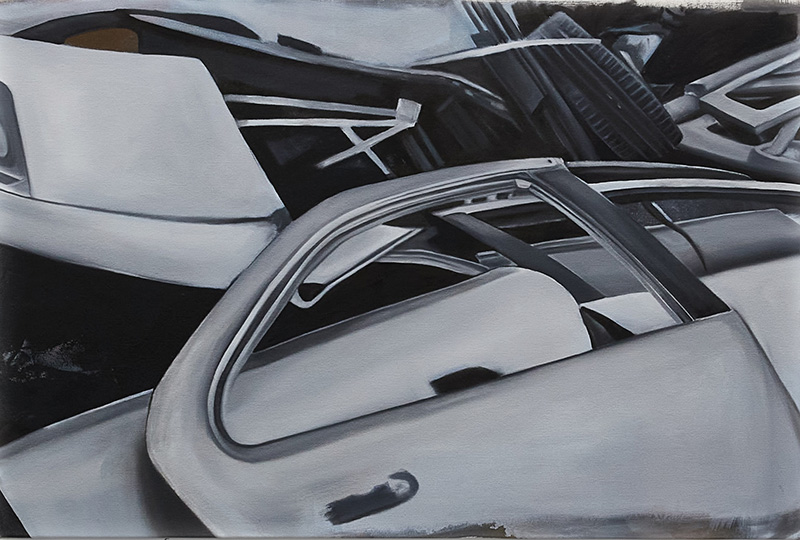
Marika Thunder, Car Doors B&W (2025), oil on canvas, 24 x 30 in (61 x 76 cm)
Some of these paintings, like the 48 x 72-inch Egyptian Chevy, are massive in scale and anchor the room with their gleaming parts. Others are more intimate, inviting a closer look. This intimacy is captured in smaller works like the 16 x 20-inch Junkyard Snowday (2025)—an oil and coarse medium on aluminum—and the black and bubble gum pink Soviet Cartoon Wolf (2025), which is oil on canvas mounted on panel.
Thunder, whose mother was born in Hungary during the Soviet era, tells us the title, Soviet Cartoon Wolf, is a nod to “Volk,” the chain-smoking, troublemaker wolf from the classic Soviet cartoon Nu, pogodi! As she puts it, she watched the cartoon growing up and “was obsessed with the wolf and his outfit. So, the color combination of pink and black is always associated with that for me.”
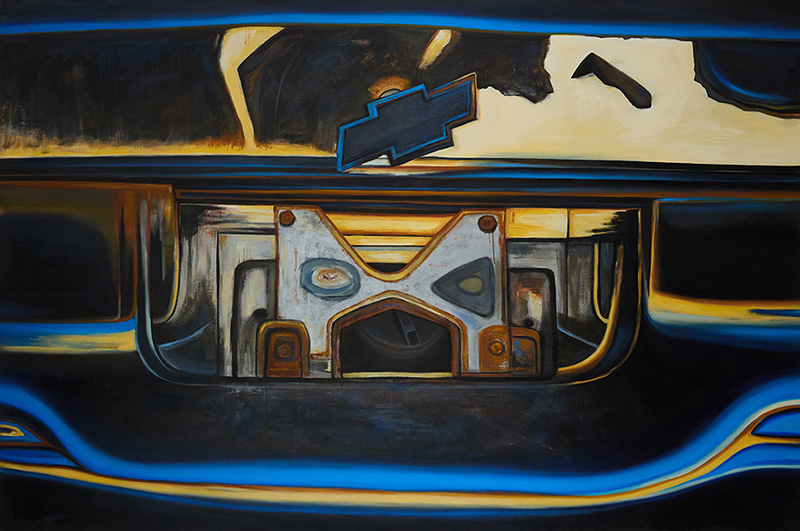
Marika Thunder, Egyptian Chevy (2024-2025), oil on canvas, 48 x 72 in (122 x 183 cm)
It’s these kinds of personal touches that make the mechanical decay feel so human. This raw energy and Thunder’s technical skills are exactly what drew LeBlanc to her work; he notes he feels “very fortunate” to have met the artist, finding her a “natural fit for his program and taste.”
That fit is evident in the work itself. These are real-deal painterly paintings; you can see the artist’s hand in every stroke, finding a haunting kind of beauty in twisted metal. It’s a reminder that even in the things we’ve tossed aside to rot, there’s still a story worth telling.
marikathunder.com • mleblancchicago.com
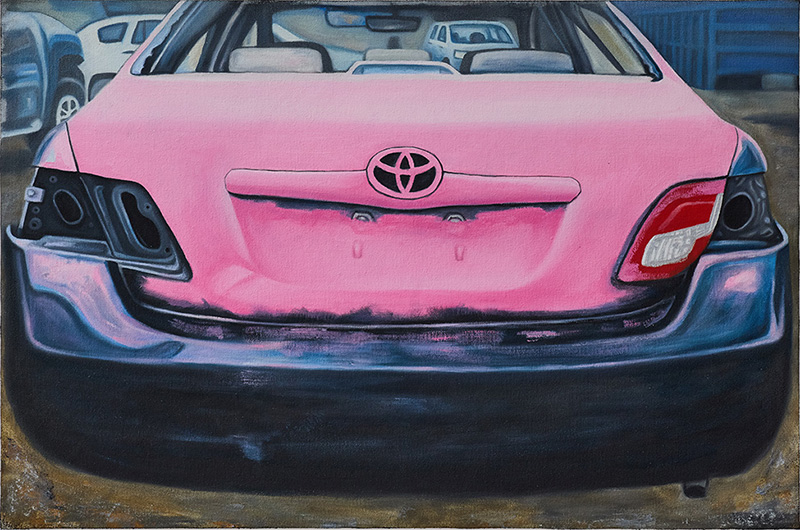
Marika Thunder, Soviet Cartoon Wolf (2025), oil on canvas mounted on wood panel, 16 x 20 in (41 x 51 cm)