From Chicago to Scotland: The Reach of Public Art
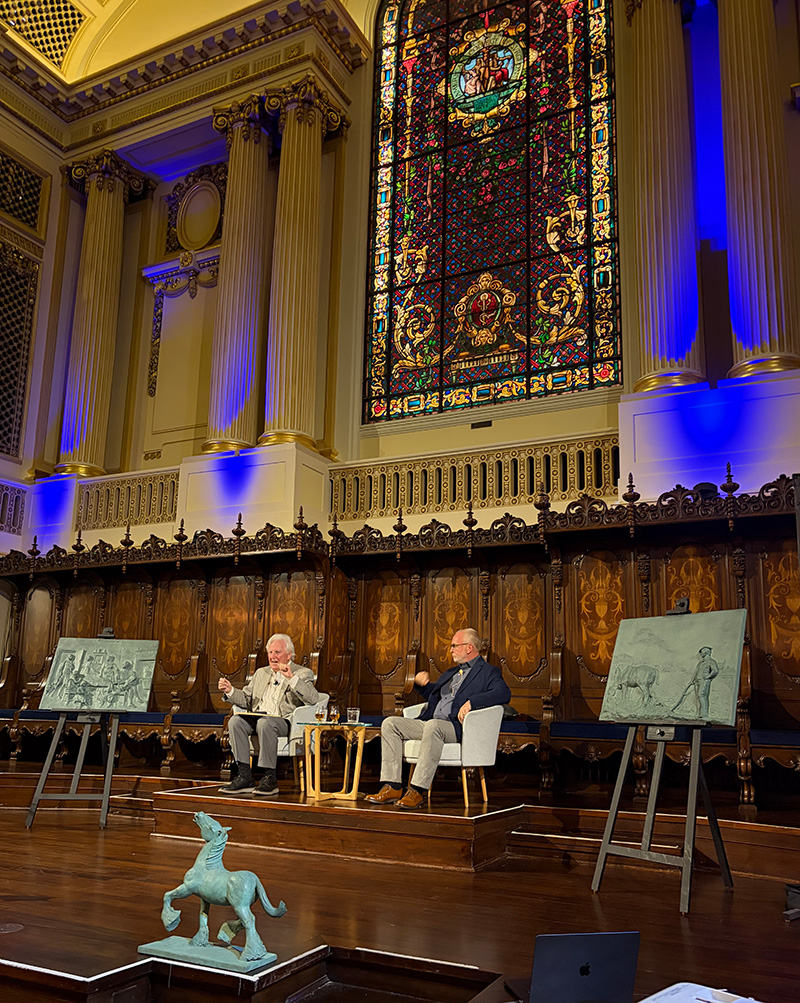
Professor Tony Jones and artist Andy Scott in the Driehaus Museum's Murphy Auditorium on August 29, 2026.
By GINNY VAN ALYEA
“Now in Chicago, we have a tradition of significant public sculptures, not without controversy,” Professor Tony Jones CBE observed during an August 29 conversation with Scottish sculptor Andy Scott OBE at the Driehaus Museum.
Hosted by Chicago Scots, the evening brought together artists, preservation specialists and members of Chicago’s Scottish community for a dinner and discussion about the cultural and economic importance of public art. It also recognized the restoration underway at the Robert Burns monument in Garfield Park, a gift to Chicago from its Scottish community in 1906.
Gary Maclean, National Chef of Scotland, prepared an exceptional three-course tasting menu with whisky pairings. Following dinner in the museum’s newly-restored auditorium, Jones and Scott turned to the work behind public sculpture, from securing funding and solving engineering problems to seeing an artwork become part of a community’s identity.
Jones and Scott met during Scott's student years at the Glasgow School of Art, which Jones then led. A sculptor himself, Jones later served as president of the School of the Art Institute of Chicago and is a Chicago Scots board member.
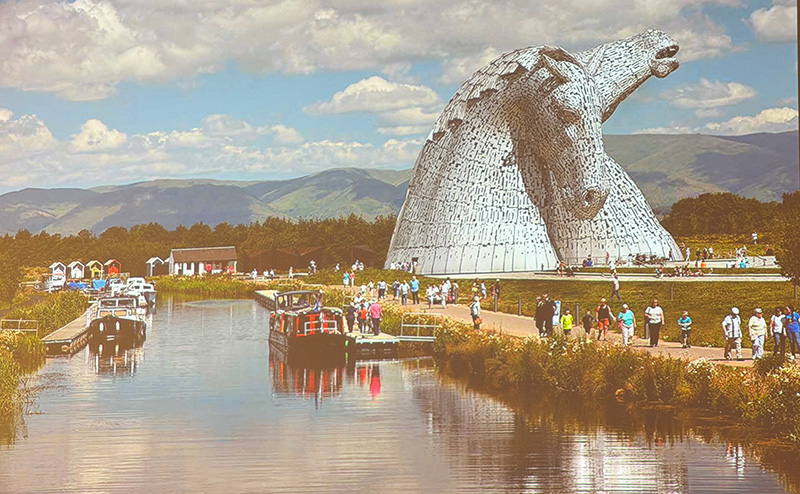
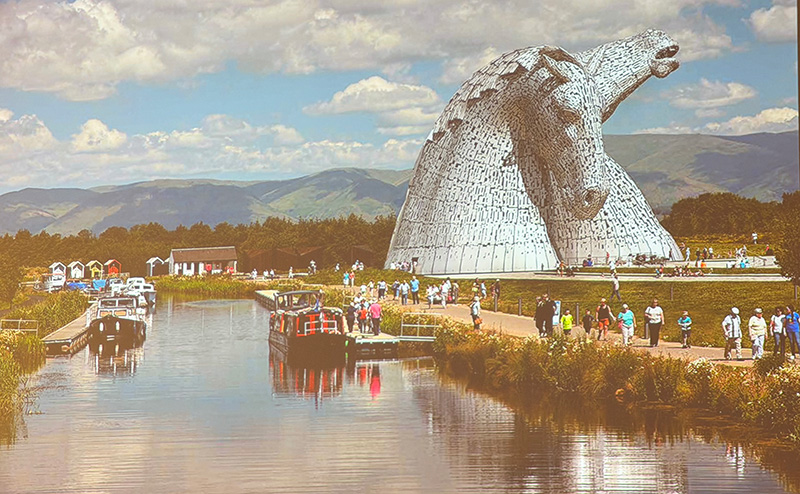
A view of Scott's The Kelpies in Falkirk, Scotland
Scott is best known for The Kelpies, two 100-foot steel horse heads in Falkirk, Scotland, inspired by the Clydesdales that worked along the canals and on the land. Chicago audiences encountered their maquettes on the lakefront during the 2012–13 Chicago Sculpture International exhibition.
Chicago, of course, offered an example of what ambitious public art could accomplish. Scott recalled using the city’s large-scale artworks as inspiration and to give his client team confidence in the project that became The Kelpies. That confidence was tested, he says. Scott described an eight-and-a-half-year process, prolonged by political impasses and funding difficulties. Some coverage became hostile. As the sculptures began to rise, however, opinions shifted in their favor.
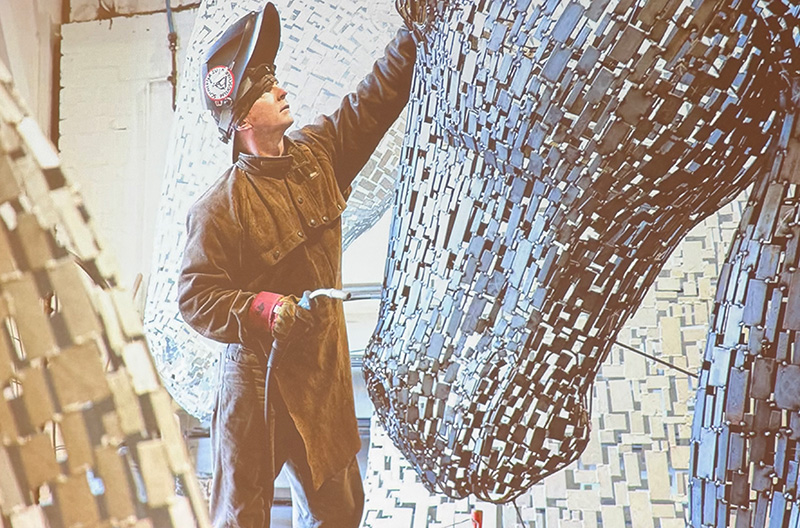
Scott during fabrication of the Kelpies
“You need to tough it out,” he shared.
At one point, financial pressures prompted suggestions to reduce the sculptures to roughly a third of their intended size, or build only one horse head. Scott and his wife, Hanneke, resisted.
“We drew a line in the sand and said absolutely not,” he recalled.
The finished sculptures became a tourism landmark and appeared in campaigns promoting Britain, including advertisements in China and at a London airport. In April 2025, Falkirk Council reported that The Helix, the park home to The Kelpies, had welcomed one million visitors in the preceding year, helping attract business to the area. Over a decade since their construction there are measurable benefits directly attributed to the Kelpies, including a tourism boost to Falkirk of 73% and 1,380 local annual jobs. Falkirk's population is just 40,000 residents.
For Scott, the response extended beyond visitor numbers. He pointed to “that passion and ownership and pride” among people who had embraced the sculptures.
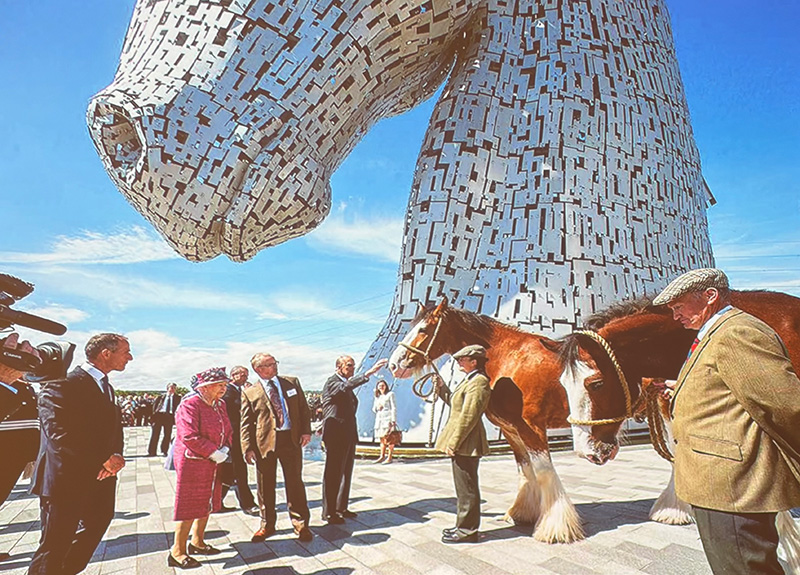
Queen Elizabeth and Prince Philip visited the Kelpies when the Queen officially opened the Queen Elizabeth II Canal in 2017.
Jones described a similar sense of attachment in Chicago. Recalling the opening of Jaume Plensa's Crown Fountain, he noted how quickly children adopted its shallow pool, learning to anticipate the water pouring from the faces on its towers.
“It was an amazing moment that we could never have predicted,” he said.
Jones went on to highlight the numbers that back up the impact of Millennium Park and its public art on the City of Chicago. From 2003-2026 the estimated impact is $2.5 billion. The Kelpies have not been in existence quite as long but their impact will last for decades to come.
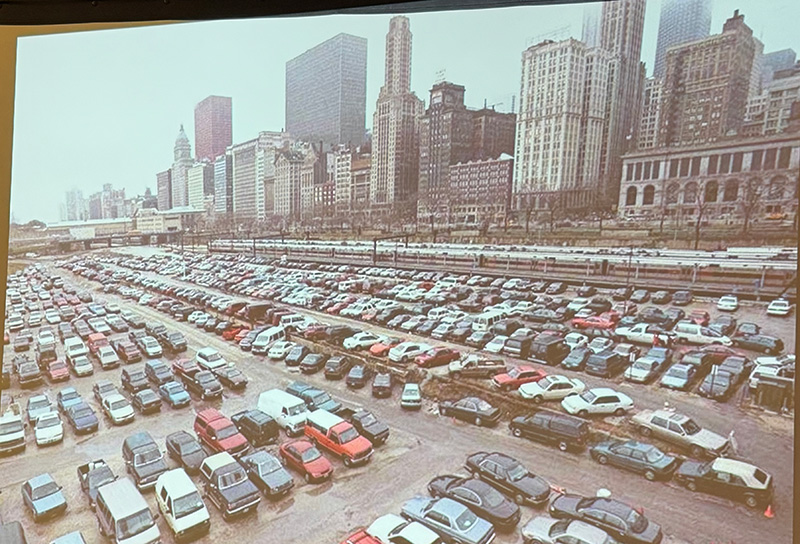
Jones shared a photo of the parking lot that Millennium Park and its public art replaced.
*
Public art was the theme of the evening, and not just because an internationally known artist from Scotland was in Chicago to discuss the Kelpies. The Chicago Scots have their own long history of supporting art that is part of the community. Chicago Scots, founded in 1845 as the Illinois Saint Andrew Society, joined other Scottish organizations in supporting William Grant Stevenson’s Robert Burns monument more than a century ago. Today, the organization is raising funds to supplement the Chicago Park District’s restoration budget and support ongoing maintenance of the ode to Scotland's national poet here in has a long history in Garfield Park.
Conservator and sculptor Andrzej Dajnowski, who attended the dinner, is in the process of recreating four stolen bronze relief panels that once belonged on the sculpture, as Burns’s missing quill. Dajnowski will quite literally help put a pen back into the poet's hand soon.
Andrew Schneider, the Park District’s director of historic assets, described its long-term stewardship partnership with Chicago Scots as the first of its kind in the district’s history and one that connects the creation of new landmarks with the responsibility of caring for those Chicago already has so that the public may enjoy art and its impact for the ages.
#
Publisher's note: Ginny Van Alyea has served on the Chicago Scots Board of Governors since 2009 and also attended the Glasgow School of Art in 2001.