Art Matchmaking: Hyde Park Art Center’s Not Just Another Pretty Face Returns This Fall
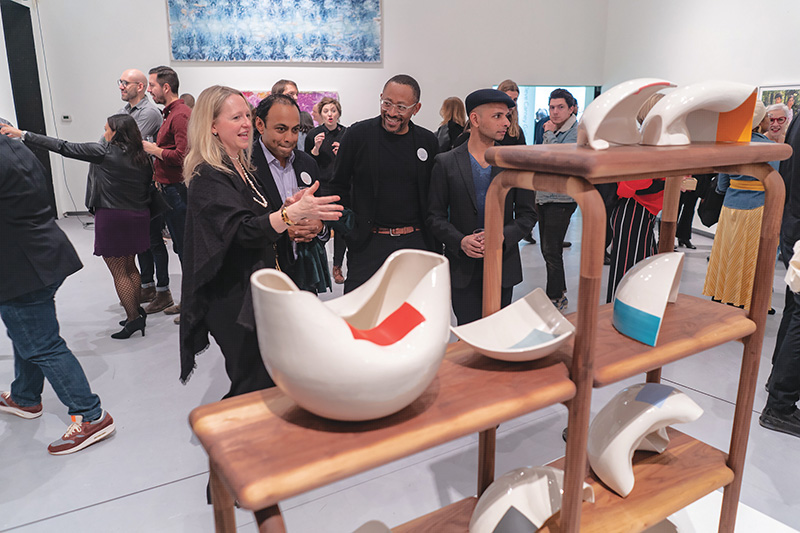
Collectors and artists attend the Not Just Another Pretty Face unveiling at the Hyde Park Art Center.
By JACQUELINE LEWIS
This year, Hyde Park Art Center is hosting the latest installment of Not Just Another Pretty Face (NJAPF). This special experience and exhibition began in the mid-1990s and occurs only every three years.
Not Just Another Pretty Face uses a matchmaking program to connect local patrons with artists. During this experience, patrons and artists choose each other, and the artist creates artwork specifically for that patron. Works range from traditional to experimental, depending on the artist chosen and the desires of the patron. At the end of the experience, the pieces are unveiled in an exhibition later this year before being purchased and taken home by the patron.
This matchmaking process differs from traditional art purchasing. Instead of collectors looking for works that already exist, purchasing them, and moving on, they become part of the artistic process and the work’s origin. Once matched, patrons meet with artists to discuss what they like and what they hope for from the final work, and the artist melds those desires with their own style.
The process cultivates a sense of generosity between artist and patron as they mutually share themselves and allow each other into their individual worlds. It facilitates lasting relationships that do not often develop naturally in gallery spaces and plays an important role in establishing broader financial support for the artistic community.
Director of Development Eric Thompson has been with Hyde Park Art Center since 2023, making this his second iteration of NJAPF. As this year’s program nears completion, Thompson offered insight into how the experience comes together.
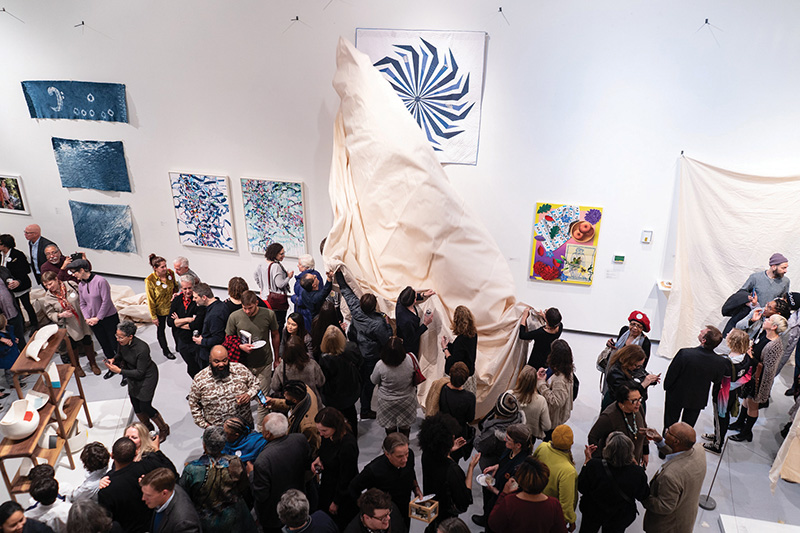
A commission being unveiled at Hyde Park Art Center
Jackie Lewis: What is the process for artists and patrons to sign up for this experience?
Eric Thompson: For the artists, our team begins reaching out to invite them to participate about 18 months before the unveiling. For this iteration, conversations began in late spring 2025. They provide information on their artistic process, image examples of their work, and their commission rate. Our team then publicizes this information on our website and presents the artists at various salons throughout the city.
Several supporters of the Art Center host NJAPF salons and invite their own guests. Potential patrons learn about the artists and the project at large and express interest with our team. From there, we work to get the commission started!
JL: Once artists and patrons are chosen, what does the matchmaking process look like? Is there any process beyond the salons?
Eric Thompson: Much of the process happens after the salons. Patrons and the Hyde Park Art Center staff discuss artists who have piqued their interest. The HPAC staff sets up studio visits with the artists, giving the patron and artist a chance to meet, learn about each other, and discuss a possible commission. Sometimes artists may meet with multiple patrons through the project, and patrons will visit multiple studios before making a decision. Once a patron and artist agree to work together, the artist begins the work.
JL: What is your role in the process? How does HPAC support both the artists and the patrons?
Eric Thompson: NJAPF is a win-win-win situation for all parties. The patron has the opportunity to meet amazing Chicago artists, receives a unique commissioned work, and has that piece included in a public exhibition at the Art Center. The artist receives payment for the work, has the opportunity to expand their network of collectors, and often pushes their own practice through this process. The Art Center also benefits, as half of the commission serves as a tax-deductible donation that supports our mission to sustain Chicago art and artists.
JL: What aspect of NJAPF do you think has the greatest impact on the Chicago art community?
Eric Thompson: The project itself embodies the mission of the Art Center: it is designed for artists in Chicago to flourish. I think the greatest impact from the program’s ten iterations is the access it has created between artists and patrons. Relationships have been built. It is all about connection—a personal connection to the art and the connection between the artist and the patron. As a staff member, it is a wonderful thing to observe.
*
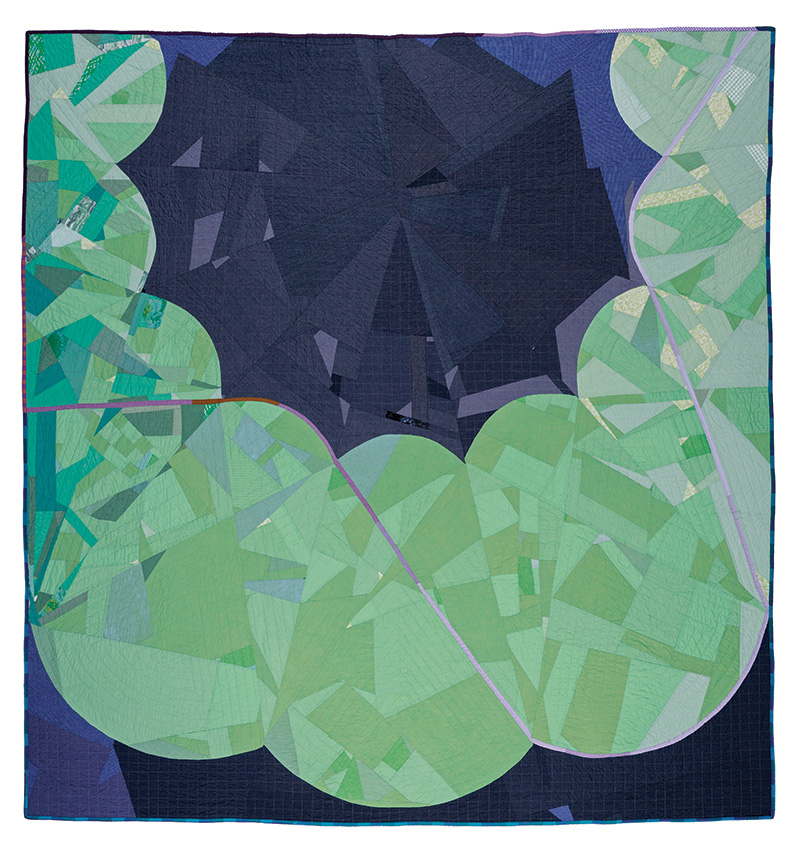
Sarah Nishiura, Inching
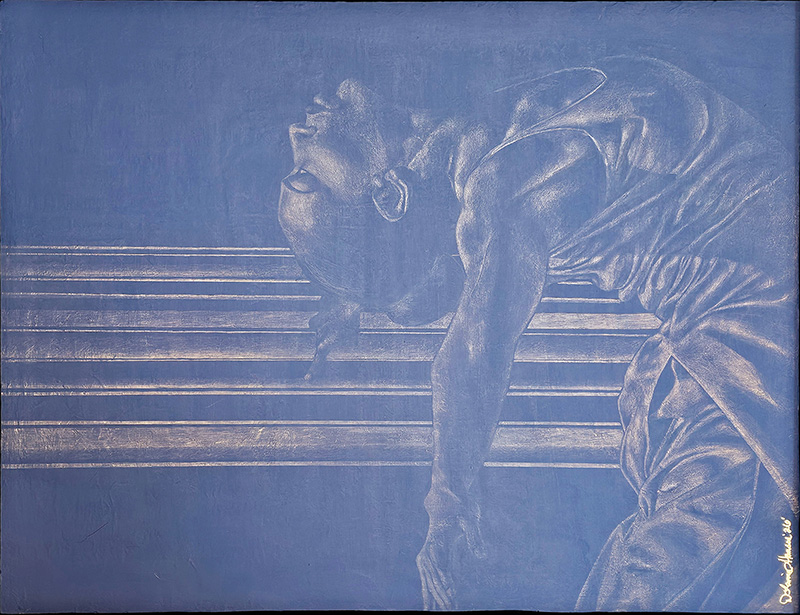
D. Lammie-Hanson, Agility to Surrender, 14k gold on Acrylic (wood panel)
A Word From the Artists
For a deeper understanding of the experience, artists D. Lammie-Hanson and Sarah Nishiura shared their own perspectives. Both have completed commissions for NJAPF in the past and are currently creating work for this year’s iteration.
JL: How did you first learn about NJAPF, and how did you become involved?
Sarah Nishiura: I have been teaching and exhibiting with the Hyde Park Art Center for over 15 years now, and I think it was through this affiliation that I was first invited to participate in NJAPF. I was lucky enough to receive two commissions the first year that I participated, and I think this success led to repeat invitations through the years.
D. Lammie-Hanson: I learned about NJAPF through an email invitation from Hyde Park Art Center. After I responded that I was interested, they placed me in their rotation to be presented to their patrons.
JL: How has working with NJAPF affected your artistic career? Did it fit within your practice?
Sarah Nishiura: My favorite thing about NJAPF is the opportunity to step outside my usual practice to try something different. Many of the commissions I have done in the past have involved working with materials given to me by the patron. This presents technical challenges that I wouldn’t normally take on, but I learn so much from stepping outside my comfort zone every few years. I have had continued relationships with patrons, and I have appreciated seeing the commissioned pieces in their homes. There is nothing better than seeing your work be part of someone’s life.
D. Lammie-Hanson: The patron trusted me to interpret their direction through my own lens. They gave me the subject and overall intent, and I stayed grounded by making creative choices around composition and focus that matched their goals while keeping my personal approach. Because metalpoint/silverpoint isn’t a widely known medium, working with NJAPF and Hyde Park Art Center helped me present my process to a wider audience. It also strengthened my broader portfolio by giving my work a strong platform and context.
JL: What was your experience working with a patron? How did it differ from your usual process?
Sarah Nishiura: The two patrons came by my studio, and we immediately found we had a lot in common and a lot to talk about. We shared some of our favorite artists, our experiences with travel, our love of craft and nature, and from these conversations they came up with great ideas for jumping-off points for the commission. At the same time, they let me know they really wanted me to have the freedom to go in any direction I wanted with the final piece. This experience only differed from my usual process because it began with conversations with other people rather than the conversation that usually happens in my own head!
D. Lammie-Hanson: The patron visited my studio while I was an artist in residence at Little Black Pearl, and we discussed his vision. He chose my silverpoint-on-black/metalpoint technique, and we developed the direction together. This differed from my usual process because I don’t usually enjoy doing commissions, but I enjoyed working with Hyde Park Art Center through this program. After we aligned on the creative direction for the artwork, the patron gave me the freedom to carry out the piece according to my own vision.
JL: Since you have participated in NJAPF before, what made you decide to do it again?
Sarah Nishiura: I love HPAC, and I feel like this is a great program that allows me to support their mission while also giving me a wonderful opportunity to work with collectors I might never meet otherwise. It is a win-win!
D. Lammie-Hanson: I enjoyed the opportunity to work with Hyde Park Art Center again. I submitted my interests without knowing which new collectors would be interested, but I was willing to take the chance, and I’m glad I did.
*
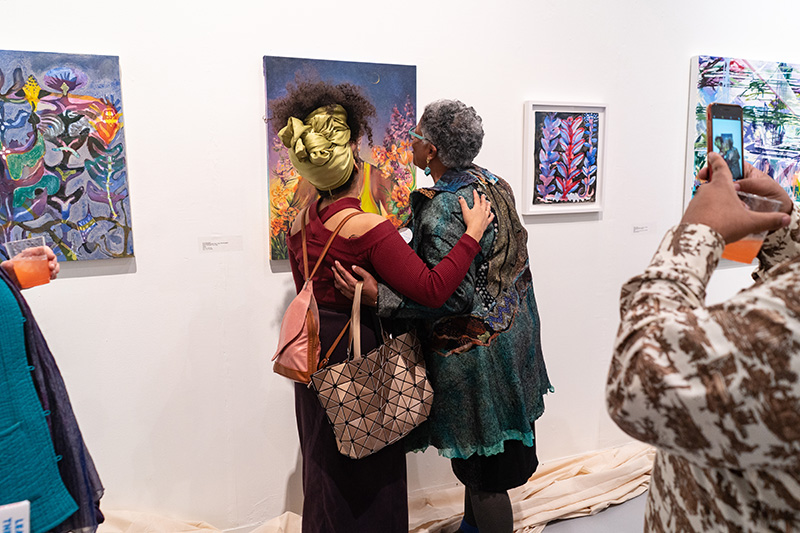
Unveiling party attendees at Hyde Park Art Center
From the Collectors
To understand more about another side of the program, Ginny Van Alyea, CGN’s publisher and a past participant of NJAPF, shared her perspective as a patron who commissioned a work by artist Mel Watkin several years ago.
JL: Before NJAPF, did you consider yourself an art collector? Had you ever commissioned a work before?
GV: NJAPF appealed to my husband and me because we had bought art separately and together, but we hadn’t commissioned anything. My parents gave us the commission as a wedding gift, so it was especially meaningful.
JL: Before meeting with the artist, did you have a specific idea for the artwork you wanted?
GV: We looked through a lot of artwork before deciding whose work would be the best fit. There were so many choices, but we liked Mel Watkin’s particular focus. It felt like a good fit for creating something that spoke to both of us and our families when we got married.
JL: What was your experience working with the artist like? Did it feel collaborative?
GV: Working with Mel on a piece that was just for us was so cool. We sent images, ideas, and references back and forth. We met for coffee. We gave a little feedback but also listened to what she suggested. It was definitely a collaborative experience, but ultimately it was still the artist who made the art.
JL: Have you continued your relationship with your paired artist?
GV: Yes! A few years later, for a milestone birthday, I commissioned Mel again to make two more works: one about our daughter and one about our son. Now all three works hang together at home.
JL: Is there anything else you’d like to add about the experience?
GV: I know many collectors who have participated in the program more than once, and I can see us doing it again someday. It’s a wonderful chance to work with a local artist while also setting the parameters—like price and size—up front, which is another unique benefit of the program. It’s also terrific to support HPAC and local artists at the same time. While there are some big artist names in the program, NJAPF is also a wonderful way to discover emerging artists.
*
This year’s unveiling reception will take place on December 11, 2026, from 6:00–8:00 p.m. at Hyde Park Art Center. Following the reception, the artwork will remain on display and will be accompanied by a catalogue documenting the entire process for patrons, artists, and visitors alike.
The success of NJAPF has extended beyond Chicago, with similar exhibitions adapted in Boise, Indianapolis, Philadelphia, and Salt Lake City. To date, the program has generated more than $2 million in sales. Half of the proceeds go directly to participating artists, while the other half supports Hyde Park Art Center’s programs and mission. With more than 400 works commissioned by over 300 new and established collectors, NJAPF has cultivated an ecosystem of patronage that enables artists to thrive.
By embracing and encouraging the idea of patronage in contemporary art, NJAPF has built a community of people who value not only finished works of art, but also the creative process behind them. If you missed your opportunity to participate this year, consider becoming a patron for the next iteration.
More details at hydeparkart.org/njapf-2026/