From Idea to Place: The Invisible Journey of Public Art
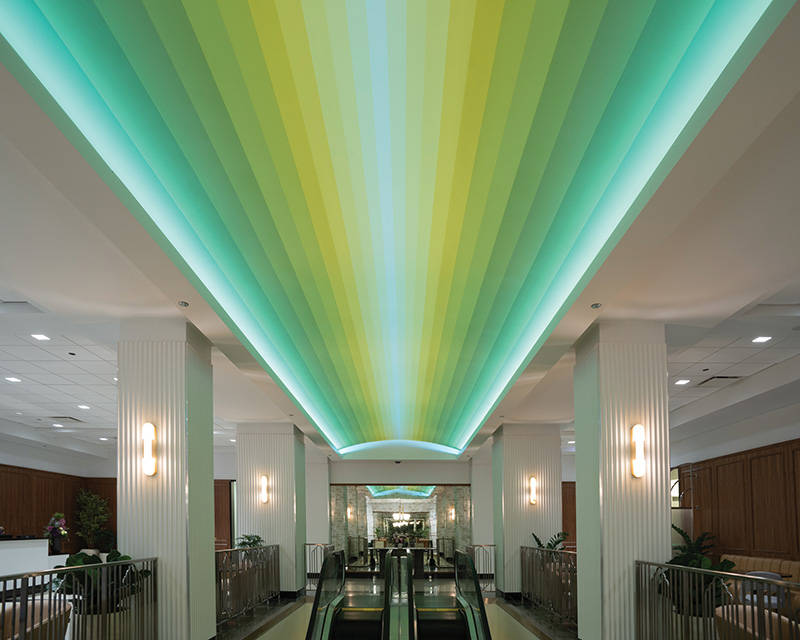
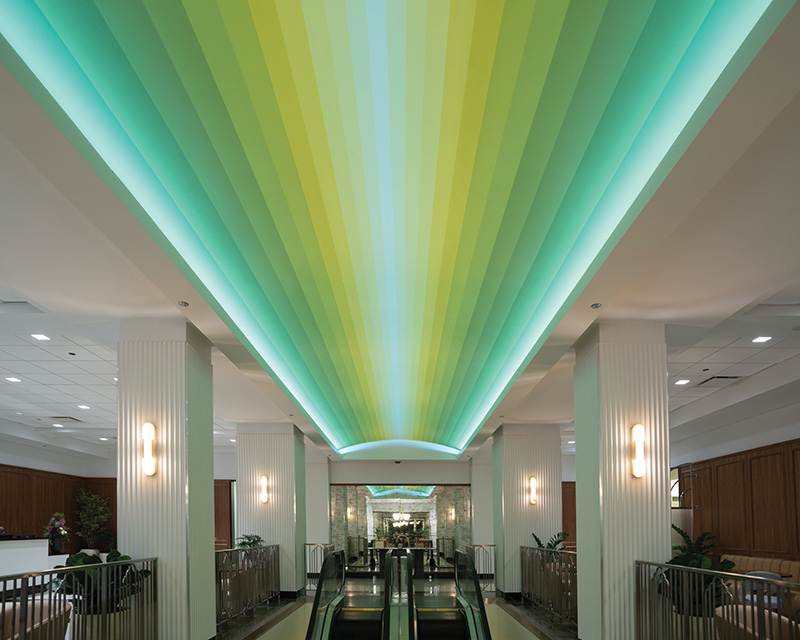
Luftwerk, Yellow Light to Dark, Acrylic paint, LED programming, 45’ x 15’, Chicago Board of Trade Building, 2025. Photo by Aron Gent
By CORTNEY LEDERER
When we encounter a public artwork, we often only experience the finished piece. We may pause beneath a sculpture, walk through an immersive installation, gather in a plaza, or pass an artwork on our daily commute. We rarely think about what came before it.
What remains invisible are the years of conversations, site visits, research, community engagement, artistic experimentation, engineering, fabrication, debate, and collaboration that allow a single idea to become part of a community.
That invisible but exciting journey is exactly where my work begins.
Every public artwork begins with an idea and a possibility.
A city hopes to transform a neglected riverfront into a place where people gather. A corporation wants its headquarters to reflect its history and values. A landmark building wants to become more welcoming. A community asks how forgotten stories might finally become visible. A museum imagines extending its mission beyond its walls.
Through CNL Public Art Consulting, I help transform those early ideas into opportunities for artists to imagine what does not yet exist. The most rewarding part of the process isn’t finding someone to execute a vision—it’s identifying the artist who will challenge it, expand it, and reveal possibilities none of us could have imagined at the outset.
That invisible transformation—from an idea to an artwork that becomes part of a community—is what has captivated me for nearly a decade.
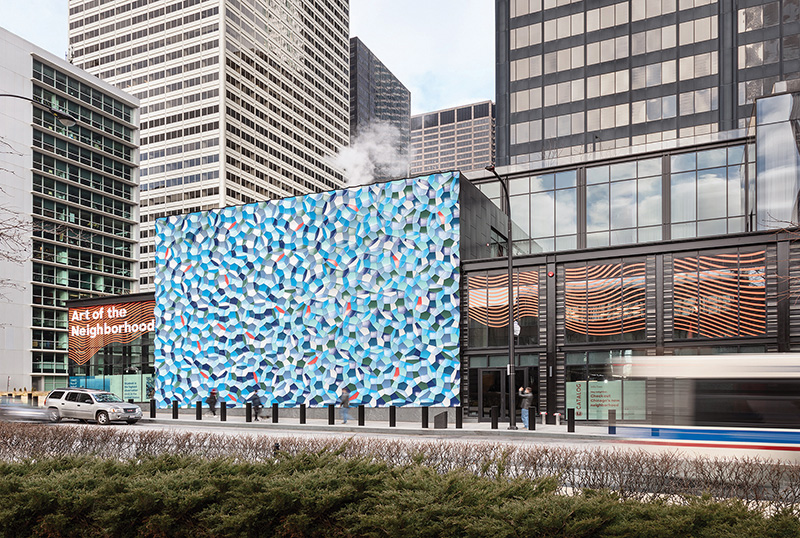
Olafur Eliasson, Atmospheric wave wall, 2020, Willis Tower, Chicago, Photo: Darris Lee Harris, Courtesy of EQ Office Chicago
After serving as Director of Exhibitions at the Chicago Artists Coalition, where my work centered on building community through residencies, exhibitions, and professional development, I stepped into a world where art became deeply intertwined with architecture, engineering, history, ecology, and civic life. I quickly realized that successful public art is never created in isolation. It requires curiosity, trust, advocacy, collaboration, and an extraordinary willingness to embrace the unknown.
One of the first artists who fundamentally changed the way I think about public art was Olafur Eliasson. While working with Gensler and EQ Office to develop Art of the Neighborhood at Willis Tower, I watched his process unfold long before a sculpture ever took shape. Before discussing the form, Olafur set out to better understand Chicago’s physical environment. Inspired by the movement of wind and sun across the surface of Lake Michigan and the Chicago River, he crafted 1,963 metal tiles to reflect the light of the sun, with concave surfaces to collect shadows that shift as the day progresses. The sculpture, Atmospheric wave wall, didn’t simply respond to its location—it emerged from it.
After the project was completed, Olafur shared that he hoped the work would “make a positive contribution to the building and to the local community by reflecting the complex activity all around us.” He believed that understanding how our perspective shapes what we see “is an important step toward realizing that we can change reality.” Watching him move so seamlessly between scientific observation, philosophy, and artistic expression fundamentally shifted the way I think about site-specific public art. The invisible work of observation, listening, and research is every bit as important as the visible artwork itself.
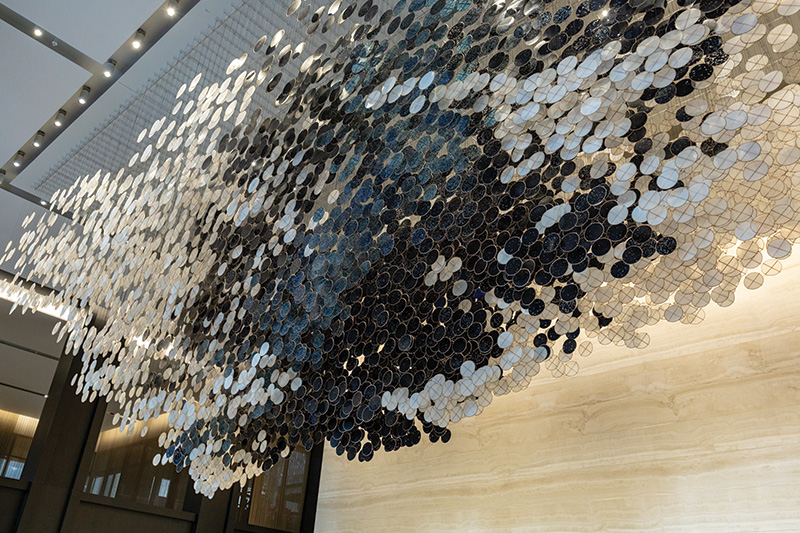
Jacob Hashimoto, In the Heart of this Infinite Particle of Galactic Dust, 2019, Composed of resin, bamboo, UV prints, acrylic, and stainless steel, Photography by Ed Knigge Courtesy of EQ Office Chicago
As Olafur provided a fascinating example of how artists research a project, Jacob Hashimoto engaged in his own deep research and exhibited what it takes to translate ambitious ideas into a beautiful sculptural installation that is new and fresh with each experience. Standing beneath Jacob as he balanced on a crane, high above the Wacker Lobby, I watched more than 7,000 hand-crafted resin kites slowly transform into a luminous cloud floating above that visitors experience as something effortless and ethereal.
I had the privilege of witnessing the years of engineering, fabrication, coordination, and trust required to make that seemingly impossible moment a reality. Yet what I remember most isn’t the installation itself. It’s returning to the lobby weeks later and noticing individual kites continuing to move almost imperceptibly with the currents of air passing through the building. That quiet movement is a beautiful reminder that some aspects of an artwork can never be fully controlled. Jacob conceived of a work that continues to respond to its environment long after the installation crew has left. The sculpture is never static—it remains alive, shaped by the invisible forces surrounding it. Those experiences taught me that public art isn’t simply placed within a site—it evolves within it.
That lesson continued while working on the Chicago Board of Trade Building with Gensler and R2 Companies. Here, the challenge wasn’t simply commissioning contemporary art but connecting artists to one of Chicago’s most historically significant buildings. Artist Bob Faust distilled the visual language and relentless energy of the trading floor into a series of bold contemporary imagery. Artist collaborative Luftwerk responded to the building’s remarkable Art Deco architecture through an immersive light installation that rests above the escalators and transforms the experience of the newly designed lobby. Each artist approached the same building uniquely, reinforcing something I’ve come to believe: there is never simply one approach to a site. The right artist reveals possibilities we might have never imagined.
*
Serving as Public Art Consultant for the Chicago Park District’s response to the Chicago Monuments Project challenged me again to think differently about the role of public art. Working alongside an extraordinary advisory committee of artists and cultural practitioners, we selected artists Hector Gonzalez and collaborative team Sonja Henderson and Sadie Woods to create temporary, site-responsive installations that introduce new narratives into Chicago’s public landscape.
Hector, Sonja, and Sadie each approached their individual works with extraordinary care—not only for the artwork itself but for the communities who would encounter it. Every decision, from the materials they selected to the programming, performances, and conversations surrounding the installations, was guided by a deep sense of responsibility toward the public experience and to the work’s narrative. Their work is a reminder that the most meaningful public art is something people participate in, question, and carry with them long after they leave the site.
*
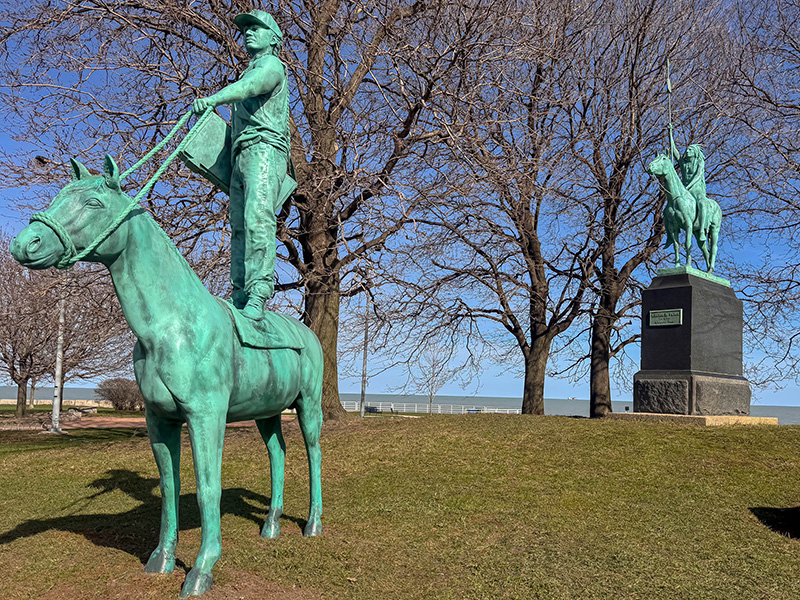
Hector Gonzalez, TIERRA NUESTRA, 2026. Photograph ©Sandra Steinbrecher
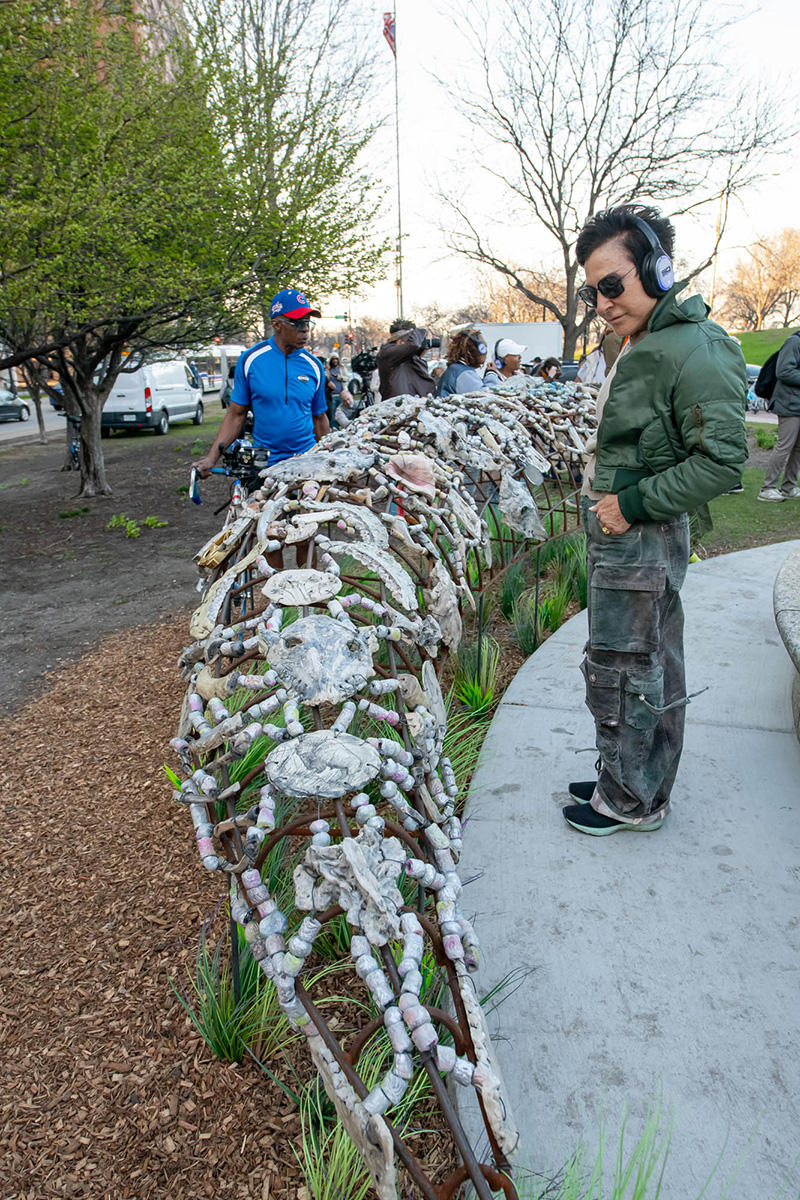
Sadie Woods and Sonja Henderson, We Still Here, 2026.
Not every project begins with commissioning a single artwork. Sometimes the invisible work is building the framework that allows great public art to happen.
Working with EQ Office at the United States Bank Centre in Seattle, I researched artists throughout the Pacific Northwest to build a collection rooted in the region’s creative and ecological identity. Visiting galleries, speaking with artists and curators, and discovering practices shaped by the Northwest’s landscape, culture, and design traditions reminded me that curating a collection is also an act of storytelling.
That same philosophy shaped our work with the City of Wichita. Rather than beginning with artists, we began by creating the conditions that would allow great artists to succeed. Together we built the public art program itself, assembled a national selection committee, and ultimately selected Ivan Depeña, Chris Pappan, and Scott Hocking to create permanent works that will become part of the Arkansas River for generations. Much of that work will remain invisible to the public, but it is essential to every successful commission.
Today, one of the most meaningful projects of my career is supporting the Alabama Historical Commission, alongside Ralph Appelbaum Associates, Room for Magic, and Civic Projects on The Clotilda Memorial, which will honor the last known African captives trafficked to the United States through the transatlantic slave trade, while celebrating the resilience and enduring legacy of the Clotilda survivors.
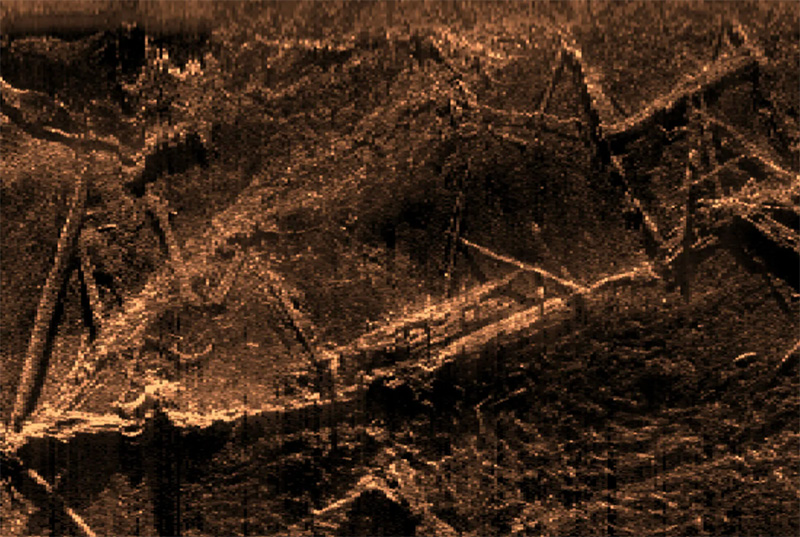
A sonar image showing the wreckage of the Clotilda, the last ship known to have brought enslaved people to the United States from Africa. Credit: Alabama Historical Commission, via Associated Press
The conversations surrounding this project have been critical to its development. Listening to members of the jury, historians, descendants, and community leaders has reinforced the urgency and responsibility of this memorial. Every word matters. Every interpretation matters. We have continually returned to the question of how a work of public art can honestly acknowledge profound trauma while also honoring extraordinary resilience. It has reminded me that the most meaningful memorials do more than commemorate the past—they create space for truth, reflection, and healing, ensuring that those most directly affected by history help shape how that history is remembered.
Looking back over the past decade, I’ve realized that while every public artwork begins differently, they all share a similar invisible journey. They begin with an idea, grow through collaboration, and are transformed by artists whose imagination allows us to see our world differently.
By the time a public artwork is unveiled, most people see only the finished piece. I have the privilege of witnessing everything that comes before it—the research, the conversations, the experimentation, the debate, the trust, and the extraordinary collaboration that allows an idea to become something lasting.
Perhaps that is the real artwork. Not only the sculpture, mural, memorial, or installation that stands before us, but the invisible journey that brought it into being—and the countless people whose imagination, care, and commitment made it possible.