From West Loop to West Town: The Development of an Arts District
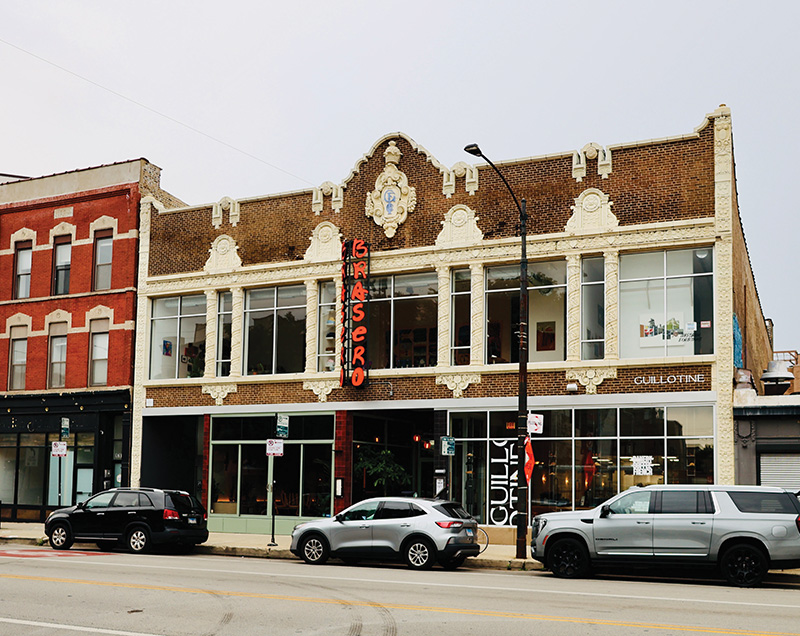
A view looking across Chicago Ave. in West Town to the 1709 building. Photo by CGN.
By ELISA SHOENBERGER
When you think of West Town, you may think of an abundance of art galleries and restaurants. But that reputation as a center of the city’s contemporary art scene is a relatively recent one. With a decade in the rearview mirror, what now seems well-established is a change that did not happen overnight.
Previously, and for many years following a gallery migration from the traditional nexus of River North, the West Loop was a Chicago art scene hot spot, particularly near Randolph Street and its restaurants. In 2016 galleries began leaving the West Loop to find new, more affordable spaces, which they found in West Town. Today there’s arguably a larger concentration of galleries in the area than there was in the West Loop, and the shape of a definitive arts district has formed in a part of the city that offers sustainable options for galleries to exist. Five gallerists share their thoughts with CGN about what it took to get here and what West Town is today.
Needing a New Home
West Loop initially offered gallerists great opportunities to grow their galleries and reputations, but in time, the neighborhood’s popularity made it harder for businesses to be sustainable. Monique Meloche, owner of moniquemeloche (451 N. Paulina), opened her gallery to the public in 2001 in the West Loop because “That’s where everyone needed to be.”
Claire Warner, co-owner and co-director of Volume Gallery (1700 W. Hubbard), explains that the West Loop presented a lot of advantages; there was an abundance of vacant and raw spaces that worked for holding art shows. Additionally, landlords seemed to really like what the galleries were doing to bring clientele to the area. Attracting people to the new destination was also a great benefit for the burgeoning restaurants nearby.
However, that adjacent success had another cost, Warner explained, “the restaurants really started bringing in a lot of traffic to the area, and we noticed during exhibitions that our clients weren’t able to park or come up to the gallery to see the show, which was really disappointing.”
On top of that, landlords’ priorities began to change. Scott Speh, founder and director of Western Exhibitions (1709 W. Chicago), says that landlords initially let galleries share floors between different galleries, which included Volume Gallery and DOCUMENT.
As the neighborhood gained popularity, the landlords decided they wanted to rent entire floors, not parts of floors. That meant that the galleries had to find a new location.
Meloche noted that the neighborhood’s success, largely driven by galleries in the first place, eventually priced many of the same galleries out. Her gallery moved earlier than others, in 2008, to Wicker Park/Bucktown, before eventually moving to its current location at Paulina and Hubbard.
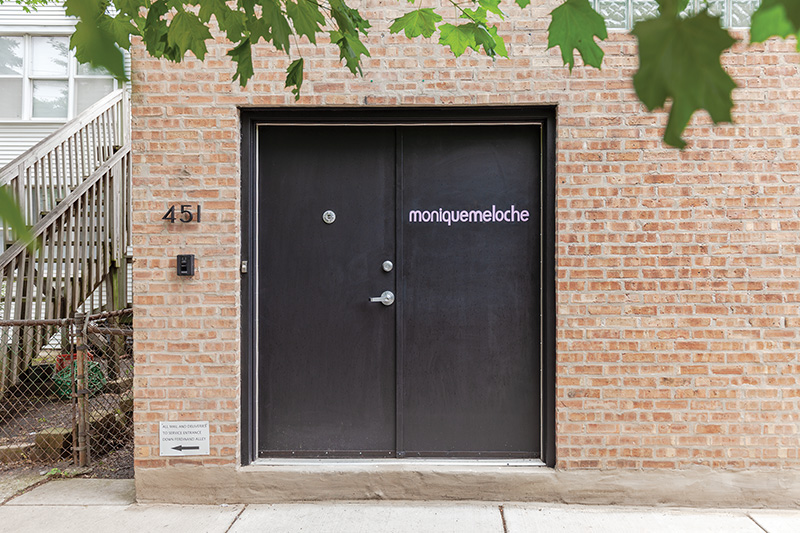
The entrance to moniquemeloche on N. Paulina St.
The Right Feel
As the West Loop became less sustainable, gallerists needed to find more suitable locations. Warner wanted to find an area that was unlikely to develop as quickly as Randolph Street. She looked for something that felt equally commercial and residential. She recalls, “We wanted mostly the scale to feel like it was walkable, where people would want to spend time, and so we went out and looked all over the city.” Ukrainian Village and West Town fit the bill for the neighborhood feel she was seeking.
It was also a group effort to find a location that worked for all three galleries, DOCUMENT, Volume, and Western Exhibitions, which had previously been at 845 W. Washington. Speh explains, “We all liked each other. We didn’t feel our programs overlapped at the time, and we all worked well together. So we decided we were going to look for a new address that would house all of us.”
In late 2016/early 2017, they found a building that was suitable at 1709 W. Chicago Ave. Owned by their former West Loop landlord, Warner says, “They were more than happy for us to bring the same energy into West Town that we had into [845 W. Washington]. It felt like we could all be a community together but maintain individual spaces.”
Other gallerists also saw the benefits of the neighborhood. Sara Dulkin, owner and gallery director of Chicago Truborn (1741 W. Chicago), was already living in West Town when she first incorporated her LLC to create her gallery in 2011. She began curating shows at street festivals and held independent pop-up shows before moving into a physical storefront at 1418 W. Division in 2013.
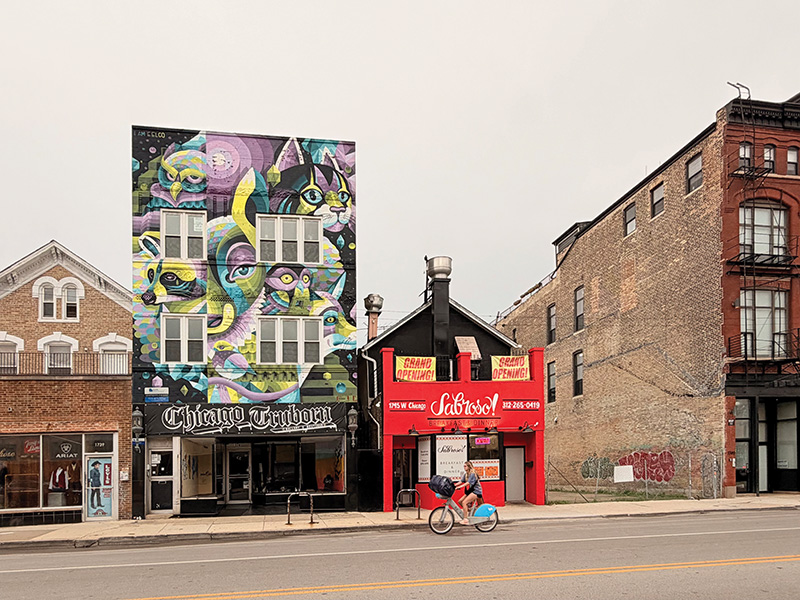
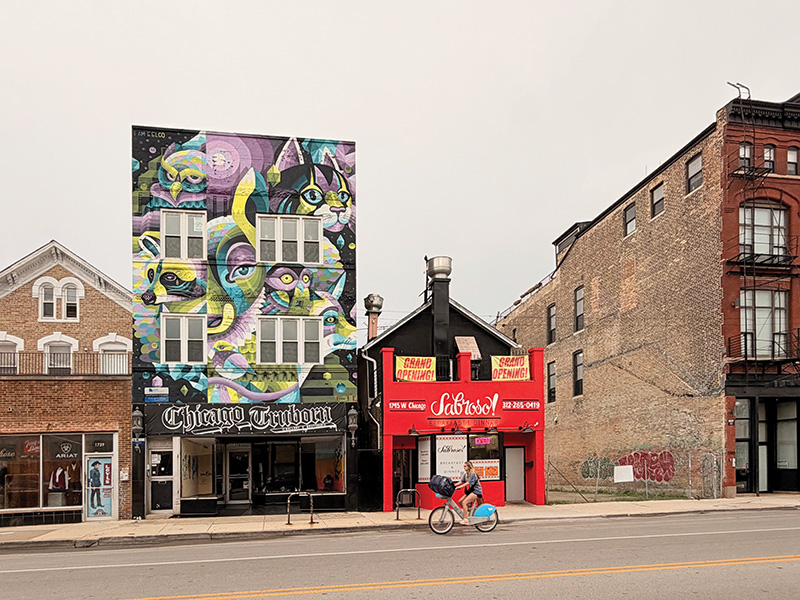
The street view of Chicago Truborn on Chicago Ave.
Dulkin found her current gallery space on Chicago Ave. simply by walking the neighborhood and keeping an eye out. She eventually passed a vacant, dark storefront that intrigued her. When she learned it had a dirt floor and two fluorescent lights, she still saw that it fulfilled her needs. With a manageable size of around 1,000 square feet and large, street-level windows that could display murals while staying protected from the elements, as well as vandalism, it also reminded her of her family’s shoe business. “It was just the perfect size and felt like a good neighborhood,” Dulkin says.
Dulkin notes that the area likely attracted art galleries and art enthusiasts in part because of its number of public murals. Today for many of Chicago Truborn’s exhibitions, Dulkin continues to work with local businesses and other entities to get permission to paint murals nearby, an ongoing effort that she says has resulted in crowds coming to the area just to see and photograph them.
As galleries began to move in in greater numbers, that collective momentum encouraged other galleries to follow suit. Meloche recalls that a year after she moved to West Town, fellow gallerist and friend Mariane Ibrahim asked about moving her gallery into the space next door. Meloche remembers thinking “That makes perfect sense. We have such overlap in our programming and in our clientele.”
Meloche says that a big advantage of having everyone in the West Loop in the 2000s was that it was easy for clients and other visitors to go to multiple galleries at once. That would prove just as true in West Town.
In the spring of 2017, Richard Gray Gallery, which had long been based in the Gold Coast, opened a warehouse location in the Kinzie Corridor at 2044 W. Carroll, which provided more exhibition space, explains Valerie Carberry, President and Chief Executive Officer, at GRAY. In 2024, they moved all Chicago operations to West Town.
A year later another Chicago mainstay with a national reputation, Rhona Hoffman, moved from her West Loop North Peoria space to 1711 W. Chicago. Hoffman’s ground floor presence on the street cemented the significance of what was developing for galleries, both new and established, in West Town.
West Town Today
When asked about West Town today, the gallerists I spoke with all agreed that it remains a vibrant place for galleries to do business. Speh notes that it’s easily walkable, dense but not too dense, and filled with a diversity of businesses. “It’s been a great location,” Speh says, “Unlike the West Loop, there’s not a new high-rise going up every three weeks. It still feels manageable.”
Warner concurred that she felt West Town “could accommodate galleries without overwhelming the neighborhood or having to adapt amidst the kind of overnight development that took place in the West Loop.” She hoped the new neighborhood would have a slower pace of change.
Since Volume Gallery’s relocation to West Town in 2017, Warner says she feels like the area has largely stayed the same in a good way. “I think we’re finding ways to kind of work with the larger community here and not overwhelm it, while also building up a sense of community in the galleries and working towards a critical mass here as well.” Warner credits a supportive alderman, Alderman Walter R. Burnett Jr., and an active [West Town] Chamber of Commerce. Since GRAY consolidated in West Town, Carberry notes there have been recent upgrades in the neighborhood, including the renovated Green Line Lake Street station, as well as investment and improvements for 2024’s Democratic National Convention, which took place nearby at the United Center. She says, “Overall, the neighborhood is much livelier and more pedestrian and bike-friendly.”
The evolution that Volume was part of a decade ago continued when Warner and gallery partner Sam Vinz moved out of 1709 W. Chicago to an expansive space at the corner of N. Paulina and W. Hubbard. David Salkin made the same address change as well. Now Volume is close to Meloche and Ibrahim, as well as Secrist | Beach. Elise Seigenthaler, who worked for Rhona Hoffman before she closed in 2025, opened in January 2026 where Volume used to be, with Ox-Bow School of Art opening an office in the space as well.
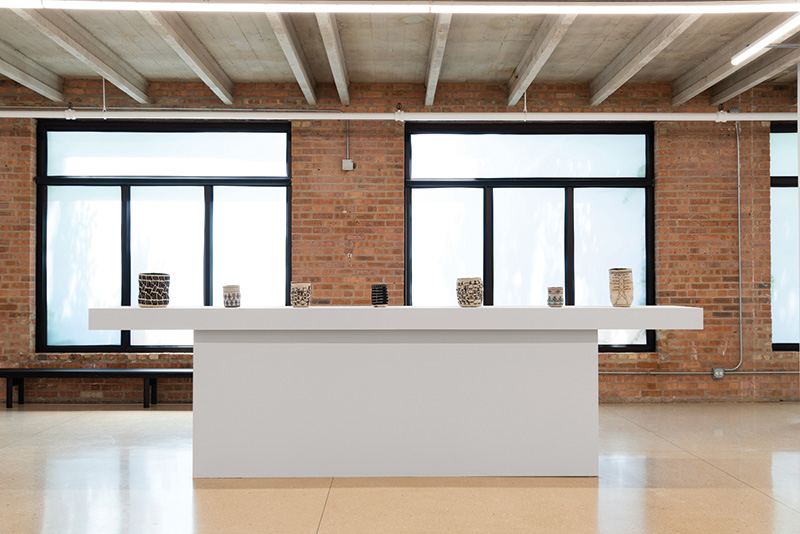
A view of Volume Gallery’s new space at W. Hubbard and N. Paulina Streets.
For Dulkin, who has been in West Town the longest, the changes have been a pleasant surprise. She was drawn to the area in part because it was a commercial corridor, but she thought it would develop more of a retail stretch featuring vintage clothing shops. Alcala’s Western Wear, which opened in 1972, remains an anchor on the street. Dulkin says she would never have expected so many galleries to open in the area. Farther west on the south side of Chicago Ave. is Andrew Rafacz Gallery, while across to the north and to the east are PATRON, as well as the more recently opened Tala. ARC Gallery, which opened in 1973, relocated from Bucktown to Chicago Ave. east of Ashland in 2018. Carrie Secrist closed her West Loop space around the pandemic and reopened as Secrist | Beach at 1801 W. Hubbard, where Jaime DeGroot also has her art consultancy. Secrist’s former West Loop neighbor at 835 W. Washington, McCormick Gallery, is now at 2251 W. Grand, a little west of the Golden Triangle, which moved there from River North. There are many other galleries throughout the area, with more choosing to open in West Town every year.
With the concentration of galleries continuing to grow, Meloche notes that they often try to hold simultaneous openings; this fall there are plans for many galleries to open the same weekend in September in conjunction with Chicago Exhibition Week. Dulkin notes that the West Town Chamber of Commerce has hosted Art Walks and First Fridays for many years, notably with a key event in the fall, where participating galleries all host openings or stay open later on the same night.
Of course, there’s always room for improvement. Several gallerists have expressed a desire for more day-to-day food options, especially around Grand Avenue, though they may be wary of the consequences that can spill over from culinary success, like the ones that contributed to the move that drove galleries from the West Loop.
Speh also would like to see more third-type spaces, where people could hang out after going to a gallery. West Town’s reputation has been spreading beyond the borders of Chicago. Meloche notes, “We definitely have seen a lot more out-of-town visitors make a concerted effort to come to our openings.”
Warner also sees a lot of people from New York City, Los Angeles and around the world come and visit the galleries in West Town, always commenting how incredible the art scene and the community is in Chicago. But it’s something that Chicagoans may take for granted. “Sometimes I feel like we get more out-of-towners than Chicagoans coming through,” she says.
For locals West Town doesn’t have to be a destination, but it is worth remembering how much art has become a part of the neighborhood and appreciating how close to home it really is.
#