Road to the Farthest Room: Elizabeth Lalley + Dan Devening Collaborate
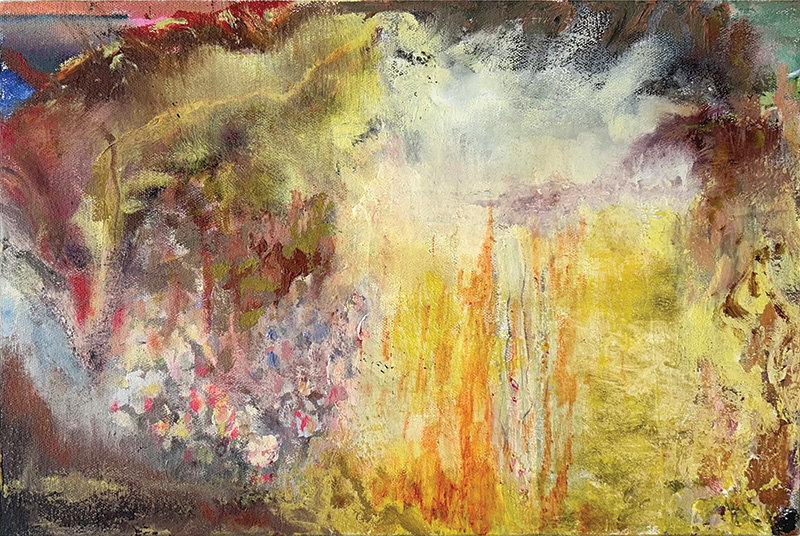
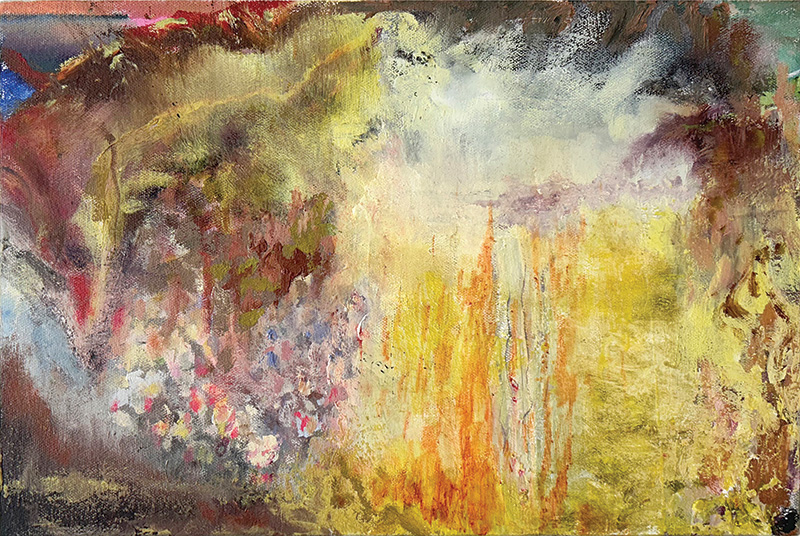
Jobe Gemmell-Hughes, Towards Passage, 2026, oil on canvas, 10” x 15”
This interview is part of CGN's Fall 2026 issue. Purchase a copy or subscribe.
By Curtis Anthony Bozif
Upon learning that Dan Devening and Elizabeth Lalley would be co-curating a three-person exhibition at Devening Projects this fall, and that the show would explore inwardness, privacy, and the domestic, I was eager to find out more and get both of their thoughts on curation and collaboration, as well as to hear from Lalley about what it’s been like to return to the art world after stepping away from it for a while.
Curtis Anthony Bozif: Dan and Elizabeth, can you tell me what the impetus for this exhibition was and how it came together? Dan, can you talk specifically about your decision to collaborate with another curator?
Dan Devening: For the opening exhibition of our fall 2026 season at Devening Projects, I had planned a solo show of recent paintings by Jobe Gemmell-Hughes, a young artist recently graduated with his BFA from SAIC. His paintings from this year seem acutely relevant to our times: dark, impressionistic, densely textured canvases that seem preoccupied with trying to capture a delicate balance between apprehension and euphoria. These paintings really resonate with me, more so because so much of what they express comes through his touch and sensitivity to his medium. I looked forward to debuting this work but had not yet considered an artist with whom to pair him.
With two spaces in the gallery, I typically feature a pair of solo projects for each show. I had recently connected again with Elizabeth, as she and her husband Billy James Joyce moved into a studio space in the same building as the gallery. Elizabeth was talking about how she was looking forward to relaunching Slow Dance Projects now that she had returned to Chicago after living in Michigan for a year. I always loved Elizabeth’s curation at Slow Dance, particularly her focus on strong emerging artists. We’re also both deeply committed to the material integrity of the work. In her shows at Slow Dance it was the delicate atmospheres evident in the paintings of Noelle Africh as well as the visceral and primordial sculpture of Travis Morehead. I knew she would have a particularly interesting way to build a show with Jobe’s paintings as a starting point.
With my invitation to contribute ideas to how this show might evolve, we agreed that co-curating Road to the Farthest Room would lead to something fantastic. We considered several propositions that resulted in adding the Detroit-based painter Julia Firestone Callis and the Chicago sculptor Ben Driggs to the mix. There were threads in the work of each artist that suggested interiority, domestic spaces and uneasiness. From a curatorial standpoint, we began with the idea that each of the two painters would be showcased in a solo show, one in each of the two galleries. We asked Ben to consider making small installations for both spaces that would reveal something even more mysterious in the paintings of the other artists. Through the witchy, wonderfully eccentric constructions and castings he makes, we knew Ben would add a layer of depth and mystery to a show already thick with emotional and psychological undercurrents.
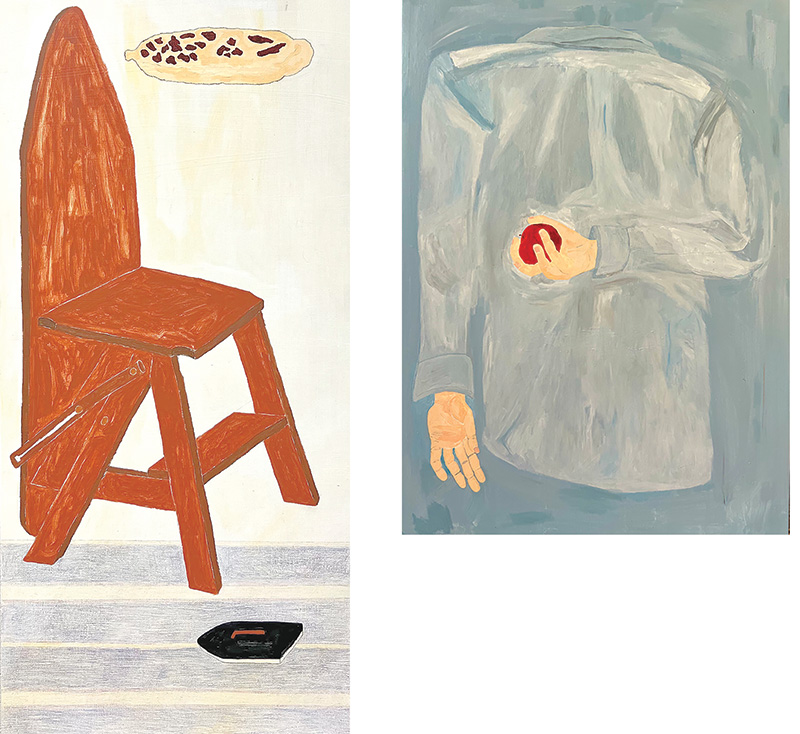
Left: Julia Callis, A Chair in the room upstairs Pt. 1, 2024, Acrylic, colored pencil, on board, 31.5 x 15.5”
Right: Julia Callis, Pedestrian Equestrian, 2026, Acrylic on board, 36.75 x 26.6”
CAB: Elizabeth, your curatorial project, Slow Dance, is currently on hiatus. In different periods of my life, I too have stepped away from the art world, and my return to it, if I’m being honest, hasn’t always been easy. I wonder what this experience has been like for you. Did it clarify anything? How do you think your time away has influenced this exhibition?
Elizabeth Lalley: The hiatus was really a hiatus from urban life, to which the art world was sort of inextricably linked. We moved to rural Michigan for a year, a bit impulsively, after fantasizing about it for a while. I think I was in a place, in terms of my relationship with the art world, where I was just moving through things a little robotically. I wasn’t seeking things out or exploring or being driven by my own curiosity the way I had been before. I was feeling too impressionable, feeling in a little bit of an echo chamber, and I was working at SAIC in Graduate Admissions, so I was also tired from juggling a creative practice and an intense arts administrator role.
As soon as we moved, we found out we were having a baby, so that intensified the hiatus too. We were living with so much space around us—big skies, fields—and I spent a lot of time writing and just remembering my influences, the things I return to, the art I love. We came back to Chicago when our son was 3 months old and I felt immense renewed excitement and love for the city and the art scene here.
I’ve respected Dan and his program for a long time, and the opportunity for this show had me spending a lot of time thinking about who I would want to work with, after this break from curation and after such a personal shift.
Julia is someone whose work I looked at a lot over the past few years, and there’s a deeply personal resonance I feel with her practice, in terms of connection to Detroit, love for food and for home. And Ben, who is also a dear friend of mine and my husband’s, is one of the most creative, incredible makers I know and he doesn’t operate in a traditional gallery context. So there was also a vulnerability in inviting him to be part of this that felt very real and true to me, especially when feeling a vulnerability myself of coming back to something as a new mother, which can be such an isolating time. I feel more invested in developing true relationships and making things without affect or pretense than ever before.
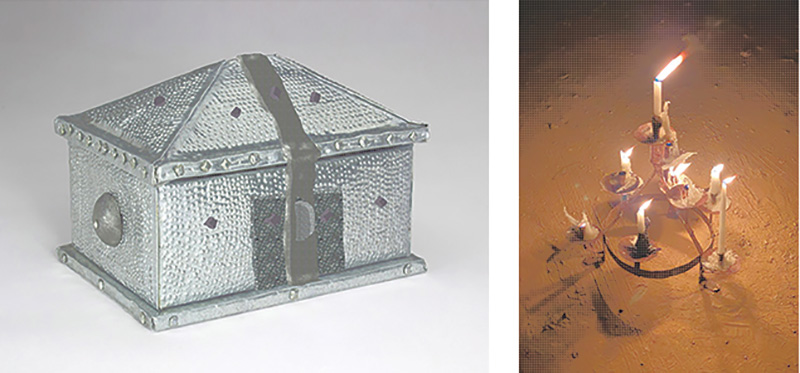
Left: Ben Driggs, Cell Cage, 2026, steel, wood, cloth, 8 x 7 x 13”.
Right: Ben Driggs, Bath Light, 2026, copper, 41 x 16 x 16”
CAB: Could you tell me a little bit more about each of the artists and their practices? Dan has already alluded to how their work might suggest “interiority, domestic spaces and uneasiness.” What other ideas, states of mind, or feelings do you hope to explore or elicit in this exhibition?
DD: As I said, Jobe’s paintings reflect a young painter’s desire to tease out the emotional and psychological states of searching and discovery through the process of making. It’s as if he’s mapping the inside of his own mind, looking closely at the circuits and neurons that interconnect to form what then reads as physical space. To me, his paintings suggest landscape, but rarely does a horizon appear. Instead, what he conjures are expansive chambers that feel both vast and claustrophobic—environments with so much surface activation that the air itself feels close, the space encroaching. That pressure could only come through the patient accumulation of his surfaces. Mark by mark, pigment layered and scraped onto an already heavily worked canvas.
We love how Ben’s work suggests a different kind of intense focus—that of a hermetic tinkerer who takes what material is most readily available and breathes life into it with delicate craftsmanship and delightful whimsy. Everything is functional. Everything has specific domestic use. The work is clearly sculpture, but as Ben says, each object has a specific place in his home and functions with purpose. Although often highly peculiar, each sculpture has a reference and use that becomes more apparent as the work is experienced.
EL: And to echo this, there’s something about the intense specificity of Ben’s pieces that I think makes them even more mysterious, as they’re sort of “unhomed” and brought into the gallery. It makes me think a little about how, when you isolate a single word and poke at it, it can expand and expand the more you look at and investigate it. Ben is so deeply focused in his making, yet so expansive—he seems to hold so much at once. He’s also deeply invested and interested in outsider artists and artists’ homes and art environments. He and his wife, Ash, are intensely curious about the way people live with objects and put objects into the world. Something he said recently to me was that Ash showed him a picture of a door Ruth Asawa carved from redwood for her home in San Francisco, and how Ben was more drawn to it than to any of her better-known artworks. This interest in the sort of “non-professional” parts of an artist’s life—the parts that don’t seem to fit a prescribed space or arch—are important to Ben.
DD: For me, Julia’s paintings have a surreal lightness that’s less present in the work of the other two artists. Her paintings are graceful and open—there’s room to move, room to breathe. That sense comes through in how her characters seem to freely populate the work: they float and hover, not always in control of their own trajectory, but clearly active, buoyant, alive. That lightness carries through in her palette too, which ranges from colors grounded in nature to more richly saturated hues, bringing a wonderfully joyful energy to the work. Her paintings are important to this project because they offer a lyricism and cadence less present in the other two artists’ work.
Together, these three artists reveal how each might dig deep into their own inner states to tune into the frequency the times demand.
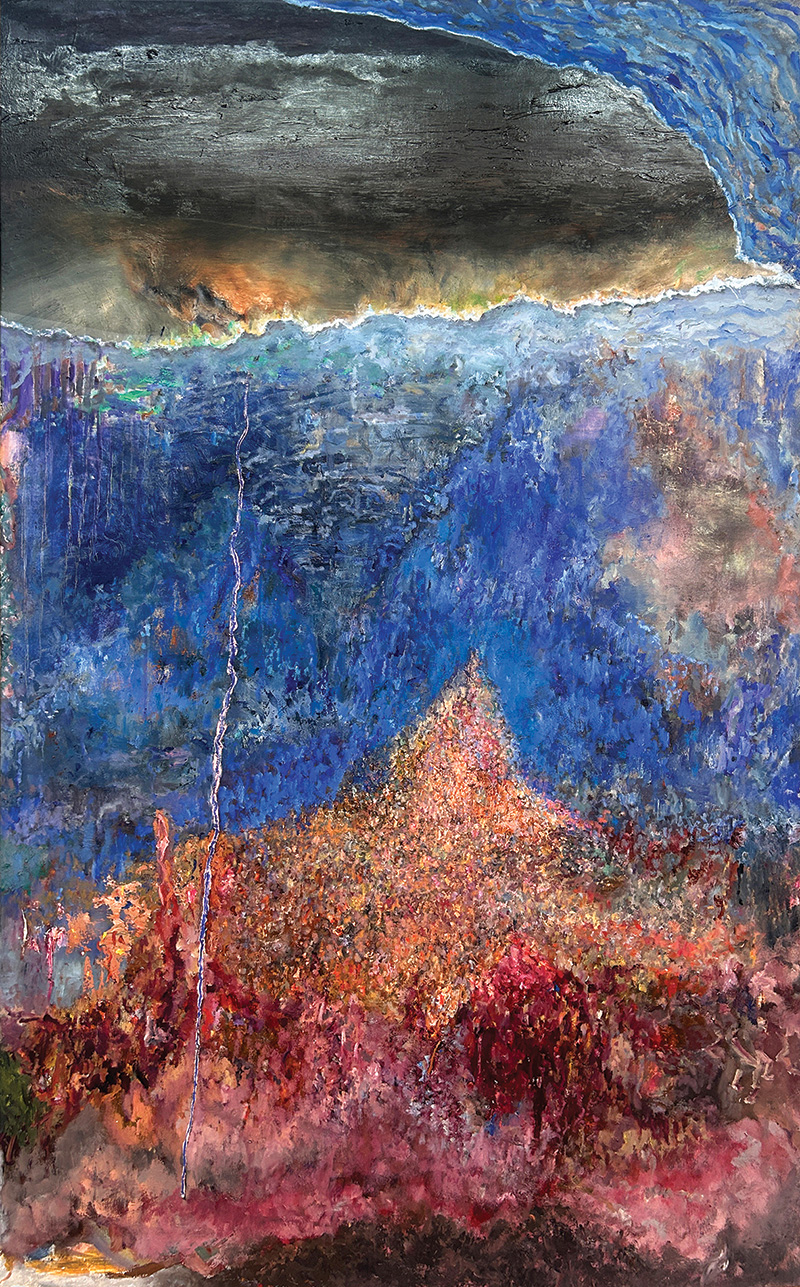
Jobe Gemmell–Hughes, Gulf, 2026, oil on canvas, 74 x 46”
CAB: Collaboration of any kind involves giving up some control and putting your trust in the people you work with. I’m thinking of your collaboration as co-curators, but I’m also thinking about how you’re working with artists, much of whose work I understand is still in progress. What is it like for both of you, giving up some control and trusting each other and your artists?
DD: From my experience running a gallery, collaboration has always offered more opportunities for positive gain than any real loss of control. Working with other curators and artists on projects and shows lets my ideas expand beyond my own limitations. There are always new angles from which to see a concept; I rely on my collaborators and co-curators to lead me in unexpected directions that make a show better, more rigorous, and more interesting.
This is especially true when working with artists showing at the gallery. When I begin working on an exhibition, I know the artist will already have ideas about what they’d like to show and how. My role is to offer thoughts on how that vision can be realized within the spaces of the gallery—that’s where I think my contributions are most useful. I know the possibilities and limitations of the rooms, how full or empty a show should feel based on the work, and how visitors tend to move through and around the installations. I share that with the artists, and together we arrive at a strategy that most successfully and accurately reflects their intent.
For this show, we’re in close contact with the artists as they fine-tune the work they’d like to feature in their installations. In most cases, we’ll have more work than we can show, which allows for flexibility and gives real collaboration room to happen. Each of the three artists, along with Elizabeth and I, will spend a good amount of time with the work in the galleries. For me, this is a chance to get to know the artists and their most recent work better—which is the greatest pleasure of collaborating: meeting the artists and growing closer to both them and their work.
EL: I love collaboration. Sometimes I forget how much I love it until I’m working on something with others, and then I realize how much I miss it when I’m working in solitude. Being together with artists in a space, watching how the space and the work are responding to each other, all of that is, to me, the very best part of the process. There can be real surprises, and the different perspectives that everyone brings make the space and the work feel really alive. Working on this with Dan as a co-curator has been such a wonderful opportunity for me because I have such respect for his program. He has an exquisite and incisive eye, and his tastes feel varied while also running deep and feeling very honest.
Road to the Farthest Room is a three-person exhibition featuring the work of Julia Callis, Ben Driggs and Jobe Gemmell–Hughes, co-curated by Elizabeth Lalley and Dan Devening
September 13–October 24, 2026
Reception September 13, 3 – 5 pm
3039 W. Carroll
Chicago, IL 60612
#